Spring is Here! Which Counties are Physically Active

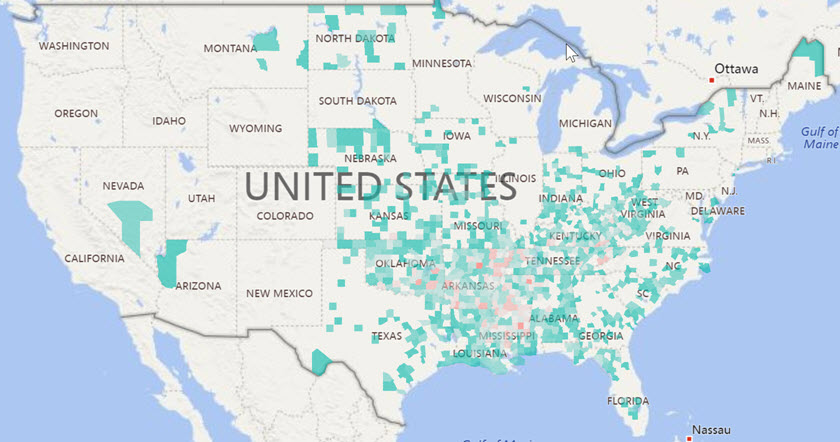
I love spring!  As a warm weather person living in the Northeast, I can’t wait to get outside and be physically active. While many are like me, still 29% of the U.S. remains by and large physically inactive and it is very regionally concentrated. The County Health Rankings uses a measure of physical inactivity as one of the ranking measures using data from the CDC Diabetes Atlas. The map below shows the counties where 30% or more of the population is physically inactive. 


There are 937 counties where 30% or more of the population self-identifies as being physically inactive, or approximately 29% of all counties in the U.S. Nearly half of these counties are in the states of Mississippi, Arkansas, Oklahoma, Tennessee, and Kentucky. This does not appear to be related to age, poverty, or access to exercise facilities. Michigan and Illinois for instance have only 2 counties that have greater than 30% inactive populations. These regional anomalies appear to be very complicated and deeply entrenched. Much has been studied about socio-demographics of physical inactivity with few conclusions.
 

Share This Story

Similar Posts

  • Diving Deeper into Opioid Prescriber Data

    Last week we introduced the new CMS opioid data set and what it means. This data tries to initiate transparency around this hot topical area even though Part D Medicare claims may not be the best proxy of all opioid prescription activity. There are three elements to this data: Part…

  • Outpatient Medicare Hospital Costs up 13%

    The 2016 outpatient procedure data shows overall hospital volume up 11% from 2015. Using data from the Outpatient Procedure Analysis Interactive, we also found that the volume times the average full cost (weighted average cost) on a procedure basis has increased 13.3%. We ran the numbers several ways – first…

  • International Student Enrollment Visualized

    In last week’s blog, we talked about out of state enrollment and its potential impact on both the diversity and finances of the university. International enrollment is even considered a bigger potential bonanza to colleges and universities as many international students pay full tuition. According to the Institute of International…

  • Self-Funded Research Remains the Trend in Higher Education

    Research and development expenditures continued their flat growth since 2011 according to the most recent data from the National Science Foundation Higher Education Research and Development Survey (HERD). Research expenditures increased 1.66% for all reporting institutions from 2013 to 2014 and have increased cumulatively only 4.76% since 2011.  The primary…