CDC Publishes 2016 Natality (Births) Data

The CDC recently released updated Natality (Births) data for 2016. State laws require birth certificates to be completed for all births, and Federal law mandates national collection and publication of births and other vital statistics data. The National Vital Statistics System provides access to statistical information from birth certificates and CDC makes this data available using the CDC Wonder tool. There are a wealth of category breakdowns of this data at national and regional levels subject to privacy suppression where the number of births is less than 10. 


We have curated the birth data into a new CDC Natality Interactive. We have aggregated all of the major category breakdowns including gender, race, age of mother, education, gestational period, and many more since 2000. We have applied this at the national, state, and county level (where data is available). This Interactive is automatically available to subscribers as part of our growing Community Health library.  


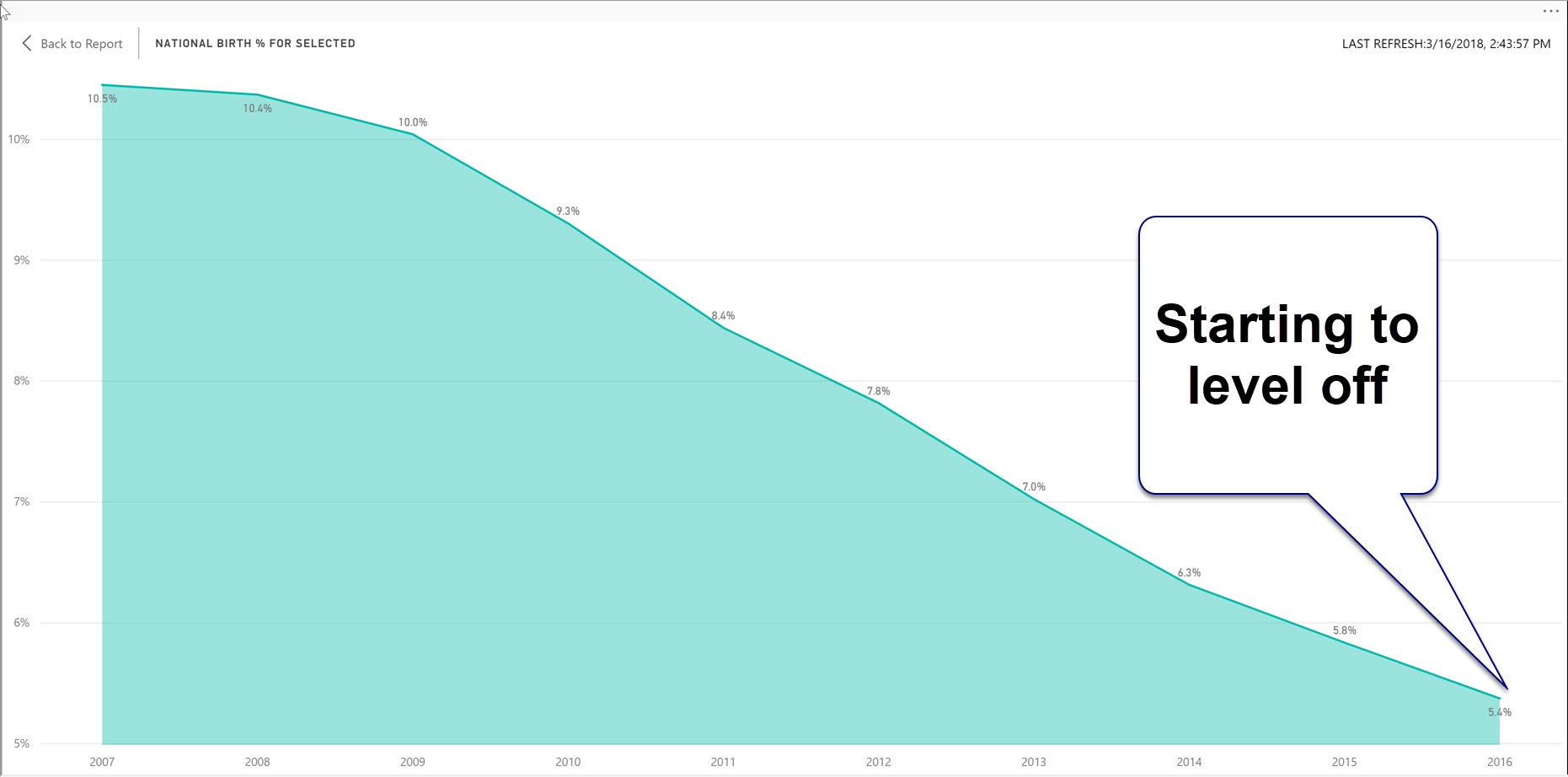
We will be diving into this data over the next several weeks and posting various video blogs and free Interactives. One topic sure to be interesting is teen birth rates. Teen birth rates continued to decline in 2016, but as you can see below, they have started to level off. In 2007, the teen birth rate across all races was 10.5%, but in 2016 it is now 5.4%. However the trend is not universal across all races. Asian teen births for example actually increased in 2016. We will look at this and other trends in the coming few weeks. 


Share This Story

Similar Posts

  • Hot Jobs, Growing Wages, and Weird Titles

    I love looking at the Bureau of Labor Statistics Occupational Employment Statistics data. This data produces employment and wage estimates annually for over 800 occupations and estimates for states and metropolitan areas. I especially enjoy looking at this data from both a job growth and a wage growth perspective. That…

  • Student Financial Aid up 6.2%

    Postsecondary institutions gave over $17 billion in financial aid in 2015. This represented a 3% increase from 2014. However, the number of student receiving the financial aid declined 3% so the average financial aid per student when looked at over the entire postsecondary landscape actually increased 6%. We used data…

  • A Look at the New Education Outcome Measures Data

    The new IPEDS Outcome Measures (OM) survey is the first stab at going outside of the traditional first-time, full-time reporting. We took a birds-eye view of this data across the landscape of reporting institutions using a new Graduation Rates Interactive.  A total of 3,838 institutions reported data under the OM…

  • Rural Hospitals are Five-Star According to CMS

    Los Angeles County, CA and Cook County, IL (Chicago) have 117 CMS rated hospitals between them and over 15 million residents. Yet, there is not a single five-star hospital in either county. In this mini-series, we have examined the profile of the current 188 five-star hospitals as it marks its…