Employment Numbers Support America's Love of Eating Out

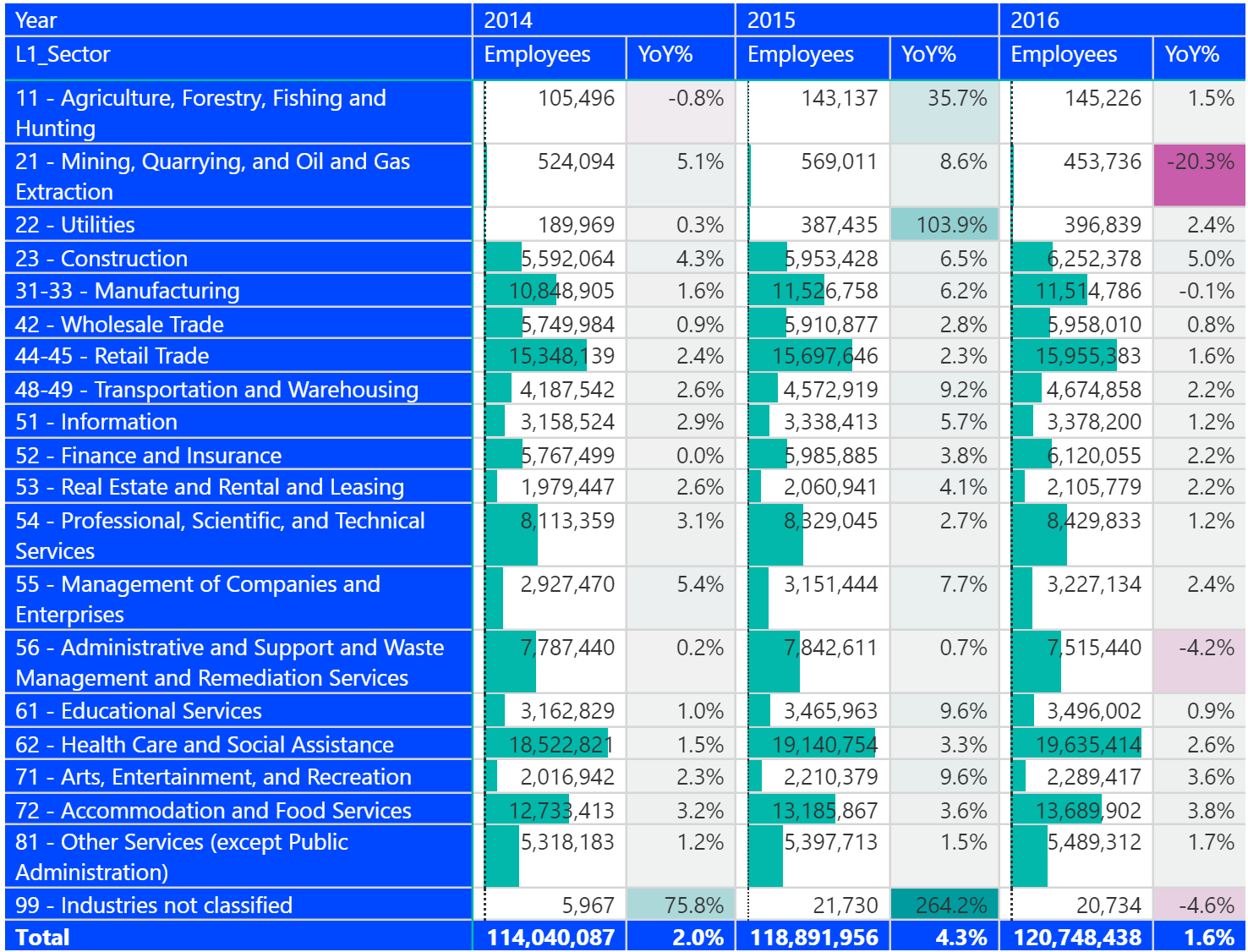
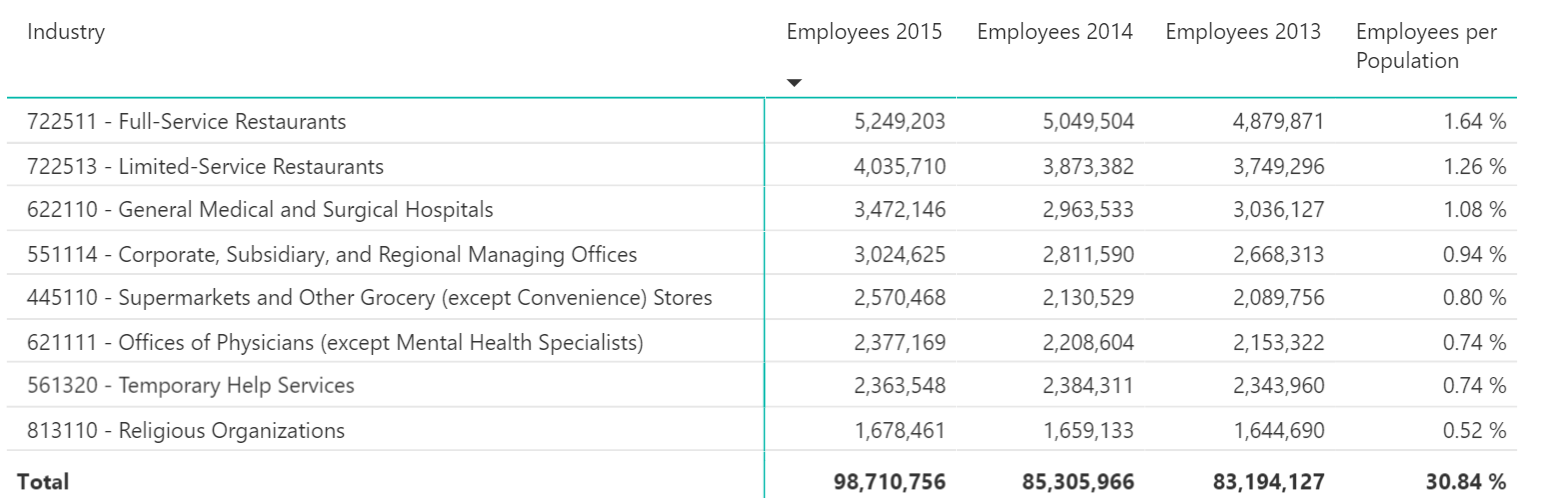
One of my favorite movie lines is from the movie “A Christmas Story”. After the Bumpus dogs demolish the Thanksgiving turkey, Ralphie’s dad says, while holding a half-eaten drumstick, “we are going out to eat”. We Americans love to eat our food out, as evidenced by the fact that 1 in 30 Americans are employed in the restaurant industry, according to the most recent data from the U.S. Census. Moreover employment in the restaurant industry continues to tick up as shown by the following table.


The Census Bureau recently released new 2015 County Business Patterns data which includes data on employees per industry based on the North American Industry Classification System (NAICS). County Business Patterns is based on the number of employees for the payroll period including March 12 of the applicable year so it does not really factor in seasonal workers. The largest employers on a per-capita basis are in the restaurant industry with 3.14% employed in NAICS code 7225 which are restaurant groupings. This is based on U.S. population of about 320 million. Using employable Americans (those 18 and over or 240 million), the number is over 4%. 


Breaking this down further, full-service restaurants employ more people on a per-capita basis than limited-service, or fast food restaurants. Also included in our top five is another food-related industry, grocery stores (NAICS 445110), which employed nearly 2.6 million workers in 2015. We Americans love our food and we employ lots of people in the food distribution system to get us our food. However, when it comes to the payroll cost, food service is not at the top of the list but health related industries dominate. We will look at that next week.
 

Share This Story

Similar Posts

  • Is the Federal Work Study Program Working?

    Over 4,000 institutions participate in the Federal Work Study Program. This program provides funds for part-time employment to help needy students finance the costs of postsecondary education. For the fiscal year ending June, 2016, $1.16 billion was paid to students under this program. This was roughly the same as the…

  • Tuition Bears Increasing Brunt of Higher Ed. Revenue

    In 2011, Tuition and Fees represented 20.6% of public institutional revenue. In 2015, it has increased to 24.25%. Most of the reshuffling of revenue has come from federal operating grants and contracts as noted by the graphs below. Interestingly, state appropriations have remained relatively constant. Similarly, non-profit institutions have seen tuition…

  • CDC Publishes 2016 Natality (Births) Data

    The CDC recently released updated Natality (Births) data for 2016. State laws require birth certificates to be completed for all births, and Federal law mandates national collection and publication of births and other vital statistics data. The National Vital Statistics System provides access to statistical information from birth certificates and CDC makes…

  • Students Moving Back on Campus

    The number of students living on-campus for the approximately 4,500 non-state institutions has increased from just over 43% in 2011 to nearly 53% just four years later in 2015. The pie graph below shows the movement from 2011 to 2015 with the yellow slice indicating the percentage of students living…

  • Are Outpatient Imaging Quality Measures Effective?

    CMS began developing measures evaluating imaging efficiency back in 2007. These performance measures have been distributed as part of Hospital Compare for the past four years. Lower percentages suggest more efficient use of medical imaging. The purpose of reporting these measures is to reduce unnecessary exposure to contrast materials and/or…