Is Education Required for Fast Growing Jobs?

A hot topic, especially when new job projections come out, is whether the high growth jobs require much in the way of education. Jed Kolko at Indeed Hiring Labs did a very thorough job of analyzing projected occupational growth against their respective education requirements. His conclusion was that the slower or negative growth jobs require minimal education but the growth areas require further education. The article focuses on the typical education required, but the Bureau of Labor Statistics also provides educational attainment percentages for each occupation. We can blend the educational attainment rates against the projected growth rates and the median wage.


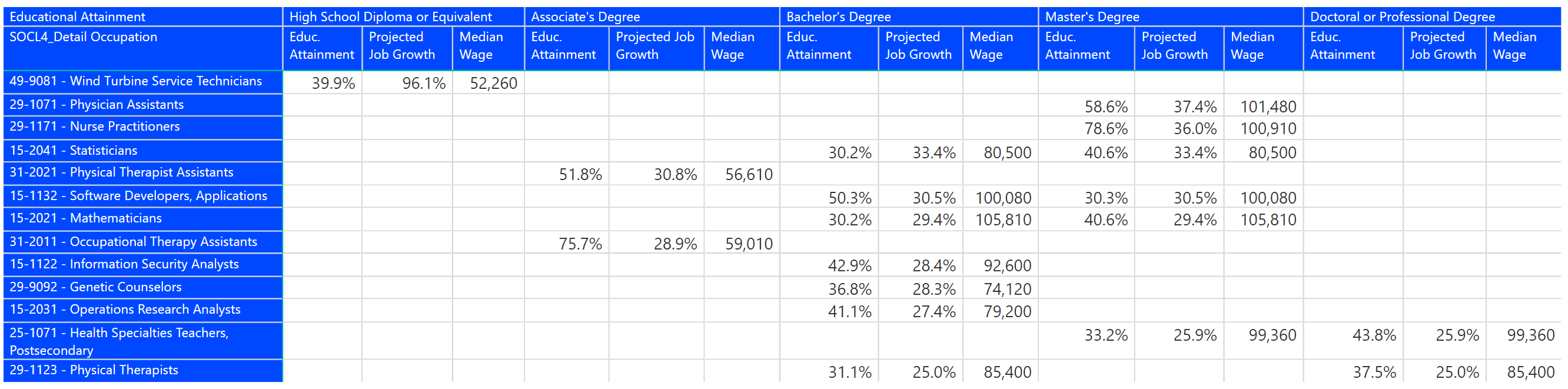
I modified the Degree-to-Jobs Interactive to organize the occupations into educational attainment buckets and looked at job growth and median wage. For example, I filtered for only those occupations that are expected to grow 20% without regard to median wage. This brought 12 occupations that only require a high school education. If I increase the minimum median wage to $40,000, I still get five occupations requiring no college education.  However, if I increase the job growth rate to 25% and the minimum median wage to $50,000, 11 out of 12 occupations require a college education as shown below. This threshold seems to knock out high school only education levels.


We have created a new Free Interactive called Job Projections and Education on our site.  You can fine-tune the filtered selections to select the parameters of the table. You can also sort and export the table. To access Free Interactives, you simply have to register.  Free Interactives will show up at the bottom of the Interactives page as shown below. Simply click the view link to launch the Interactive.

 

Share This Story

Similar Posts

  • College Building Boom Approaches $1 Trillion

    Postsecondary institutions continue to invest heavily in capital assets and the cumulative investment across public and private institutions has crossed $900 billion, an increase of 27% over a five-year period. The capital investment growth rates are almost identical for both public institutions and private non-profit institutions as noted in the…

  • Powerball and Endowment Wealth per Student

    Large dollars tend to attract many of us. That is why the Powerball attracted so many people at the tidy sum of 1.3 billion. Yet the larger the number, the more people participate. Someone had the brilliant idea of distributing Powerball winnings to everyone in the country thinking it would…

  • Infection Procedures Top Inpatient Volume Growth

    While Medicare inpatient procedure volume has remained flat since 2013, infections are a significant area of high volume change. The treemap below from the Inpatient Procedure Analysis Interactive shows the inpatient volume growth by procedure with color coding by volume change from 2013-2015 using the Medicare Provider and Analysis Review…

  • CMS Introduces New Hospital Returns Measure

    The most recent batch of Hospital Compare data has expanded the whole area of readmissions, returns, and deaths. There are now separate measures for mortality rates, readmissions, and hospital returns. The hospital returns measure is brand new, with the most recent data through June 2016, and applies to heart attack…

  • Distance Learning Growth Continues

    In one of my favorite videos of my kid’s era, Grover from Sesame Street taught us the difference between near and far. I don’t think Grover had in mind today’s high tech tools and social media interaction when he taught us this principle. Distance Education continues to be a hot…