Healthcare Rankings and the Healthiest Cities

We in the U.S. love our rankings. I think it is embedded in our DNA. As a student of data, I love to see the various rankings and how people get worked up over them. Healthgrades recently released its latest analysis of top quality hospitals and its National Health Index, which listed the 25 healthiest U.S. cities. In the Healthgrades Report to the Nation, it spotlighted Denver as getting health care right. As with any rankings, it comes down to the measures. Healthgrades uses four key indicators in their evaluation.

  • Access to Care

  • Access to Quality Hospitals

  • Population Health

  • Risky Behaviors

Many rankings use a number of measures based on the Behavioral Risk Surveillance System (BRFSS). At Public Insight, we have ingested this data into our platform by state, county (which is fairly dated), and metropolitan statistical area. We also have the CDC 500 (or 500 Cities Project) which uses sampling to weight the criteria against cities. You can browse this data for free in our Data Browser tool. Stay on the lookout for many new things coming your way for community health analysis. 


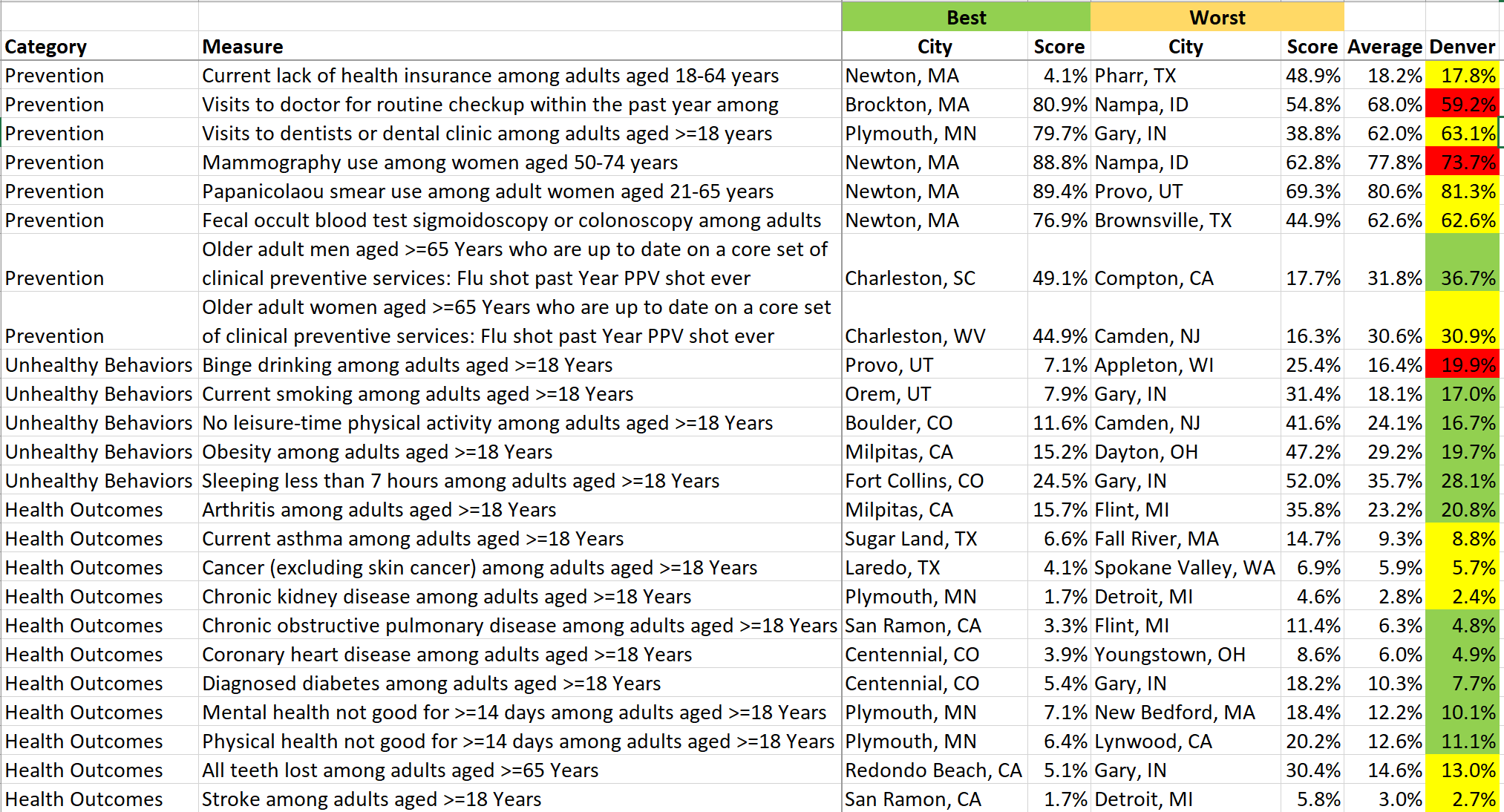
In looking at the health of cities, there is no perfect city. We used the CDC 500 to highlight the best and worst cities by category.  We also used Denver as our comparison city. As noted in the table below, Denver does well in most categories, but clearly drinking is an issue. Apparently our friends in the Mile High City also don’t like to visit the doctor routinely because they fare worse in that area. 


Share This Story

Similar Posts

  • The Race for Nurses

    There is a race that is brewing between millenials who are becoming registered nurses and the hiring that has started at U.S. hospitals. A Health Affairs study concluded that Millennials are becoming registered nurses at nearly twice the rate of baby boomers, but that still won’t necessarily prevent a nursing shortage…

  • Nursing Home Coverage of the Elderly

    While long-term care services more than the elderly, approximately 63% of residents are 65 or older. According to the Administration on Aging, population 65 years or older will increase from 14.1% of the population to 21.7% of the population by 2040. As the population ages over the course of the…

  • Room and Board Cost Increases Slowing

    After three straight years of 3-5% increases, room and board annual growth has finally slowed to a more pedestrian 2-3%. In recent years, universities have invested heavily in on-campus facilities and presumably passed these costs to the students at a rate greater than inflation. One administrator once told me that on-campus facilities…

  • Is the Federal Work Study Program Working?

    Over 4,000 institutions participate in the Federal Work Study Program. This program provides funds for part-time employment to help needy students finance the costs of postsecondary education. For the fiscal year ending June, 2016, $1.16 billion was paid to students under this program. This was roughly the same as the…

  • What is the Newly Released Carnegie Data?

    The Carnegie Classification™ has been the major institutional framework for describing higher education institutions since 1970. This classification system comes out approximately every five years with the latest rendition released on February 1, 2016. This release represents the initial data provided by the Indiana University Bloomington Center for Postsecondary Research…