Death Rates Rise Sharply for Millenials

The new CDC mortality data continues to paint a rather grim picture. Last week we focused on the external causes of the rise in death rates. This week we analyzed the mortality (death) rate among age groups using over 1.8 billion data points over 17 years from the CDC. You can now analyze this extensive data yourself with no data knowledge using the new Mortality Rate Interactive.  This Interactive is part of the Community Health subscription.


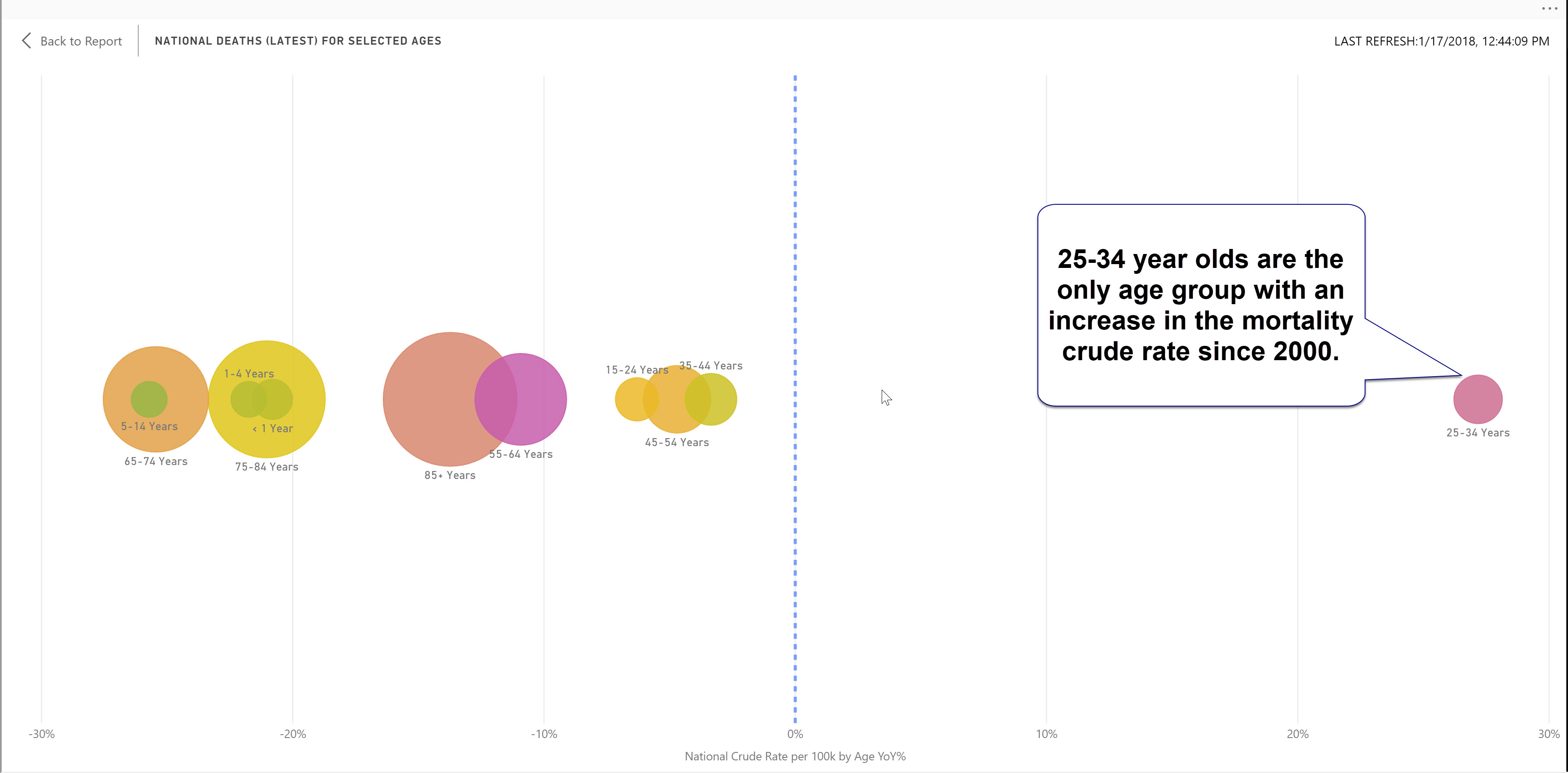
The mortality for every age group has declined from 2000 to 2016. The exception is the 25-34 year olds which is up 27% from 2000. The dot plot graphic below starkly shows this.


The mortality rate has skyrocketed in the past two years among age groups covering ages 15-44. This is a consistent trend that we saw with the external and behavioral causes last week. The counties that have experienced the highest jumps in this age bracket appears to be most concentrated in the MidAtlantic and Northeast. I go into these topics in more depth in the video blog.  


The new CDC mortality data is now available in Public Insight. We have launched an amazing new Interactive based on nearly 2 billion data points and 17 years of mortality data down to the county level. With Interactives, you can explore and analyze this critical data yourself with no data knowledge or experience. We have also created a free Interactive for the specific age related mortality data.
Share This Story

Similar Posts

  • March 2020 Job Postings Signals Seismic Labor Shifts

    New Labor Market Analysis Application Released by Public Insight The COVID-19 reality is starting to reflect itself in the labor market. Volatility in the labor market will be the new normal for the foreseeable future. We analyzed and coded over 2 million active job postings as of past Saturday, March…

  • The Aging of Housing in America

    They are building three new homes across from my house here in Northeast Ohio. It seems we are past the time of the severe slowdown of housing starts and there has been a mini-housing resurgence. Home inventory levels remain low. The problem is, like my new neighbors, new housing tends…

  • Is the Federal Work Study Program Working?

    Over 4,000 institutions participate in the Federal Work Study Program. This program provides funds for part-time employment to help needy students finance the costs of postsecondary education. For the fiscal year ending June, 2016, $1.16 billion was paid to students under this program. This was roughly the same as the…

  • 12 Colleges with Sustained Enrollment Growth

      According to data collected from the Integrated Postsecondary Education Data System (IPEDS), 60.6% of colleges experienced flat or declining enrollment growth while only 39.4% experienced increasing enrollment growth from 2013-2014. This is also very consistent with statistics from 2012-2013.   College enrollment growth may be hard to sustain and…

  • Diving Deeper into Opioid Prescriber Data

    Last week we introduced the new CMS opioid data set and what it means. This data tries to initiate transparency around this hot topical area even though Part D Medicare claims may not be the best proxy of all opioid prescription activity. There are three elements to this data: Part…