Regional Disparities in Health Insurance

We all know that health insurance is a moving target. According to the most recent ACS survey data, the national uninsurance rate declined from 13.0% to 11.7% in 2016. Public insurance coverages increased slightly more than private coverages (increases of .9% and .6%) respectively. This change was short-lived as Gallup recently disclosed a significant rise in the uninsurance rate in 2017, a trend that is likely to continue. 


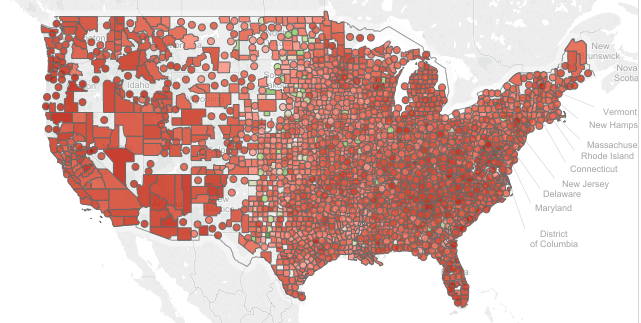
What is intriguing about the whole health insurance advance and retreat is the regional differences in health insurance coverage. Counties in the south are much less likely to be insured than counties in the north and, if they have health insurance coverage, tend to use the public health coverages. Using the Population Analysis Interactive, we found geographic concentrations where private health insurance has declined more than 3% in Texas and Georgia. We highlight these and other discoveries in the video blog


Share This Story

Similar Posts

  • Infection Procedures Top Inpatient Volume Growth

    While Medicare inpatient procedure volume has remained flat since 2013, infections are a significant area of high volume change. The treemap below from the Inpatient Procedure Analysis Interactive shows the inpatient volume growth by procedure with color coding by volume change from 2013-2015 using the Medicare Provider and Analysis Review…

  • Women's Basketball Revenues Gaining Ground

    Women’s basketball revenues are closing in on the $1 billion mark according to the latest data from the Equity in Athletics Disclosure Act. Women’s basketball revenues for the 2014-15 year were $806 million dollars. This represents 43% of the men’s basketball revenues from the same year of $1.87 billion. However,…

  • Have Student Debt Repayment Rates Bottomed?

    Student repayment rates continues to decline, although the trend seems to be slowing, according to the most recent College Scorecard data. This data measures repayment rates at 1,3,5, and 7 years. Repayment rates and default rates are very different. Repayment rates are the percentage of students who have made progress…

  • STEM Enrollment Fields Show Strong Growth

    The IPEDS Enrollment by Major Fields of Study is collected every other year and 2016 is a new reported year. IPEDS collects nine major fields of study and the enrollment is disaggregated by attendance status (full-time, part-time), level (undergraduate, graduate), race, and gender.   There are numerous ways to breakdown…

  • Breaking Down Net Price, Tuition, and Aid

    Reports by College Board and others have indicated that net price, the true measure of what a student pays to attend college, continues to rise. College Board has maintained that the actual net price has been increasing for six to eight straight years.    Net price is defined as the…

  • When is a Job Essential?

    Critical Infrastructure Accounts for 60% of Jobs as the Rest Open Up The stay-at-home orders under the COVID-19 pandemic separated “essential” from “non-essential”. Businesses deemed essential stayed open. Those that were not essential shut down. Sometimes those lines were very blurred with individual states and even communities making those choices…