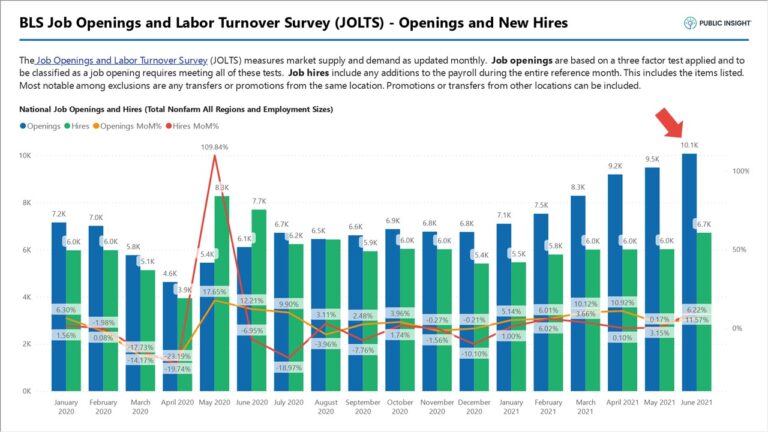
Before we get into workforce migration, let’s recap the most recent labor market data. It indicates we may finally be seeing the light at the end of the tunnel in terms of job market stability.
- Job openings are declining indicating jobs may be finally being filled.
- Quit rates have leveled off indicating less volatility in the market.
- Labor force participation rate is finally going up indicating those on the sidelines are returning to the labor market.
Workforce Volatility is Not Going Away
However, there is little to indicate that things will revert back to the way they were pre-pandemic. There is a besetting tension in the market that suggests that workers still seek improvement from the current status-quo.
- The work rate for prime-age people—25 to 54—has been going down since the turn of the century.
- At the same time, workers that are retiring early could be coaxed into the market.
- Over 60% of workers have indicated they are considering switching jobs in the next year.
- On the flip side only 62% have indicated they are staying in their current job for the next year.
Understanding what motivates the workforce is essential to understanding how to attract, recruit and retain them. Worker motivation is a moving target. Fortunately, workforce movement leaves a trail that we can analyze and that is what we call workforce migration.
What is Workforce Migration?
Workforce Migration is simply the movement or change of workers FROM one position TO another position. Workers change for any number of reasons.
- Promotion to a new job title within the same employer
- Changing jobs to a new position and/or employer
- Moving geographically

In the above example, we are looking at the movement of nurses from one job title to another. By clicking on any of the values in the FROM and TO, we can gauge the movement. For example, 2% of Nurses go on to become Nurse Practitioners. As the healthcare workforce contracts, it is imperative to create a path for nurses to take on more and more responsibilities from traditional physician roles.
Using Workforce Migration Insights to Understand Geographic Mobility
Workforce migration analysis can also identify geographic movement. In the example below, we can understand the movement of workers out of the Chicago metro area.

The top three markets for Chicago relocation are Dallas, Atlanta, and Phoenix.
Workforce migration combined with supply and demand analysis forms a powerful combination for understanding the current situation and emerging trends.
Use Cases for Insights
- HR leaders can understand shifts and relocation trends from their former employees and their competitors’ employees.
- Combined with TalentView’s Supply and Demand Insights, recruiters can determine the most desirable locations where workers are migrating. And of these, which have the optimal supply and demand ratio.
- Recruiters can view which industries and locations have lost workers in order to target alternate sources of workers.
- Workforce and economic development organizations can utilize insights such as industry and location shifts to help develop policies, resources and programs.
Watch Workforce Migration Webcast

Watch our webcast “Workforce Migration: Market Insights for Talent Acquisition” from the HR Technology Virtual Conference. In this webcast we demonstrate how to understand and utilize workforce migration insights and present a segment from Emily Fabiano of Workmorphis on “hidden workers”.
TalentView Insights
TalentView Resumés and Skills Insights enables workforce migration insights by capturing job seeker movement through resumé changes across employers, titles, occupations, industries and metro areas.