The Profile of the Five-Star CMS Hospital (First in a Series)

It is hard to believe but it has been about one year since the Centers for Medicare & Medicaid Services released its initial hospital rating system. At that time 102 hospitals earned the coveted five-star rating. The most recent ratings show 188 hospitals with the five-star rating out of roughly 3,500 hospitals. The rating system is still evolving and has received criticism across a number of fronts as penalizing urban hospitals.


We ran the numbers to see what the profile of the 188 five-star hospitals are. Using the Hospital Consumer Assessment (HCAHPS) Interactive blended with general survey data from the AHA Annual Survey Database™, we were able to get a picture of what the five-star hospitals look like and where they are located. We constructed a ratio of five-star hospitals over all hospitals for various classifications.


Five-Star Hospitals are Small

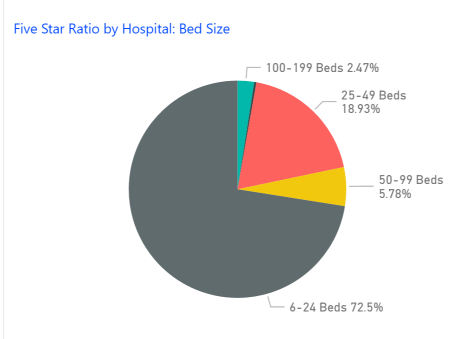
Of the 188 five-star hospitals, 144 of them are in hospitals with less than 50 beds. On the contrary, not a single hospital with more than 300 beds had a five-star rating. The following pie graph shows this discrepancy very starkly.


Five-Star Hospitals are Capitalistic

The 188 hospitals includes 26 that are owned by physicians which is 58% of all physician owned hospitals as noted in the table below. The list includes 38 hospitals that are private partnerships or 24% of all hospital partnerships. The worse five-star ratios? Non-profits which have less than 4% that are five-star hospitals.



Share This Story

Similar Posts

  • When is Free Tuition Really Free?

    The sticker pricing game has been in place a long time. No one ever pays full sticker price for items such as jewelry or cars. That is probably why University of Michigan came under scrutiny for its free tuition guarantee for families with income under $65,000. Cynics pointed this out…

  • New Data Highlights Student Loan Repayment Rates

    According to the Institute for College Access and Success, seven in 10 seniors (69%) who graduated from public and nonprofit colleges in 2014 had student loan debt, with an average of $28,950 per borrower. Over the last decade—from 2004 to 2014—the share of graduates with debt rose modestly (from 65%…

  • Is the Federal Work Study Program Working?

    Over 4,000 institutions participate in the Federal Work Study Program. This program provides funds for part-time employment to help needy students finance the costs of postsecondary education. For the fiscal year ending June, 2016, $1.16 billion was paid to students under this program. This was roughly the same as the…

  • Students Increasingly Opting for High Cost Debt

    Many prognosticators are projecting a coming economic crisis caused by student debt. This is typically focused around an inability to pay off the principal of the loan. But it really appears that we are also setting ourselves up for a real problem with the cost of debt.    Overall new…

  • Healthcare Rankings and the Healthiest Cities

    We in the U.S. love our rankings. I think it is embedded in our DNA. As a student of data, I love to see the various rankings and how people get worked up over them. Healthgrades recently released its latest analysis of top quality hospitals and its National Health Index, which…

  • Violence Against Women Offenses Up 9.5%

    This is the third year that the Campus Safety and Security (CSS) data has released separate violence against women (VAW) offenses. This data captures three types of offenses; domestic violence, dating violence, and stalking and analyzes it for both on campus and off campus locations. Overall, there were 16,183 VAW…