Real Estate, Personal Care, and Uber Top Latest Self-Employment Data

The U.S. Census recently released its 2015 Nonemployer Statistics. This data is the companion data set to the County Business Patterns. Nonemployer Statistics is an annual data set that provides county economic data for businesses that have no paid employees and are subject to federal income tax. The data consist of the number of businesses and total receipts by industry. Most nonemployers are self-employed individuals operating unincorporated businesses (known as sole proprietorships), which may or may not be the owner’s principal source of income.


Self-employment continues to inch up. The number of nonemployer establishments increased 3.28% to 24.3 million in 2015. By comparison, the number of employer based businesses only increased 1.22% to 7.6 million. Thus, for every employer establishment in 2015 there are 3.2 small self-employed businesses. As a whole self-employment is still only $1.16 billion of receipts compared to annual payroll of $4.9 billion or 23%. As the nation has regained its footing, self-employment still continues to flourish. 

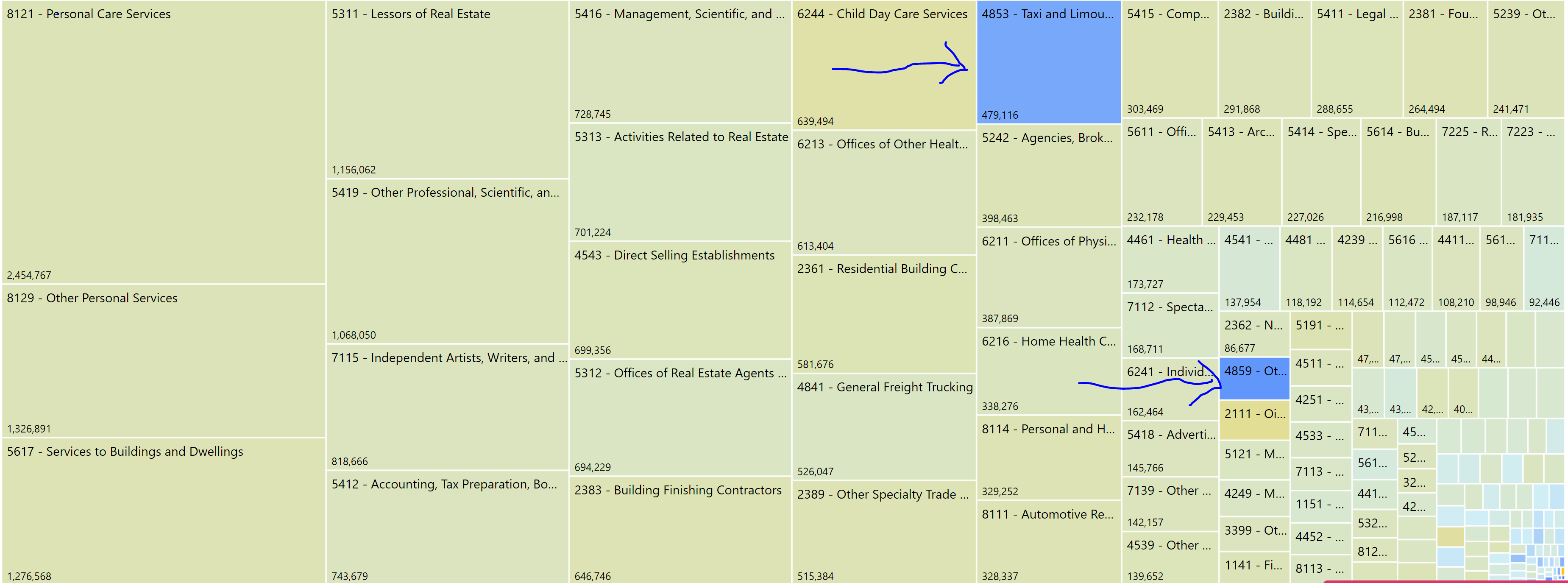
  • The top number of establishments for self-employment continues to be personal care services.

  • Of the top 10 number of self-employed industries, real estate comprises three of them. The number 11 ranked industry is also in real estate.

  • Real estate smokes the amount of self-employment gross receipts where it is nearly three times the next highest amount from personal care services. These types of businesses, for the most part, are your landlords.

  • Other notable top 10 self-employment professions include accountants, management consultants, and independent artists.

  • The highest growth area should not be a surprise – transportation (e.g. Uber and Lyft) are exploding with growth rates of betwen 60 and 70%. The tree map below shows the islands of growth (blue color) in the transportation industry.



Share This Story

Similar Posts

  • The Gender Debt Disparity

    The Huffington Post recently posted a very interesting article on gender debt disparity. The article notes that women hold nearly two-thirds of all student debt – a whopping $833 billion dollars. The article postulates that women also take longer to pay off the debt because they earn less than men….

  • Nursing Home Coverage of the Elderly

    While long-term care services more than the elderly, approximately 63% of residents are 65 or older. According to the Administration on Aging, population 65 years or older will increase from 14.1% of the population to 21.7% of the population by 2040. As the population ages over the course of the…

  • How Healthy Are U.S. Hospitals?

    If we said that 20% of any industry was at financial risk, we would all be up in arms. However, a recent Morgan Stanley report citing that statistic was met with some degree of yawning. The report cites that 450 hospitals are at risk of closure and another 600 are…

  • Nursing Home Deficiencies by State

    When nursing home incidents occur, they receive big news. Just this week, a Pinellas Park, Florida nursing care center resident died after appearing to have been left outside in the sun. The nursing home had been cited for various deficiencies and had received a one-star rating. In fact, the nursing…

  • Private Room Average Hospital Stays up 10%

    While average length of stay has experienced a long-term decline, one component of average stay seems to be increasing – private rooms. The average stay in a private room increased nearly 10% based on an analysis of the 2016 Medicare Provider Analysis and Review (MedPAR) data set.    Even more…

  • The States That Send Students Elsewhere

    IPEDS reports residency numbers for first-time undergraduates by state. This data can be challenging to work with from several perspectives. It is not collected every year by every institution and it does not summarize the students coming from out of the state of the institution.     The Enrollment Suite…