I remember getting my first certificate. I don’t remember what it was for, but I do remember proudly putting it behind glass and noting that the certificate was signed in real ink by presumably a real person. A certificate seems to have that sense of authentication. The growth in distance or online education seems to be weighted towards certificate programs that are outside of the standard form of degrees.

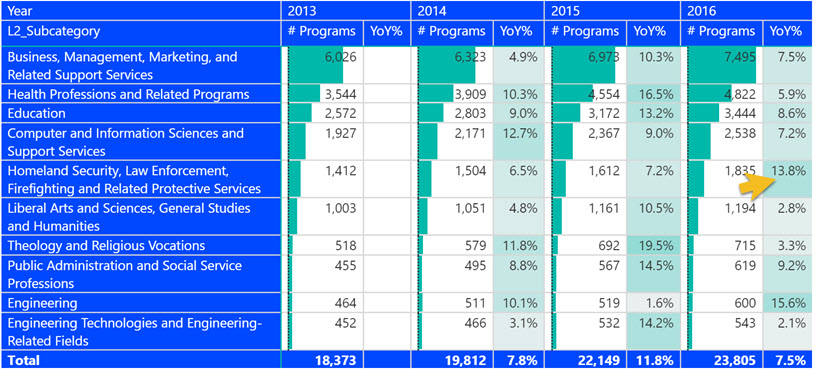
In my last blog, I commented that the number of distance education programs is up 18% and the preponderance of growth lies in computer and security areas. However, as we dive down into the types of degrees and the offering areas, we find some interesting data:
-
Certificate programs regardless of the academic level or time to completion are up 20%
-
Certificate programs that are less than one year are up 22.5%
-
Associates level distance education is up 14% which seems to suggest that certificate based distance education could be diverting attention from traditional associates level education.
Certificate programs may also lend themselves to the credibility of a defined target outcome. This could explain why certificate based growth in programs are concentrated in computer and security. For example, one of the hot growth areas in Homeland Security are certificates (less than 1 year and 2-4 year) in Corrections, which are up 80%. High growth areas in masters programs tend to be in more traditional business, health, psychology, and theology fields.
I’ve compiled some of the raw numbers for distance education totals for 2 digit CIP codes. You can download this spreadsheet that contains items like degree growth for various programs ranging from Less than 1-Year Certificates, all the way up to Doctor’s Degrees. You can download the spreadsheet by clicking HERE.
We’ve also recently stessed that all of this information can easily be found, manipulated, exported, and analyzed within the Public Insight platform. We highly encourage all readers that like what they see, to give our Premium Tools or Content Packs a try. Our Premium Tools are risk-free for 30 days and include tools that we use in practically every blog post/analysis for significant time savings and discovery. You can learn more about our Premium Tools by clicking HERE.