Distance Education Programs Growth Up 18%

After a few weeks break, we are back with this week’s edition of the Insight for Education blog. In my previous blog on distance enrollment, we cited that distance enrollment exclusive growth was up nearly 15% and more and more schools were offering distance education. In this analysis we wanted to dive more deeply into the programs being offered in distance education.


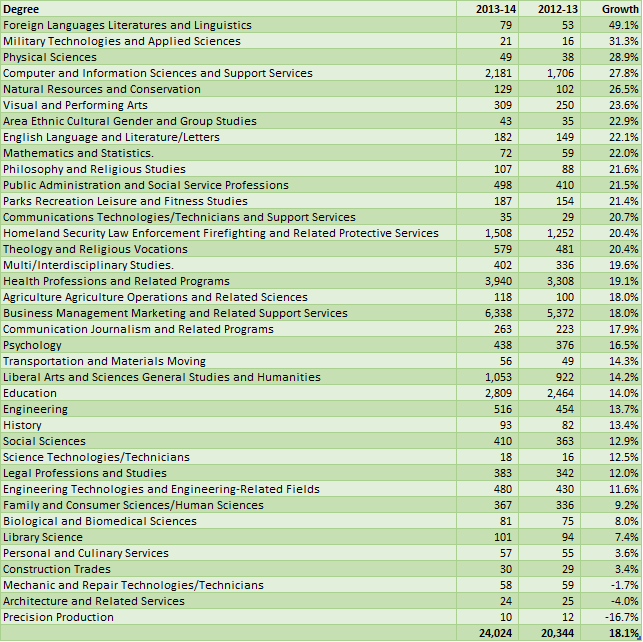
This data has been collected by the Integrated Postsecondary Education Data System (IPEDS) for the past two years and so we have limited, but telling data on the growth in distance education programs. Overall the number of distance education programs have increased 18% from 2013 to 2014. We found that all but 3 of the 38 major program categories (by two digit CIP) increased in the number of offerings. Of the major categories of programs (more than 100 offerings), Computer and Information Sciences grew the most at 27%. A relatively new category Homeland Security Law Enforcement grew 20% perhaps signaling a sign of the times we live in.


Business Management, Health, and Education continue to dominate the broad program areas in distance education with over 50% of the distance education programs from these three categories. However, only health is growing at a rate faster than the composite growth of all of the program areas.


Next week, we will dive a little more deeply underneath the hood to specific programs and levels that continue to grow.
 

Share This Story

Similar Posts

  • Maternal Care and Rural Counties

    An interesting study published in the September issue of Health Affairs found that 9 percent of rural counties experienced the loss of all hospital obstetric services in the period 2004–14. In addition, another 45 percent of rural US counties had no hospital obstetric services at all during the study period. We…

  • Where the Vets Live

    As we approach this Memorial Day Weekend, we pause to remember the sacrifice made on our behalf by our veterans. Nationwide veterans comprise 8% of the population. But there are clusters of populations where veterans comprise much higher percentages of the population. This article from Trulia published in Forbes back…

  • New Violence Against Women Data on Campuses

    A slug of new data has recently been released covering campus statistics on violence against women. This data was mandated by the Violence Against Women Reauthorization Act of 2013 (VAWA) and is added to numerous other statistics required under the Campus Crime Statistics Act, or Clery Act. College institutions must…

  • Has Distance Education Hit Its Peak?

    Programs offered through distance education or what we might conventionally refer to as online programs actually declined as a percentage of all programs from 10.8% to 10.5% in 2017 and 2016 respectively. This was the first time that distance education has actually declined since this data started being collected by…

  • COVID-19 Dashboard with NYT Data

    Analyze COVID-19 Cases by National, State and County Level It is important for today’s business leaders to consider the impact of COVID-19 when making decisions and allocating resources. The accuracy of COVID-19 data reported by news sources and online publications goes beyond the numbers themselves, the interpretation of the statistics…

  • Is Bureau of Labor Statistics Data Adequate?

    Several weeks ago, the Bureau of Labor Statistics (BLS) released updated Occupational Employment Statistics (OES) survey data. BLS OES is one of those foundational programs and datasets that are used for comprehensive occupational analysis. It produces employment and wage compensation estimates annually for nearly 800 occupations. These estimates are available…