Maternal Care and Rural Counties

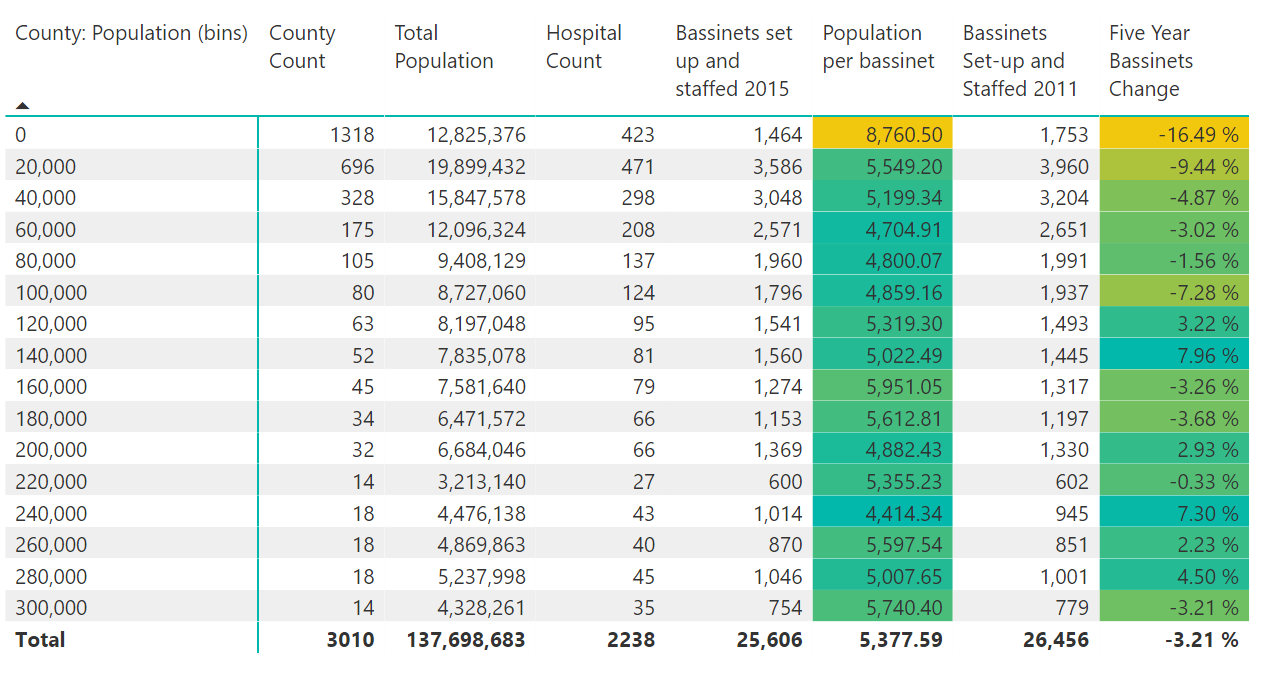
An interesting study published in the September issue of Health Affairs found that 9 percent of rural counties experienced the loss of all hospital obstetric services in the period 2004–14. In addition, another 45 percent of rural US counties had no hospital obstetric services at all during the study period. We took a slightly different angle and looked at the bassinets set up and staffed over a five year period from 2011 to 2015 and compared it to clusters (bins) of populations in increments of 20,000. The results are striking:


  • While 40% of the counties in the U.S. have under 20,000 residents, the number of bassinets set up and staffed relative to the population (population per bassinet) is about 63% lower. 

  • The number of bassinets staffed for these rural counties has declined 16.5% over the five year period compared to the national change of 3.2%. 

The table below shows this information which we assimilated using the Beds and Utilization Interactive. Note, we cut off the county population clusters at 300,000. 


The study goes on to state that rural counties with lower median household incomes, higher populations of black women, and those located in states with lower Medicaid income eligibility limits for pregnant women were the most likely to lose or have no obstetric services.

 

Share This Story

Similar Posts

  • Income Inequality Marches On

    Welcome to 2018!  We are making some fundamental shifts to our Weekly Insights which I hope you will enjoy.  We are moving our content towards more video and free self-service analysis around our weekly topical theme. We welcome your feedback and your ideas.    Over 70% of population health is…

  • Friendly Skies Just Got Friendlier

    Airlines have taken it on the chin in recent months for bad customer service. This despite the fact that overall customer service rankings of the airline industry are up. Flight attendants received nearly a 14% bump in pay based on a comparison of mean wage data from the 2016 Occupational…

  • Distance Education Rebounds

    Distance Education is now 12.3% of all programs and up 7.6% in 2018 Social distancing, at least for now, is the new normal and along with it comes distance education. Each year we look at what the data is telling us for distance education programs. Last year, I suggested that…

  • Diving Deeper into Opioid Prescriber Data

    Last week we introduced the new CMS opioid data set and what it means. This data tries to initiate transparency around this hot topical area even though Part D Medicare claims may not be the best proxy of all opioid prescription activity. There are three elements to this data: Part…

  • The Gender Debt Disparity

    The Huffington Post recently posted a very interesting article on gender debt disparity. The article notes that women hold nearly two-thirds of all student debt – a whopping $833 billion dollars. The article postulates that women also take longer to pay off the debt because they earn less than men….

  • When is a Job Essential?

    Critical Infrastructure Accounts for 60% of Jobs as the Rest Open Up The stay-at-home orders under the COVID-19 pandemic separated “essential” from “non-essential”. Businesses deemed essential stayed open. Those that were not essential shut down. Sometimes those lines were very blurred with individual states and even communities making those choices…