Black Disparities in Premature Death

County Health Rankings has always used Premature Death as a measure in deriving its ranking formula. Years of Potential Life Lost Before Age 75 (or YPLL) counts as 50% of the Health Outcomes score. Every death occurring before the age of 75 contributes to the total number of years of potential life lost. For example, a person dying at age 25 contributes 50 years of life lost, whereas a person who dies at age 65 contributes 10 years of life lost to a county’s YPLL. The YPLL measure is presented as a rate per 100,000 population and is age-adjusted to the 2000 US population.


The 2018 County Health Rankings has disaggregated this measure to Black and Hispanic populations. On average, U.S. counties have a YPLL of 8,194. Whites have a YPLL of 8,206 or right around the overall average. The Black or African American YPLL on average is 10,688 or 30% higher than the white population. Interestingly, the Hispanic YPLL is on average 6,162, or 25% less that the white population. This phenomena has been studied by a number of researchers. The YPLL measure is part of the County Health Rankings Interactive. You can now purchase these Interactives individually or as part of the Community Health Library


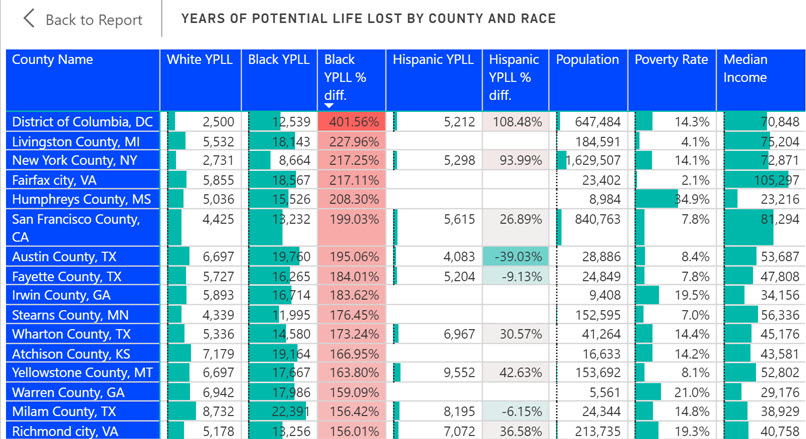
Regionally, YPLL is literally all over the map. The Black YPLL in Washington, D.C. is 4x higher than white and dwarfs the next highest county as shown in the following table. While the Black/White YPLL disparities do seem more likely in urban areas, it is not always absolute as noted by the county population and poverty rate. Clayton County, GA for example has a Black YPLL of 7,723 compared to White YPLL of 12,525 or Black/White YPLL of -38.4%. Clayton County is urban (near Atlanta), has a 68% black population and a 21% poverty rate. 


We have created a free Interactive which you can use to interact with this data which I have found to be fascinating. The table can be sorted by any of the columns and you can filter on any state. Keep in mind that this data is not available for all counties.  


Share This Story

Similar Posts

  • Free-Lance Economy Continues Upward Climb

    Moonlighting used to be a term that described a minority of people. If you moonlighted, you were supplementing your income. You either did it for extra cash or because you had to just to pay the bills. The freelance economy and the growth of the personal transportation industry alone have…

  • As the Economy Grows, So Does Poverty

    There is a general perception that a rising economy raises all economic boats. But poverty rates would indicate that the poorest of the poor just seem to get poorer. Many counties have actually experienced a rise in poverty rates from 2012 to 2016. We took a quick look at the…

  • Top Ten States with Growing Tuition Costs

    Nell Gluckman of The Chronicle of Higher Education wrote an interesting piece about the challenges of public cutbacks in the state of Louisiana. The premise of the article is that there are trickle-down implications of state cutbacks in tuition, faculty morale, and curriculum. Louisiana has passed along substantial tuition increases to its…

  • Student Debt Rises 13%

    The newest College Scorecard data released several weeks ago reveals an ongoing trend in student debt. The median student debt increased 13.1% from 2015 to 2016. The median student debt has now more than doubled since 2007 as shown by the following graph. We calculated this using a weighted average…

  • Rural Hospitals are Five-Star According to CMS

    Los Angeles County, CA and Cook County, IL (Chicago) have 117 CMS rated hospitals between them and over 15 million residents. Yet, there is not a single five-star hospital in either county. In this mini-series, we have examined the profile of the current 188 five-star hospitals as it marks its…

  • Death Rates Rise Sharply for Millenials

    The new CDC mortality data continues to paint a rather grim picture. Last week we focused on the external causes of the rise in death rates. This week we analyzed the mortality (death) rate among age groups using over 1.8 billion data points over 17 years from the CDC. You…