First in a 7-part Series on the State of the Workforce and What You Can Do About It
It’s over – 2021 that is. However, the issues related to an uneven market rebound are likely not the ending, but just the beginning. The resulting “Great Resignation” has likely created changes that will be with us for a long time. In many ways, the rebalancing and reset of the U.S. jobs and labor market may have simply pushed to the forefront workforce issues that have been dormant.
- Remote work
- Work-life balance
- Purpose
- Diversity
- Pay equity
In this seven-part series, we will look at the current state of the workforce and jobs and labor market and more importantly how to respond. The role of market-based analytics is so crucial to this step.
This series is based on a newly released white paper “The State of the Workforce and What You Can Do About It“. This white paper is automatically available to subscribers of our free jobs reports.
What Happened to 10 million Displaced Workers?
There are not many events that compare to the mass layoffs that occurred due to the full economic shutdown that started in March 2020. Over a two-month period an astounding 22 million workers were laid off or roughly 14% of the entire labor force. Over 50 million initial unemployment claims were filed compared to the normal 1-1.5 million claims filed pre-pandemic.

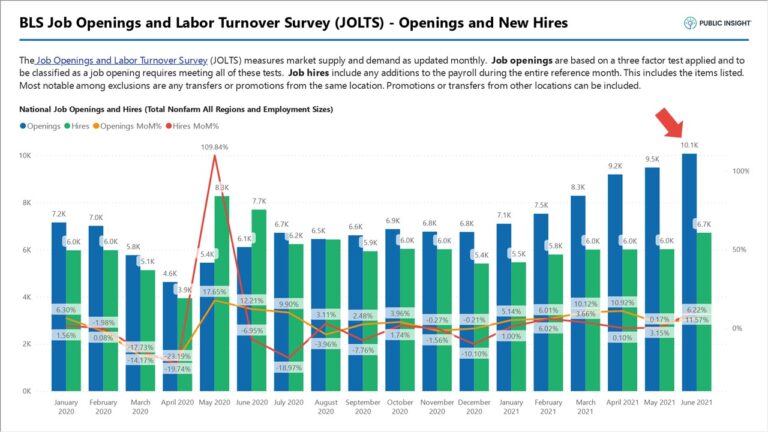
Right away, the initial signal was that this was going to be a “V” shaped recovery with a quick market rebound. New hires happened almost immediately with 8.3 million workers hired in May 2020 and 7.7 million hired in June 2020. Above average hiring has continued to this day except for a slowdown at the end of 2020 and beginning of 2021 as shown in the following graph.

The Birth of the “Great Resignation”
This hiring rebound obviously does not account for all the 22 million displaced workers.
- Approximately 10 million remain somewhat unaccounted for in the labor market.
- Only 1 million of those have left the labor force according to BLS unemployment statistics.
- Unemployment claims have dipped down to below pre-pandemic levels.
- The unemployment rate is also now at or around pre-pandemic levels.
What has happened to the remaining? The simple answer is they are looking for or doing something else.
It is not for lack of opportunity. In one of the oddest shifts of market control, workers have not only been laid off, but they have now left in droves and are being coaxed to come back. Quit rates are at an all-time high at 3% as shown in the following graph.

Employers simply cannot fill job openings. In the past when we referred to high job openings, it was perceived as a very positive sign. However, abnormal job openings on top of a lower labor force and low unemployment indicate a real problem. Today there are a little over 60 unemployed people for every 100 job openings. Record job openings just do not show signs of easing.

Now What?
Employers going into 2022 must create an environment that draws people back to work. This cannot be done just with financial incentives. With inflation at 40-year highs, compensation adjustments are just expected as table stakes. As we think about the state of the workforce, it is apparent that we will have to be informed and think critically. Understanding the market as it evolves is essential to forming good strategy.
Next post coming soon…what does job posting turnover looking like and how can we differentiate ourselves?
Get More Jobs Report Insights
Sign up to watch our Jobs Report Video for even greater insights and receive supplemental reports and market data.

See Public Insight at the HR Technology Virtual Conference
Attend the Public Insight discussion and demonstration on “Workforce Migration: Market Insights for Recruiting” and learn how to discover and motivate the hidden workforce on March 2 from 2:00-2:45 PM ET. Register for this free conference!