Hot Growth Industries

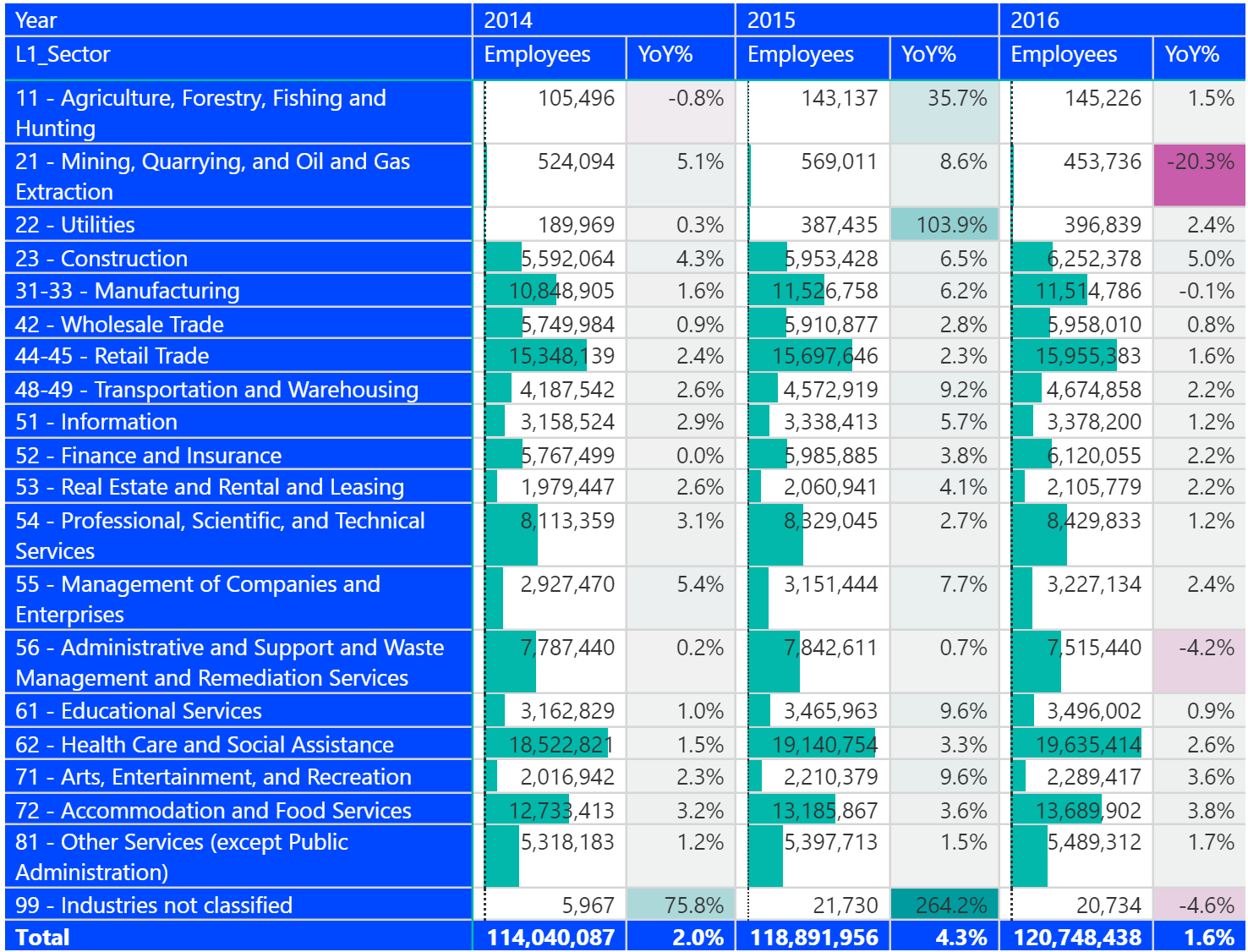
The building boom is officially back after a long hiatus. The number of construction employees increased 5% in 2016 according to the most recent County Business Patterns released by the U.S. Census.  The sector however with the most number of new establishments is the Information sector (NAICS 51) which increased 5%. This sector may be flattening out though as the number of employees only increased 1.2% and payroll only increased 1.5%. Information industries include telecommunications and hosting services possibly indicating a rapid growth in new entrants to this emerging area. The fastest growing sectors by number of employees over the trailing three years is summarized in the table below.


The business patterns data shows regional concentrations by county and zip code. For example, the health sector as a whole is fairly geographically diverse but within particular subsectors (nursing care for example), there are pockets of regional concentration. 


We have updated the Business Patterns Interactive to include the latest data from the County Business Patterns data for 2016. The Business Patterns Interactive provides industry analysis at a county level using U.S. Economic Census data over a 5 year period for over 3,000 counties. The Interactive easily identifies industry growth for over 1,000 industries at regional and state level. This Interactive is a powerful support tool for institutional and program planning, and regional economic development. This update is automatically available to our subscribers. You can purchase this as an individual Interactive for $295 or as part of the Higher Education Institution library.
 

Share This Story

Similar Posts

  • March Madness and the Top Line

    Everyone has caught March Madness fever. The first two rounds of this landmark tournament sparked more double digit seed upsets than any other year. Yet as we sit here for the sweet 16, all of the number one seeds advanced. It is no surprise to anyone either that NCAA basketball…

  • Students Increasingly Opting for High Cost Debt

    Many prognosticators are projecting a coming economic crisis caused by student debt. This is typically focused around an inability to pay off the principal of the loan. But it really appears that we are also setting ourselves up for a real problem with the cost of debt.    Overall new…

  • March 2020 Job Postings Signals Seismic Labor Shifts

    New Labor Market Analysis Application Released by Public Insight The COVID-19 reality is starting to reflect itself in the labor market. Volatility in the labor market will be the new normal for the foreseeable future. We analyzed and coded over 2 million active job postings as of past Saturday, March…

  • As the Economy Grows, So Does Poverty

    There is a general perception that a rising economy raises all economic boats. But poverty rates would indicate that the poorest of the poor just seem to get poorer. Many counties have actually experienced a rise in poverty rates from 2012 to 2016. We took a quick look at the…

  • Student Default Rates for 2014 Flatten at 15.4%

    Last week we looked at student repayment rates and noted that longer-term repayment rates continue to decline for five and seven year repayment periods. Repayment rates are in essence a measure of optimism as it is the percentage of students who have made progress in paying down their student loans….

  • New Data Highlights Student Loan Repayment Rates

    According to the Institute for College Access and Success, seven in 10 seniors (69%) who graduated from public and nonprofit colleges in 2014 had student loan debt, with an average of $28,950 per borrower. Over the last decade—from 2004 to 2014—the share of graduates with debt rose modestly (from 65%…