Diving Deeper into Opioid Prescriber Data

Last week we introduced the new CMS opioid data set and what it means. This data tries to initiate transparency around this hot topical area even though Part D Medicare claims may not be the best proxy of all opioid prescription activity. There are three elements to this data:

  • Part D opiod claims are compared to all Part D claims on a county and zip code basis to come up with a prescribing rate. The national average for this rate is 5.7%. There is some high variation with rural counties with many counties carrying rates above 10%.


  • Extended release opioid claims are compared to all opoid claims to come up with an extended release rate. Extended release medications have shown to have some effect at reducing both intentional and accidental overdose. The extended release to opioid national rate was 6.4%. There is also lower rate variation to this data and the rates are more evenly split between urban and rural counties.

  • Medicare opioid providers are compared to the total number of Medicare providers to come up with a provider ratio. The national average is 46.9%.

The Opioid Prescribing Rate Interactive gives a rapid analysis of this data down to individual counties and zip codes. It is automatically available to subscribers as part of our growing Community Health library.  We also provided a free Interactive for you to do some preliminary analysis on a state by state basis. The full Interactive provides zip code level analysis and the extended release and provider analysis.  


Share This Story

Similar Posts

  • Black Disparities in Premature Death

    County Health Rankings has always used Premature Death as a measure in deriving its ranking formula. Years of Potential Life Lost Before Age 75 (or YPLL) counts as 50% of the Health Outcomes score. Every death occurring before the age of 75 contributes to the total number of years of potential…

  • What the Ascension – Presence Merger Reveals

    This week, Ascension Health acquired Presence Health, combining the largest Catholic-sponsored healthcare system in Illinois with the nation’s largest Catholic health system, the companies announced Tuesday. The acquisition is subject to regulatory approvals. The deal underscores a continued trend towards market consolidation.    It seems Ascension, at 141 hospitals, acquiring an…

  • Decoding Outcome Measures Data

    Breaking Down the Second Year Student Success Measure The IPEDS Outcome Measures data was designed as a supplement to graduation rate data which has always been questioned as an effective measure for measuring student outcomes. Outcome Measures is now in year two of its collection and provides a lot of…

  • 12 Colleges with Sustained Enrollment Growth

      According to data collected from the Integrated Postsecondary Education Data System (IPEDS), 60.6% of colleges experienced flat or declining enrollment growth while only 39.4% experienced increasing enrollment growth from 2013-2014. This is also very consistent with statistics from 2012-2013.   College enrollment growth may be hard to sustain and…

  • Tuition Bears Increasing Brunt of Higher Ed. Revenue

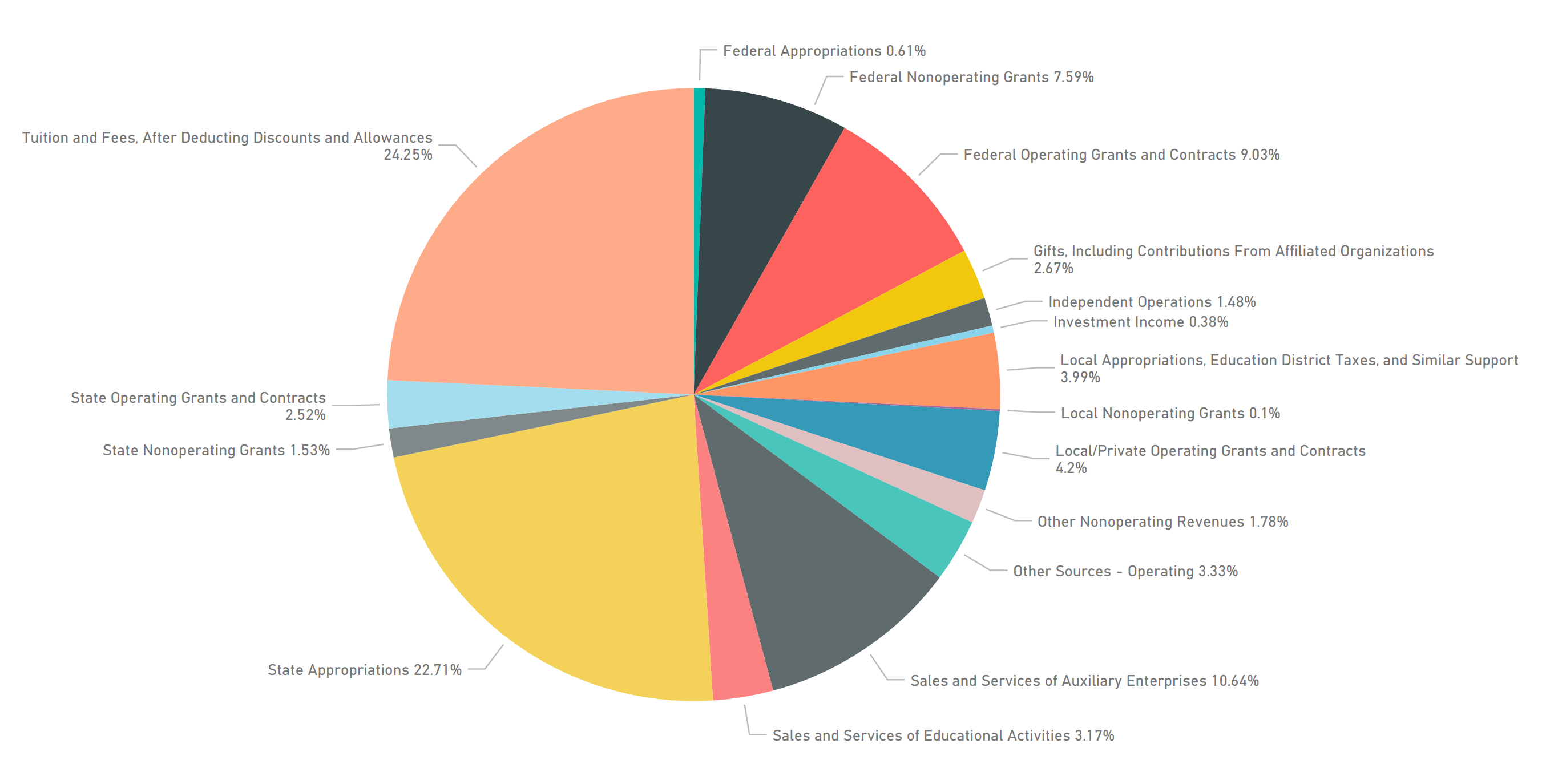
    In 2011, Tuition and Fees represented 20.6% of public institutional revenue. In 2015, it has increased to 24.25%. Most of the reshuffling of revenue has come from federal operating grants and contracts as noted by the graphs below. Interestingly, state appropriations have remained relatively constant. Similarly, non-profit institutions have seen tuition…

  • Student Earnings Experience a Sluggish Recovery

    College students are earning 8% less in 2013 than in 2008 per the most recent data published by the US Department of Education College Scorecard database. Students earned $31,382 in 2013 compared to $34,119 in 2008. The earnings were ostensibly flat from 2012 earnings of $31,528.   The College Scorecard…