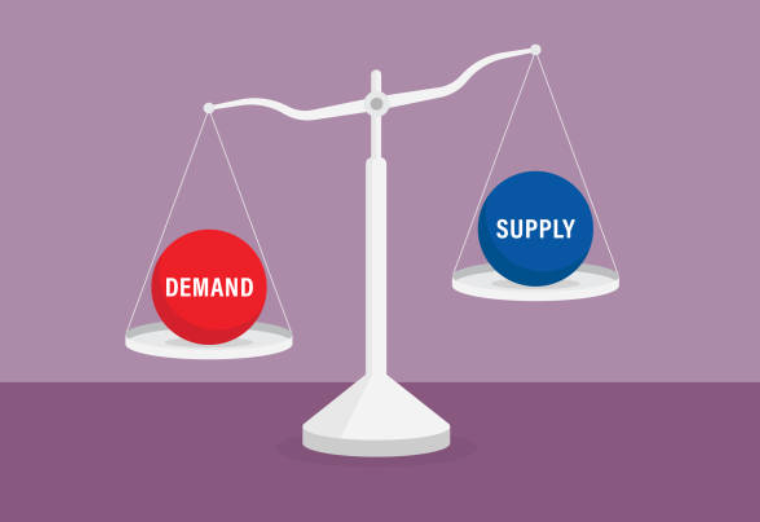
The basic concept of job market supply and demand is no different than it is for any other market. In this blog post we will explain how to measure and understand the gaps and what you can do to optimize talent acquisition strategies.
- Who are the job seekers?
- What are they looking for?
- Where are they located, or does it matter (i.e., work from anywhere)?
- How does that compare to what employers want?
How to Measure Job Market Supply and Demand
There is no perfect indicator to measure who are the job seekers and what they are looking for. However, an updated resumé is a good market signal. In our TalentView application, we define a job seeker as one who has updated their resumé on Indeed. Since the beginning of 2021, this has comprised over 40 million “active” resumés. From the resumé we curate the job title, last employer, and location. Job titles and employers can then be aggregated to occupational and industry groups respectively.
When you compare then the same information for job seekers against job postings, you can then start to form an understanding about the relative supply and demand. In the attached table, we show the comparison by occupational major group.

A resumé to posting ratio above 1 indicates more job seekers in market than advertised jobs. A resumé to posting ratio below 1 indicates there are more jobs in market than there are people to fill them.
Breaking Down Job Market Supply and Demand Issues
Customer Facing Occupations is a Timing Challenge
We have already highlighted the challenges in getting customer-facing workers. But this is not from a lack of people in the market. There is a 2:1 ratio of job seekers to job postings. Even Healthcare Support has significantly more job seekers than postings. This is likely a timing problem as job seekers are remaining on the sidelines, at least for now. Employers in a post-pandemic world with high inflation have to coax, cajole, and encourage this workforce to return to work.
Worker Shortages
The more acute problem lies in the occupations where there simply aren’t enough job seekers to cover demand. This is the group where the resumé to posting ratio is under 1.
For example, Transportation and Material Moving occupations have barely enough job seekers to cover the job postings. The job title with perpetually the highest number of open postings is CDL drivers. There just may not be enough people to go around.
Healthcare Practitioners and Technical Occupations likewise just don’t have enough people to fill the jobs. This category is at the bottom of the supply/demand ratio. This does not bode well for an aging population. These issues are more long-term in nature and require reskilling of the labor force.
Regional Variations – Concern or Opportunity?
Healthcare is also problematic because much of the labor force must work in-person despite advances in telemedicine. Consider the map below which highlights areas of the country where the number of job seekers in healthcare support occupation is less than half of the job postings.

Regional variations also create opportunities to recruit new workers where remote work is possible. For example, Computer and Mathematical occupations show a resumés to postings ratio barely above one. However, the map shows regions of the country where these occupations have at least three times as many resumés as job postings.

Hiring for Diversity
Many employers are seeking to increase diversity in their workplace. This is challenging as job seekers typically do not disclose their protected status. However colleges are required to report racial and gender diversity as part of Title IV reporting. In our College and Career Insights module we highlight enrollment and degrees awarded by gender and race.
For example, the following table shows colleges and universities with computer degrees awarded where the growth for the previous year exceeds 30%. This type of analysis enables employers to specifically target their recruiting efforts.

Identifying Reskilling or Upskilling Opportunities
As the market continues to reset from the pandemic, reskilling or upskilling will be increasingly important. Reskilling means that an individual will be trained for a different type of work. Upskilling means that the individual will add a set of skills to better equip them for a different type of work. For example, education teachers have the core skillset to teach and are now upskilled to go into education technology or reskilled to go into sales. Unfortunately, there is not a single source of credentialing although several organizations are working the problem.
Utilizing Indeed Assessments for Skills Analysis
In TalentView, we analyze several sources for understanding workforce skills. One of these sources is the Indeed® assessment system. Indeed provides both standardized assessments and the ability to generate customized assessments. Scores range from completed to expert category which we quantify from one to five. By relating assessments to job titles and regions, we can identify skills gaps.
In the example below, we analyze assessments for registered nurses regionally. This is accompanied by looking at relative skills concentration using a location quotient calculation. Location quotients benchmark to a national value (which is equal to one). Skills below one therefore have a lower than national concentration and skills above one have a higher than national concentration. As you can see, there is a wide variation in assessments taken for registered nurses. The map below indicates a higher regional concentration in the southeast of registered nurse skills than the west.

This is the fifth post in a seven-part series about the current state of the workforce and jobs and labor market and more importantly how to respond. The role of market-based analytics is so crucial to understanding the unfolding of remote work.
This series is based on a newly released white paper “The State of the Workforce and What You Can Do About It“. This white paper is automatically available to subscribers of our free monthly jobs reports.
Get More Jobs Report Insights
Sign up to watch our Jobs Report Video for even greater insights on the job market supply and demand topic and receive supplemental reports and market data.