Distance Education Programs Growth Up 18%

After a few weeks break, we are back with this week’s edition of the Insight for Education blog. In my previous blog on distance enrollment, we cited that distance enrollment exclusive growth was up nearly 15% and more and more schools were offering distance education. In this analysis we wanted to dive more deeply into the programs being offered in distance education.


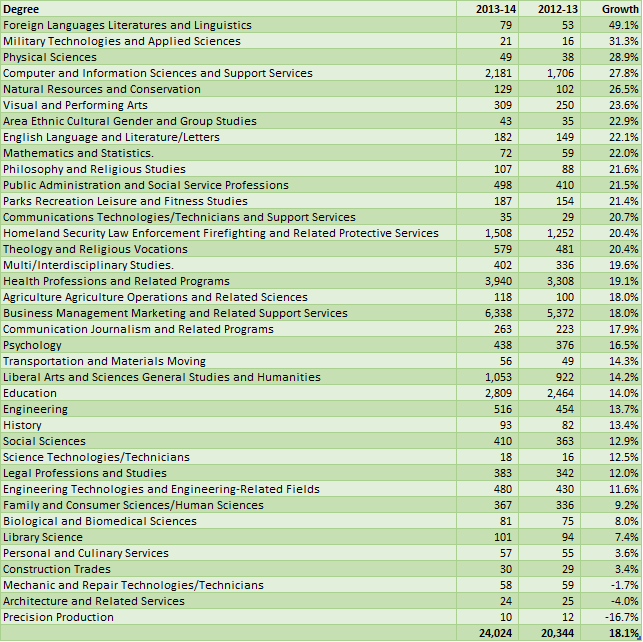
This data has been collected by the Integrated Postsecondary Education Data System (IPEDS) for the past two years and so we have limited, but telling data on the growth in distance education programs. Overall the number of distance education programs have increased 18% from 2013 to 2014. We found that all but 3 of the 38 major program categories (by two digit CIP) increased in the number of offerings. Of the major categories of programs (more than 100 offerings), Computer and Information Sciences grew the most at 27%. A relatively new category Homeland Security Law Enforcement grew 20% perhaps signaling a sign of the times we live in.


Business Management, Health, and Education continue to dominate the broad program areas in distance education with over 50% of the distance education programs from these three categories. However, only health is growing at a rate faster than the composite growth of all of the program areas.


Next week, we will dive a little more deeply underneath the hood to specific programs and levels that continue to grow.

 

Share This Story

Similar Posts

  • Healthcare Rankings and the Healthiest Cities

    We in the U.S. love our rankings. I think it is embedded in our DNA. As a student of data, I love to see the various rankings and how people get worked up over them. Healthgrades recently released its latest analysis of top quality hospitals and its National Health Index, which…

  • Black Disparities in Premature Death

    County Health Rankings has always used Premature Death as a measure in deriving its ranking formula. Years of Potential Life Lost Before Age 75 (or YPLL) counts as 50% of the Health Outcomes score. Every death occurring before the age of 75 contributes to the total number of years of potential…

  • Gainful Employment – Here Today, Gone Tomorrow

    The U.S. Department of Education announced yesterday the beginning of the process to rollback and rework Obama-era rules under the gainful employment regulations. These rules, which took years to enact, were designed to hold career-preparation programs accountable for the outcomes of their graduates. The announcement establishes rule making committees to…

  • Inpatient vs. Outpatient – What the Numbers Show

    Analysts in health care don’t agree in unanimity very often, but most seem to agree that there will continue to be a quantum shift in healthcare from inpatient to outpatient. In this two part series, we will attempt to quantify and support this important trend. We utilized the Beds and…

  • New Violence Against Women Data on Campuses

    A slug of new data has recently been released covering campus statistics on violence against women. This data was mandated by the Violence Against Women Reauthorization Act of 2013 (VAWA) and is added to numerous other statistics required under the Campus Crime Statistics Act, or Clery Act. College institutions must…

  • Regional Variations in Opioid Prescribing Rates

    Given the state of the opioid crisis, any meaningful data is valuable. So when CMS released three years of Opioid Part D prescription data in November, we all rejoiced. CMS also released a mapping tool to analyze the data. While mapping tools can be effective, they can also get in…