Real Estate, Personal Care, and Uber Top Latest Self-Employment Data

The U.S. Census recently released its 2015 Nonemployer Statistics. This data is the companion data set to the County Business Patterns. Nonemployer Statistics is an annual data set that provides county economic data for businesses that have no paid employees and are subject to federal income tax. The data consist of the number of businesses and total receipts by industry. Most nonemployers are self-employed individuals operating unincorporated businesses (known as sole proprietorships), which may or may not be the owner’s principal source of income.


Self-employment continues to inch up. The number of nonemployer establishments increased 3.28% to 24.3 million in 2015. By comparison, the number of employer based businesses only increased 1.22% to 7.6 million. Thus, for every employer establishment in 2015 there are 3.2 small self-employed businesses. As a whole self-employment is still only $1.16 billion of receipts compared to annual payroll of $4.9 billion or 23%. As the nation has regained its footing, self-employment still continues to flourish. 

  • The top number of establishments for self-employment continues to be personal care services.

  • Of the top 10 number of self-employed industries, real estate comprises three of them. The number 11 ranked industry is also in real estate.

  • Real estate smokes the amount of self-employment gross receipts where it is nearly three times the next highest amount from personal care services. These types of businesses, for the most part, are your landlords.

  • Other notable top 10 self-employment professions include accountants, management consultants, and independent artists.

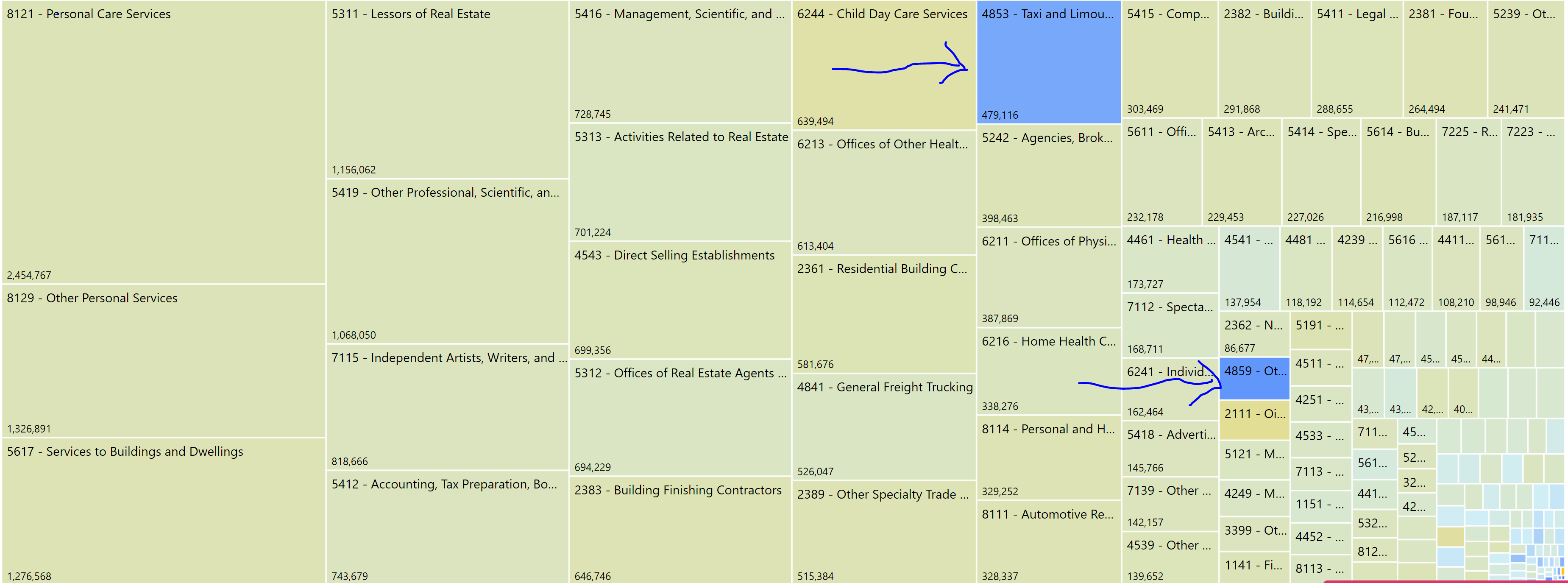
  • The highest growth area should not be a surprise – transportation (e.g. Uber and Lyft) are exploding with growth rates of betwen 60 and 70%. The tree map below shows the islands of growth (blue color) in the transportation industry.



Share This Story

Similar Posts

  • Students Increasingly Opting for High Cost Debt

    Many prognosticators are projecting a coming economic crisis caused by student debt. This is typically focused around an inability to pay off the principal of the loan. But it really appears that we are also setting ourselves up for a real problem with the cost of debt.    Overall new…

  • The Top Graduation Rate Institutions

    The character Bluto in the movie Animal House was famous for saying “Seven years of college down the drain”. This was on the heels of Dean Wormer’s pronouncement of his stellar grade point of 0.0. Given this performance, Bluto would not have graduated anyway. Thus, he would not have fallen…

  • CMS Releases 2016 Opioid Prescription Data

    This week, CMS released 2016 Opioid Part D Prescribing Rates data which follows on the heels of the original release several months ago. This data release includes Opioid prescriber, claims, and extended release claims at the national, state, county, and zip code level. We have updated our Opioid Prescribing Rates…

  • Decoding Outcome Measures Data

    Breaking Down the Second Year Student Success Measure The IPEDS Outcome Measures data was designed as a supplement to graduation rate data which has always been questioned as an effective measure for measuring student outcomes. Outcome Measures is now in year two of its collection and provides a lot of…

  • EVICTED – The Impact of Housing Affordability

    I was in the Bay Area this week for a health technology conference at Stanford University. I took Lyft back and forth from where I was staying. While conversing with one driver in my rudimentary Spanish, I found out that his family was spending $3,000 a month for a two…

  • Student Earnings Experience a Sluggish Recovery

    College students are earning 8% less in 2013 than in 2008 per the most recent data published by the US Department of Education College Scorecard database. Students earned $31,382 in 2013 compared to $34,119 in 2008. The earnings were ostensibly flat from 2012 earnings of $31,528.   The College Scorecard…