The Profile of the Five-Star CMS Hospital (First in a Series)

It is hard to believe but it has been about one year since the Centers for Medicare & Medicaid Services released its initial hospital rating system. At that time 102 hospitals earned the coveted five-star rating. The most recent ratings show 188 hospitals with the five-star rating out of roughly 3,500 hospitals. The rating system is still evolving and has received criticism across a number of fronts as penalizing urban hospitals.


We ran the numbers to see what the profile of the 188 five-star hospitals are. Using the Hospital Consumer Assessment (HCAHPS) Interactive blended with general survey data from the AHA Annual Survey Database™, we were able to get a picture of what the five-star hospitals look like and where they are located. We constructed a ratio of five-star hospitals over all hospitals for various classifications.


Five-Star Hospitals are Small

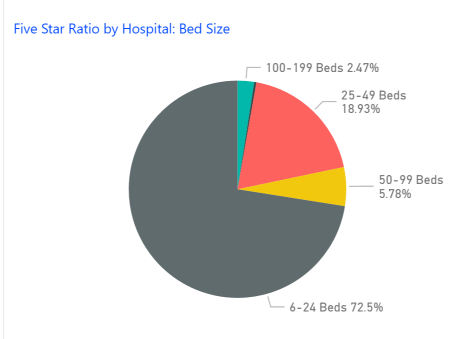
Of the 188 five-star hospitals, 144 of them are in hospitals with less than 50 beds. On the contrary, not a single hospital with more than 300 beds had a five-star rating. The following pie graph shows this discrepancy very starkly.


Five-Star Hospitals are Capitalistic

The 188 hospitals includes 26 that are owned by physicians which is 58% of all physician owned hospitals as noted in the table below. The list includes 38 hospitals that are private partnerships or 24% of all hospital partnerships. The worse five-star ratios? Non-profits which have less than 4% that are five-star hospitals.



Share This Story

Similar Posts

  • Distance Education Programs Growth Up 18%

    After a few weeks break, we are back with this week’s edition of the Insight for Education blog. In my previous blog on distance enrollment, we cited that distance enrollment exclusive growth was up nearly 15% and more and more schools were offering distance education. In this analysis we wanted…

  • Students Increasingly Opting for High Cost Debt

    Many prognosticators are projecting a coming economic crisis caused by student debt. This is typically focused around an inability to pay off the principal of the loan. But it really appears that we are also setting ourselves up for a real problem with the cost of debt.    Overall new…

  • Is Bureau of Labor Statistics Data Adequate?

    Several weeks ago, the Bureau of Labor Statistics (BLS) released updated Occupational Employment Statistics (OES) survey data. BLS OES is one of those foundational programs and datasets that are used for comprehensive occupational analysis. It produces employment and wage compensation estimates annually for nearly 800 occupations. These estimates are available…

  • Rural Hospitals are Five-Star According to CMS

    Los Angeles County, CA and Cook County, IL (Chicago) have 117 CMS rated hospitals between them and over 15 million residents. Yet, there is not a single five-star hospital in either county. In this mini-series, we have examined the profile of the current 188 five-star hospitals as it marks its…

  • Is There an Oasis in the New Food Data?

    The recently released updated Food Environment Atlas data by the USDA give us a real glimpse into the progress that we as a nation are making on combating food deserts. The USDA defines food deserts as lack of access to a healthy food retail outlet (a supermarket or large grocery store)…

  • Self-Funded Research Remains the Trend in Higher Education

    Research and development expenditures continued their flat growth since 2011 according to the most recent data from the National Science Foundation Higher Education Research and Development Survey (HERD). Research expenditures increased 1.66% for all reporting institutions from 2013 to 2014 and have increased cumulatively only 4.76% since 2011.  The primary…