Healthcare Rankings and the Healthiest Cities

We in the U.S. love our rankings. I think it is embedded in our DNA. As a student of data, I love to see the various rankings and how people get worked up over them. Healthgrades recently released its latest analysis of top quality hospitals and its National Health Index, which listed the 25 healthiest U.S. cities. In the Healthgrades Report to the Nation, it spotlighted Denver as getting health care right. As with any rankings, it comes down to the measures. Healthgrades uses four key indicators in their evaluation.

  • Access to Care

  • Access to Quality Hospitals

  • Population Health

  • Risky Behaviors

Many rankings use a number of measures based on the Behavioral Risk Surveillance System (BRFSS). At Public Insight, we have ingested this data into our platform by state, county (which is fairly dated), and metropolitan statistical area. We also have the CDC 500 (or 500 Cities Project) which uses sampling to weight the criteria against cities. You can browse this data for free in our Data Browser tool. Stay on the lookout for many new things coming your way for community health analysis. 


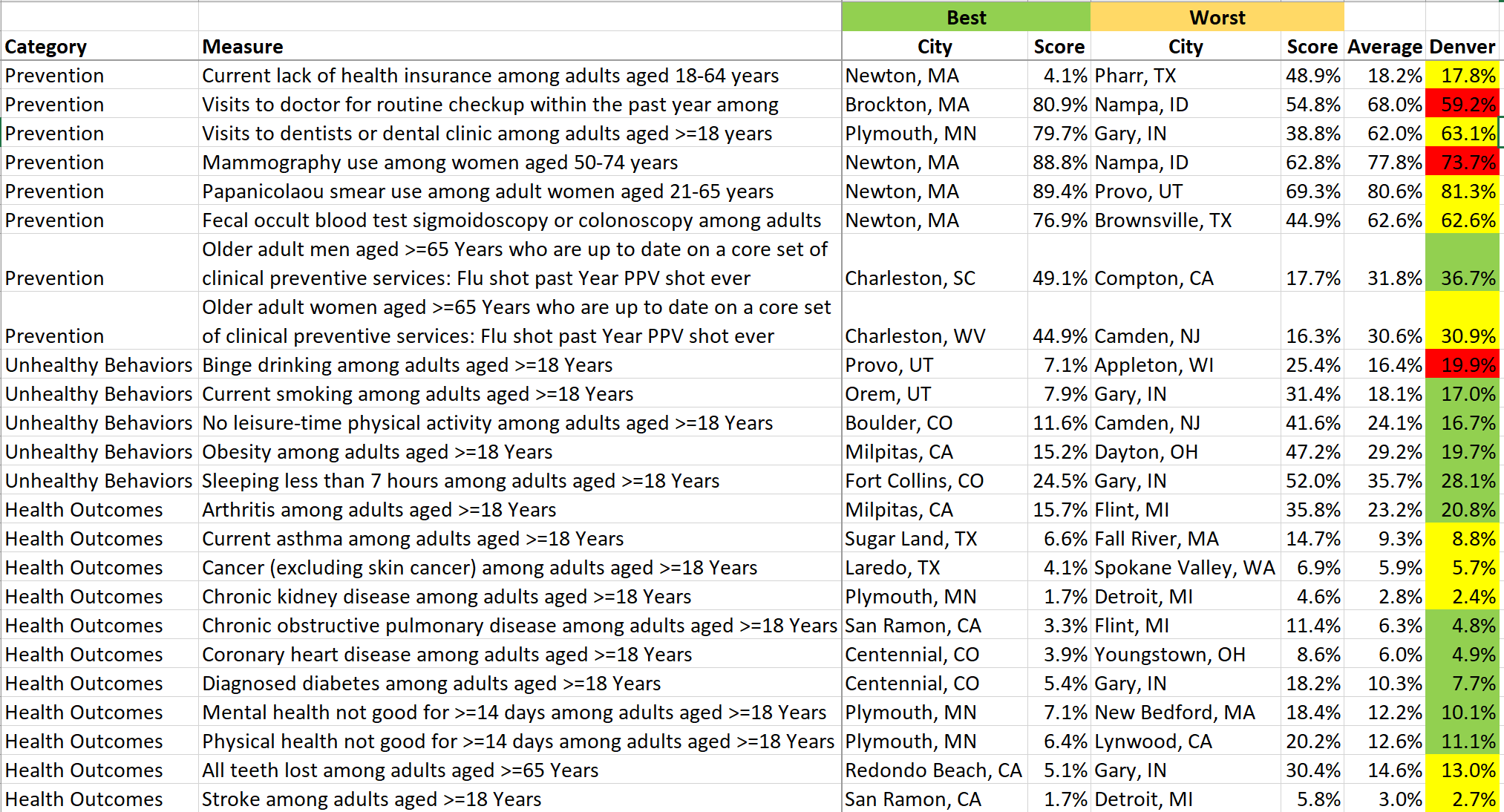
In looking at the health of cities, there is no perfect city. We used the CDC 500 to highlight the best and worst cities by category.  We also used Denver as our comparison city. As noted in the table below, Denver does well in most categories, but clearly drinking is an issue. Apparently our friends in the Mile High City also don’t like to visit the doctor routinely because they fare worse in that area. 


Share This Story

Similar Posts

  • How Long Should You Wait in the Emergency Room?

    We recently had a health scare where a family member spent over 12 hours in the emergency room. While she was not thrilled to spend so much time there, she did ultimately get good medical care. So what is excessive time in the emergency room?   Centers for Medicare &…

  • Spring is Here! Which Counties are Physically Active

    I love spring!  As a warm weather person living in the Northeast, I can’t wait to get outside and be physically active. While many are like me, still 29% of the U.S. remains by and large physically inactive and it is very regionally concentrated. The County Health Rankings uses a measure…

  • When is a Job Essential?

    Critical Infrastructure Accounts for 60% of Jobs as the Rest Open Up The stay-at-home orders under the COVID-19 pandemic separated “essential” from “non-essential”. Businesses deemed essential stayed open. Those that were not essential shut down. Sometimes those lines were very blurred with individual states and even communities making those choices…

  • Lower Student Default Rates – Calm Before the Storm?

    Loan repayment rate data may trigger resurgence in default rates The most recent Federal Student Aid student default rate data indicates that the composite student default rates declined from 10.8% in 2015 to 10.1% in 2016, a decline of 6.5% and continuing a seven-year post-recession trend. In 2010, the default…

  • Maternal Care and Rural Counties

    An interesting study published in the September issue of Health Affairs found that 9 percent of rural counties experienced the loss of all hospital obstetric services in the period 2004–14. In addition, another 45 percent of rural US counties had no hospital obstetric services at all during the study period. We…