How Long Should You Wait in the Emergency Room?

We recently had a health scare where a family member spent over 12 hours in the emergency room. While she was not thrilled to spend so much time there, she did ultimately get good medical care. So what is excessive time in the emergency room?


Centers for Medicare & Medicaid Services (CMS) publishes a quality score which looks at average time in the emergency room. In fact, there are multiple measures of emergency wait times. The average patient waits a little over four hours (based on 4,822 hospitals) in the emergency room before being sent home. What is really curious is some of the longer wait times. There are seven hospitals where the average wait time is over 1,000 minutes or over 16 hours capped by Bayshore Medical Center in Texas where the average wait time is nearly 33 hours. More and more facilities like Bayshore are publishing their current wait times (like TSA at the airport). 


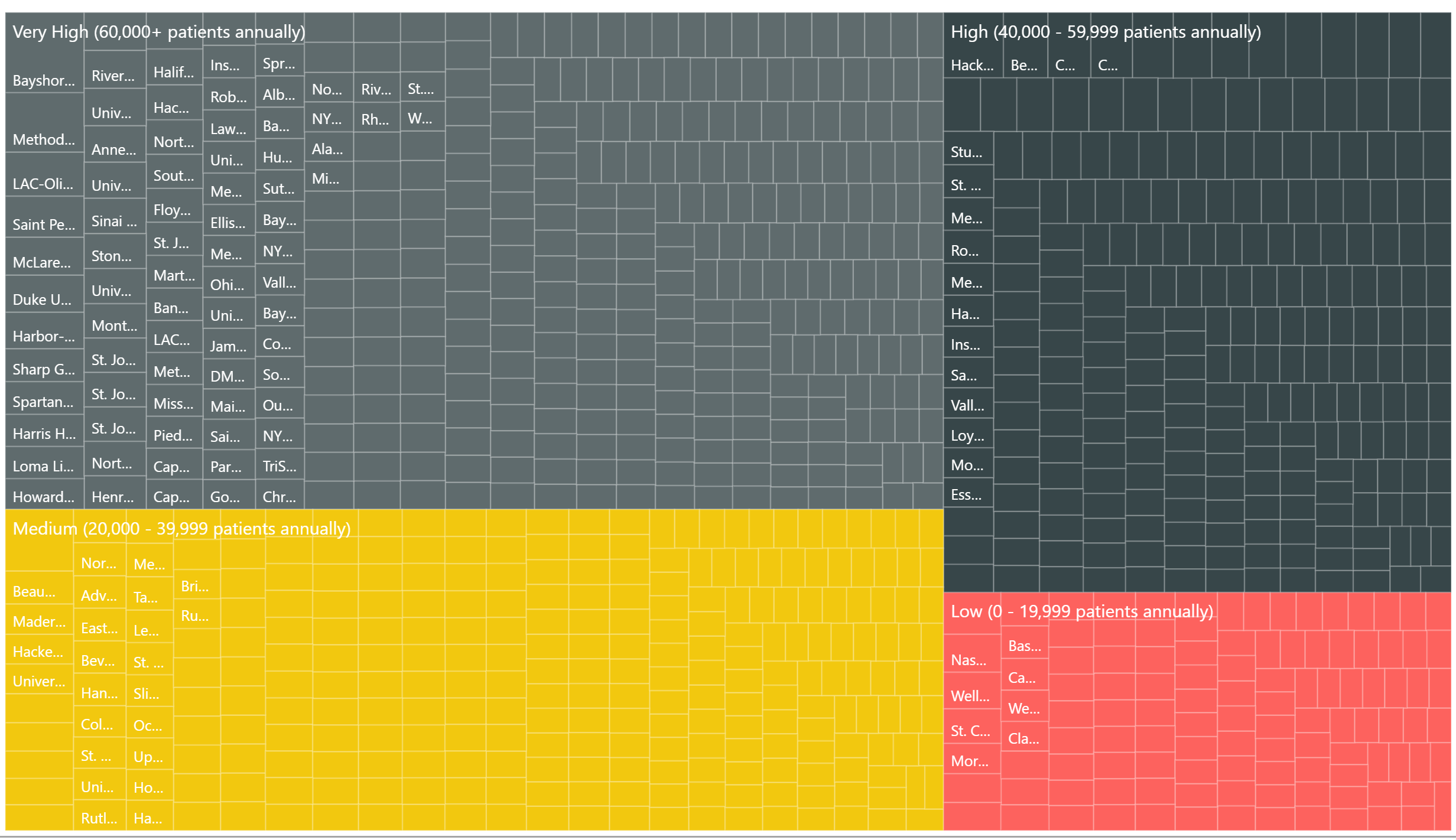
Just like the busiest airports, the busiest emergency rooms tend to have the longest wait times. The treemap below shows a visual image of the hospitals with above average wait times. As you can see, about 70% have high or very high volume as defined by CMS. So as you think about time in the emergency room, ultimately you probably want to think in terms of care first (even as you grow impatient).



Share This Story

Similar Posts

  • Inpatient vs. Outpatient – What the Numbers Show

    Analysts in health care don’t agree in unanimity very often, but most seem to agree that there will continue to be a quantum shift in healthcare from inpatient to outpatient. In this two part series, we will attempt to quantify and support this important trend. We utilized the Beds and…

  • COVID-19 Dashboard with NYT Data

    Analyze COVID-19 Cases by National, State and County Level It is important for today’s business leaders to consider the impact of COVID-19 when making decisions and allocating resources. The accuracy of COVID-19 data reported by news sources and online publications goes beyond the numbers themselves, the interpretation of the statistics…

  • EVICTED – The Impact of Housing Affordability

    I was in the Bay Area this week for a health technology conference at Stanford University. I took Lyft back and forth from where I was staying. While conversing with one driver in my rudimentary Spanish, I found out that his family was spending $3,000 a month for a two…

  • Death Rate Continues to Inch Up

    The mortality (or death) rate increased nominally from 2016 to 2017 going from 844 to 849 deaths per 100,000. This probably is not earthshaking news but based on the overall crude rate, it has actually been increasing since 2009 as noted by the following graph.   Advances in medical care…

  • Are Outpatient Imaging Quality Measures Effective?

    CMS began developing measures evaluating imaging efficiency back in 2007. These performance measures have been distributed as part of Hospital Compare for the past four years. Lower percentages suggest more efficient use of medical imaging. The purpose of reporting these measures is to reduce unnecessary exposure to contrast materials and/or…