Employment Numbers Support America's Love of Eating Out

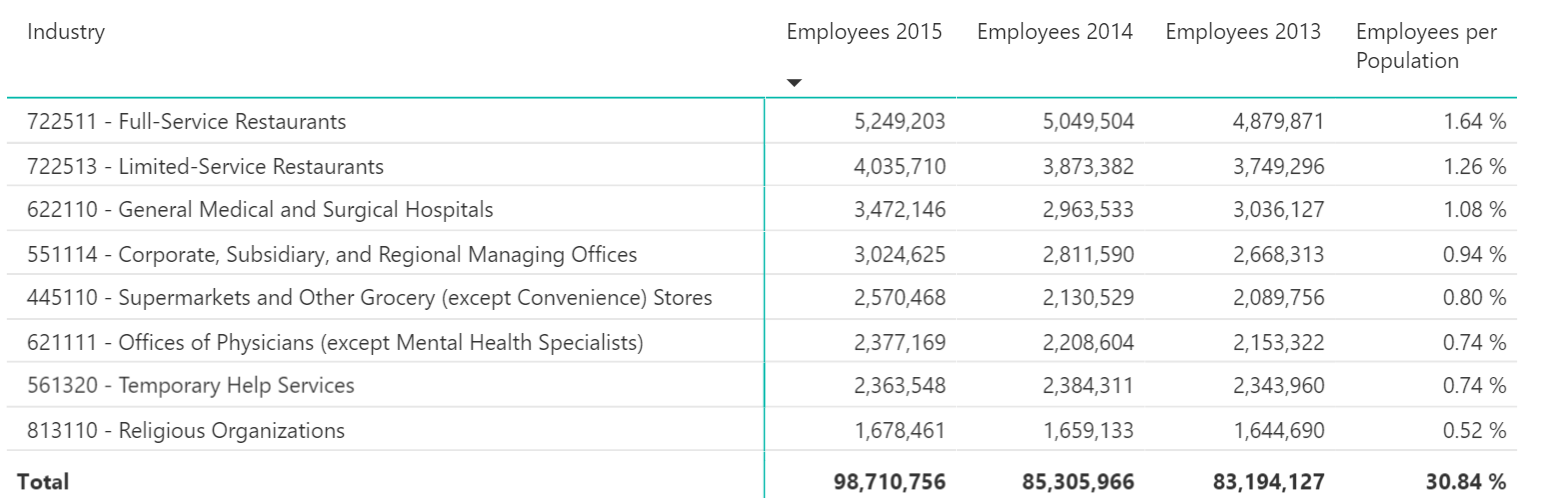
One of my favorite movie lines is from the movie “A Christmas Story”. After the Bumpus dogs demolish the Thanksgiving turkey, Ralphie’s dad says, while holding a half-eaten drumstick, “we are going out to eat”. We Americans love to eat our food out, as evidenced by the fact that 1 in 30 Americans are employed in the restaurant industry, according to the most recent data from the U.S. Census. Moreover employment in the restaurant industry continues to tick up as shown by the following table.


The Census Bureau recently released new 2015 County Business Patterns data which includes data on employees per industry based on the North American Industry Classification System (NAICS). County Business Patterns is based on the number of employees for the payroll period including March 12 of the applicable year so it does not really factor in seasonal workers. The largest employers on a per-capita basis are in the restaurant industry with 3.14% employed in NAICS code 7225 which are restaurant groupings. This is based on U.S. population of about 320 million. Using employable Americans (those 18 and over or 240 million), the number is over 4%. 


Breaking this down further, full-service restaurants employ more people on a per-capita basis than limited-service, or fast food restaurants. Also included in our top five is another food-related industry, grocery stores (NAICS 445110), which employed nearly 2.6 million workers in 2015. We Americans love our food and we employ lots of people in the food distribution system to get us our food. However, when it comes to the payroll cost, food service is not at the top of the list but health related industries dominate. We will look at that next week.
 

Share This Story

Similar Posts

  • Student Default Rates for 2014 Flatten at 15.4%

    Last week we looked at student repayment rates and noted that longer-term repayment rates continue to decline for five and seven year repayment periods. Repayment rates are in essence a measure of optimism as it is the percentage of students who have made progress in paying down their student loans….

  • Breaking Down Net Price, Tuition, and Aid

    Reports by College Board and others have indicated that net price, the true measure of what a student pays to attend college, continues to rise. College Board has maintained that the actual net price has been increasing for six to eight straight years.    Net price is defined as the…

  • International Student Enrollment Visualized

    In last week’s blog, we talked about out of state enrollment and its potential impact on both the diversity and finances of the university. International enrollment is even considered a bigger potential bonanza to colleges and universities as many international students pay full tuition. According to the Institute of International…

  • Lower Student Default Rates – Calm Before the Storm?

    Loan repayment rate data may trigger resurgence in default rates The most recent Federal Student Aid student default rate data indicates that the composite student default rates declined from 10.8% in 2015 to 10.1% in 2016, a decline of 6.5% and continuing a seven-year post-recession trend. In 2010, the default…

  • Infection Rates and the Long-Term View

    My Cleveland Indians have now won 13 games in a row. That along with their overall record and stellar play over the entire season tells me they are a good team. However, at any given point the Indians or any particular player could play really poorly. The similar challenge with…

  • Violence Against Women Offenses Up 9.5%

    This is the third year that the Campus Safety and Security (CSS) data has released separate violence against women (VAW) offenses. This data captures three types of offenses; domestic violence, dating violence, and stalking and analyzes it for both on campus and off campus locations. Overall, there were 16,183 VAW…