The Gender Debt Disparity

The Huffington Post recently posted a very interesting article on gender debt disparity. The article notes that women hold nearly two-thirds of all student debt – a whopping $833 billion dollars. The article postulates that women also take longer to pay off the debt because they earn less than men.


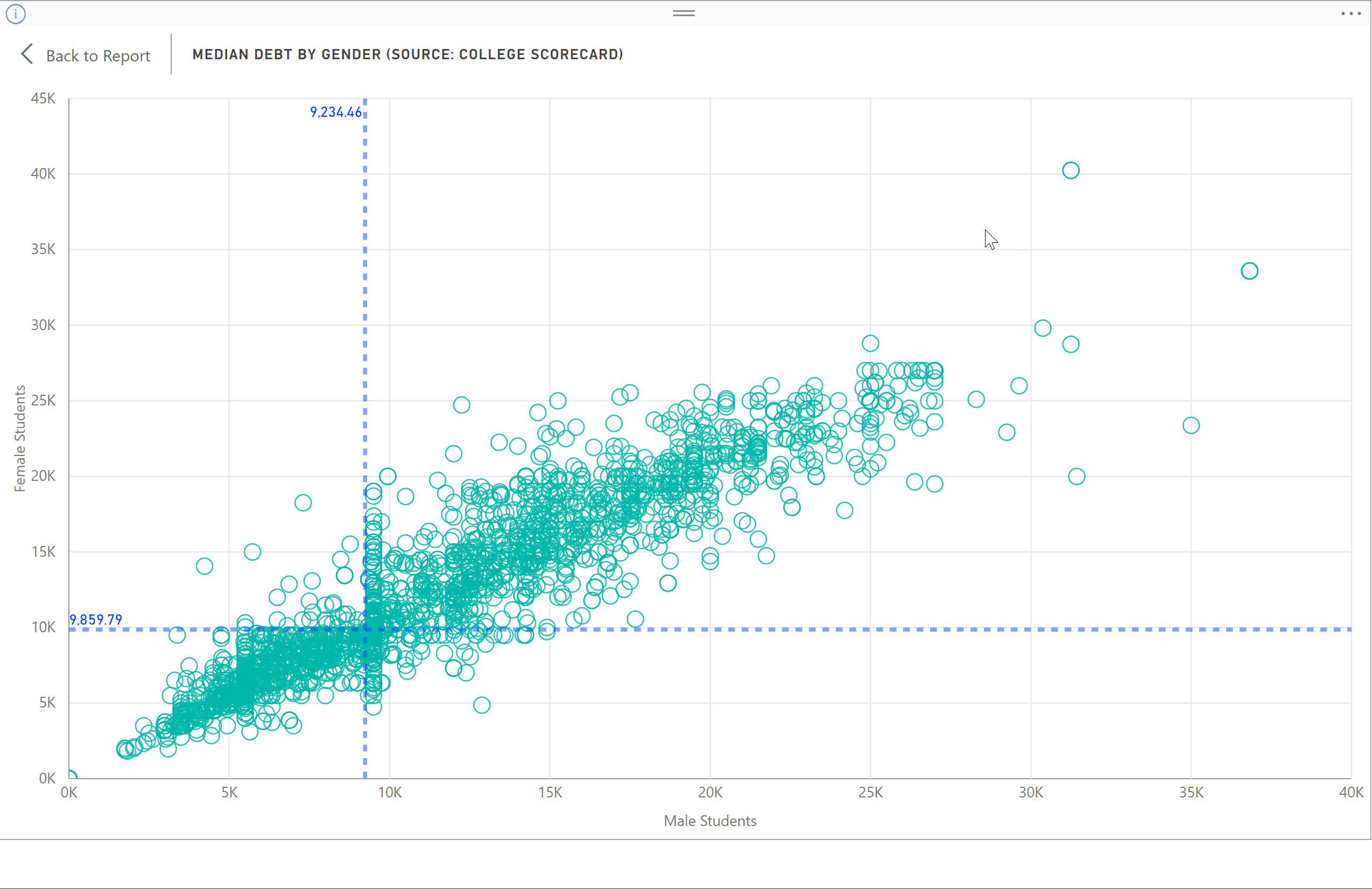
I wanted to see how that coincides with the student debt levels as reported by the U.S. Department of Education via the College Scorecard database. This database tracks the cumulative median loan debt and then disaggregates the debt by various factors including gender for approximately 6,000 institutions. The disaggregated data is profiled in the Public Insight Student Debt Interactive. You can also browse it for free using our Data Browser tool. The data, using a simple average across institutions, shows that women have a median debt level 6.7% higher than men ($9,859 vs $9,234). A scatterplot of the student loan mix is shown below. There are limitations to the data as this database only reports federal loan activity and not other loan sources such as Parent Plus loans.


The Huffington article makes the assumption that because women earn less, they take longer to pay off the student debt. But does it make them less reliable to pay down the debt? The College Scorecard database reports debt repayment rates again disaggregated by gender. The definition is very important. It is those that have entered repayment status and have made some progress in paying down their student loans which is something greater than $1 of principal.  We used the three-year metric after entering repayment status.

While women may have more debt, they are nearly 3% (48% to 45%) more likely than men on average across all institutions to have made a dent in their loan. Again, we can see the distribution using the scatterplot below. I have to be honest and say this does not surprise me in the least. I spent five years going around the world in the infancy of the microfinance movement and women are notoriously better borrowers than men. Over 90% of micro loans worldwide are to women.



Share This Story

Similar Posts

  • Free-Lance Economy Continues Upward Climb

    Moonlighting used to be a term that described a minority of people. If you moonlighted, you were supplementing your income. You either did it for extra cash or because you had to just to pay the bills. The freelance economy and the growth of the personal transportation industry alone have…

  • Are Outpatient Imaging Quality Measures Effective?

    CMS began developing measures evaluating imaging efficiency back in 2007. These performance measures have been distributed as part of Hospital Compare for the past four years. Lower percentages suggest more efficient use of medical imaging. The purpose of reporting these measures is to reduce unnecessary exposure to contrast materials and/or…

  • On Faculty Compensation and Gender Disparity

    It will take many years for the faculty gender pay gap to close at the current rate of change. From 2014 to 2015, women received around half a percent higher pay increase from men over the various institutional sectors. There is still a 16% and 14% gender pay gap for full professors…

  • The States That Send Students Elsewhere

    IPEDS reports residency numbers for first-time undergraduates by state. This data can be challenging to work with from several perspectives. It is not collected every year by every institution and it does not summarize the students coming from out of the state of the institution.     The Enrollment Suite…

  • Gainful Employment – Here Today, Gone Tomorrow

    The U.S. Department of Education announced yesterday the beginning of the process to rollback and rework Obama-era rules under the gainful employment regulations. These rules, which took years to enact, were designed to hold career-preparation programs accountable for the outcomes of their graduates. The announcement establishes rule making committees to…

  • Rural Hospitals are Five-Star According to CMS

    Los Angeles County, CA and Cook County, IL (Chicago) have 117 CMS rated hospitals between them and over 15 million residents. Yet, there is not a single five-star hospital in either county. In this mini-series, we have examined the profile of the current 188 five-star hospitals as it marks its…