EVICTED – The Impact of Housing Affordability

I was in the Bay Area this week for a health technology conference at Stanford University. I took Lyft back and forth from where I was staying. While conversing with one driver in my rudimentary Spanish, I found out that his family was spending $3,000 a month for a two bedroom, one bath home. He was working 16 hour days just to plow a large part of that income towards their rent. I am reading the book Evicted which describes the plight of inner city families to stay in one place. The downstream impact on our urban social infrastructure is staggering.


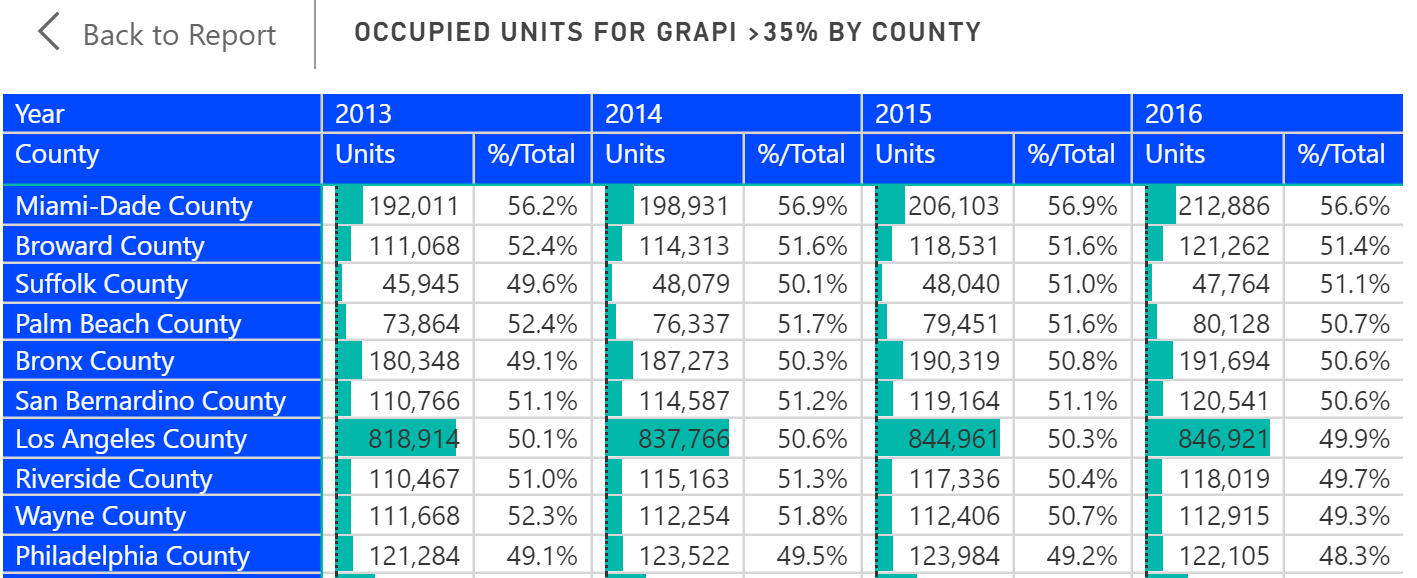
The American Community Survey collects a statistic on the number of housing units where the occupants spend more than 35% of income on rent. It is GRAPI or Gross Rents as a Percentage of Income. Nationwide, 42% of housing units spent more than 35% on rents, but in counties where the population is greater than 1 million residents, that number can cross 50%. The top ten counties for GRAPI with populations above 1 million residents are shown below. It is unfortunate that the ACS survey ends with a band at 35% because it would not be surprising to me to see homes where 70% or more of income goes towards housing.


We have curated housing data from the American Community Survey into 25 indicators as part of the Population Analysis Interactive including GRAPI. Here at Public Insight, we love to put data to work into creating useful insights. We believe that the power of curated data and business intelligence is extraordinary. We’d love to hear from you and be of help to you and your organization.  
Share This Story

Similar Posts

  • Hot Growth Industries

    The building boom is officially back after a long hiatus. The number of construction employees increased 5% in 2016 according to the most recent County Business Patterns released by the U.S. Census.  The sector however with the most number of new establishments is the Information sector (NAICS 51) which increased 5%….

  • FAFSA Application Volume Down 11%

    The FAFSA Application Volume declined nearly 11% for the application cycles from June 30, 2014 through June 30, 2017 based on data from Federal Student Aid and analyzed using the Financial Aid Interactive. FAFSA application cycles are based on an 18-month period for any one particular school year.  Note the…

  • Hot Educational Programs in 2018

    Econometrics Programs Show Nearly Triple Digit Growth I am delighted to return to the blogosphere community. It has been a few months since we have published a blog, but not for a lack of work going on behind the scenes here at Public Insight. You will notice that our blog…

  • Self-Funded Research Remains the Trend in Higher Education

    Research and development expenditures continued their flat growth since 2011 according to the most recent data from the National Science Foundation Higher Education Research and Development Survey (HERD). Research expenditures increased 1.66% for all reporting institutions from 2013 to 2014 and have increased cumulatively only 4.76% since 2011.  The primary…

  • Maternal Care and Rural Counties

    An interesting study published in the September issue of Health Affairs found that 9 percent of rural counties experienced the loss of all hospital obstetric services in the period 2004–14. In addition, another 45 percent of rural US counties had no hospital obstetric services at all during the study period. We…