Death Rates Rise Sharply for Millenials

The new CDC mortality data continues to paint a rather grim picture. Last week we focused on the external causes of the rise in death rates. This week we analyzed the mortality (death) rate among age groups using over 1.8 billion data points over 17 years from the CDC. You can now analyze this extensive data yourself with no data knowledge using the new Mortality Rate Interactive.  This Interactive is part of the Community Health subscription.


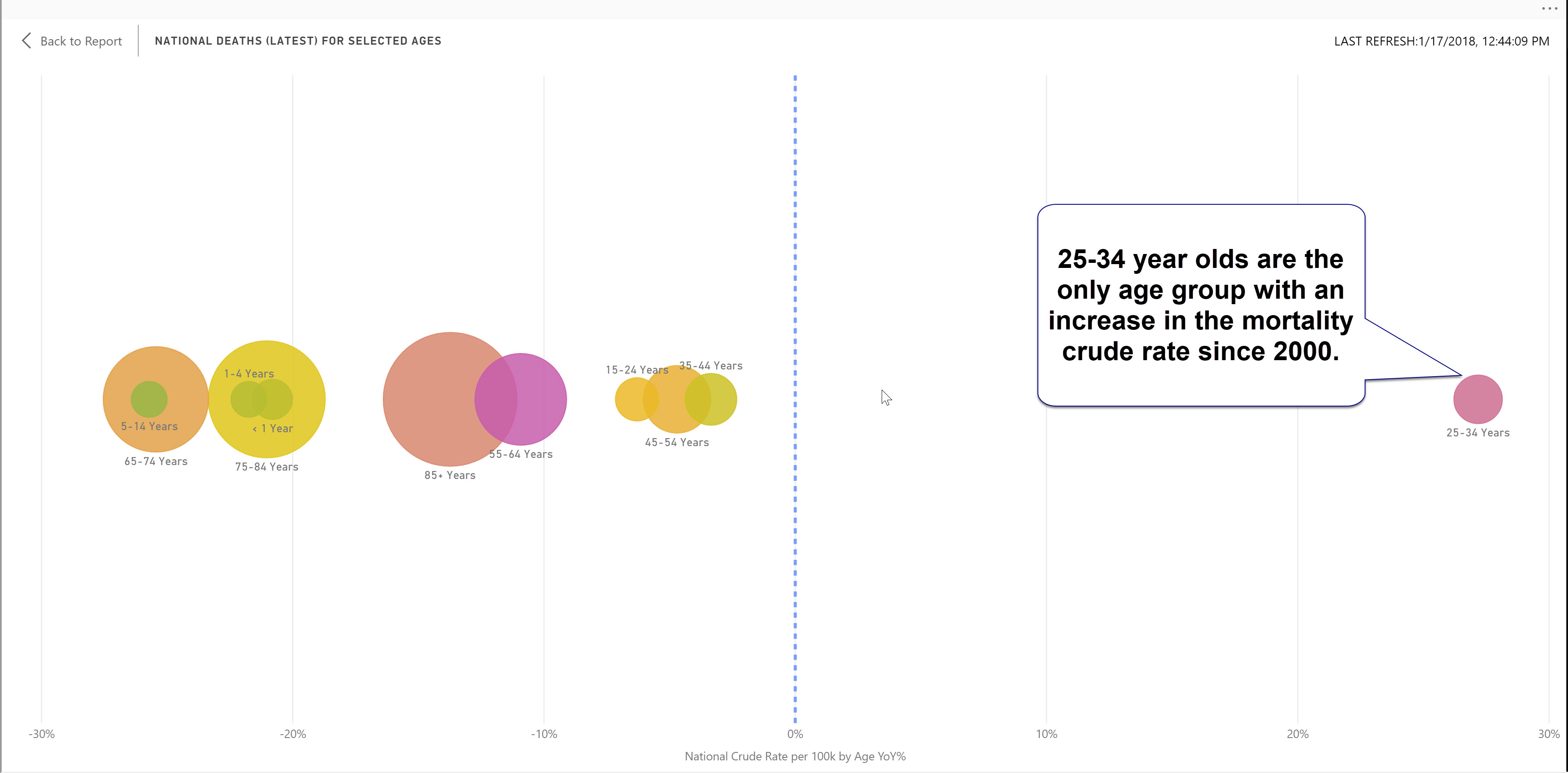
The mortality for every age group has declined from 2000 to 2016. The exception is the 25-34 year olds which is up 27% from 2000. The dot plot graphic below starkly shows this.


The mortality rate has skyrocketed in the past two years among age groups covering ages 15-44. This is a consistent trend that we saw with the external and behavioral causes last week. The counties that have experienced the highest jumps in this age bracket appears to be most concentrated in the MidAtlantic and Northeast. I go into these topics in more depth in the video blog.  


The new CDC mortality data is now available in Public Insight. We have launched an amazing new Interactive based on nearly 2 billion data points and 17 years of mortality data down to the county level. With Interactives, you can explore and analyze this critical data yourself with no data knowledge or experience. We have also created a free Interactive for the specific age related mortality data.
Share This Story

Similar Posts

  • Nursing Home Deficiencies by State

    When nursing home incidents occur, they receive big news. Just this week, a Pinellas Park, Florida nursing care center resident died after appearing to have been left outside in the sun. The nursing home had been cited for various deficiencies and had received a one-star rating. In fact, the nursing…

  • CDC Publishes 2016 Natality (Births) Data

    The CDC recently released updated Natality (Births) data for 2016. State laws require birth certificates to be completed for all births, and Federal law mandates national collection and publication of births and other vital statistics data. The National Vital Statistics System provides access to statistical information from birth certificates and CDC makes…

  • International Student Enrollment Visualized

    In last week’s blog, we talked about out of state enrollment and its potential impact on both the diversity and finances of the university. International enrollment is even considered a bigger potential bonanza to colleges and universities as many international students pay full tuition. According to the Institute of International…

  • Student Earnings Experience a Sluggish Recovery

    College students are earning 8% less in 2013 than in 2008 per the most recent data published by the US Department of Education College Scorecard database. Students earned $31,382 in 2013 compared to $34,119 in 2008. The earnings were ostensibly flat from 2012 earnings of $31,528.   The College Scorecard…

  • Is Bureau of Labor Statistics Data Adequate?

    Several weeks ago, the Bureau of Labor Statistics (BLS) released updated Occupational Employment Statistics (OES) survey data. BLS OES is one of those foundational programs and datasets that are used for comprehensive occupational analysis. It produces employment and wage compensation estimates annually for nearly 800 occupations. These estimates are available…

  • Will Voter Unpredictability Continue in 2018?

    Much has been written about the increased polarization of America and its collective impact on communities. There were many surprises in the 2016 election and people are bracing for a potentially tumultuous 2018 mid-term election. Ohio, where I live, is one of the swing states. The average county in Ohio…