Nursing, Computer Science Among Top Growth Program Areas in 2015

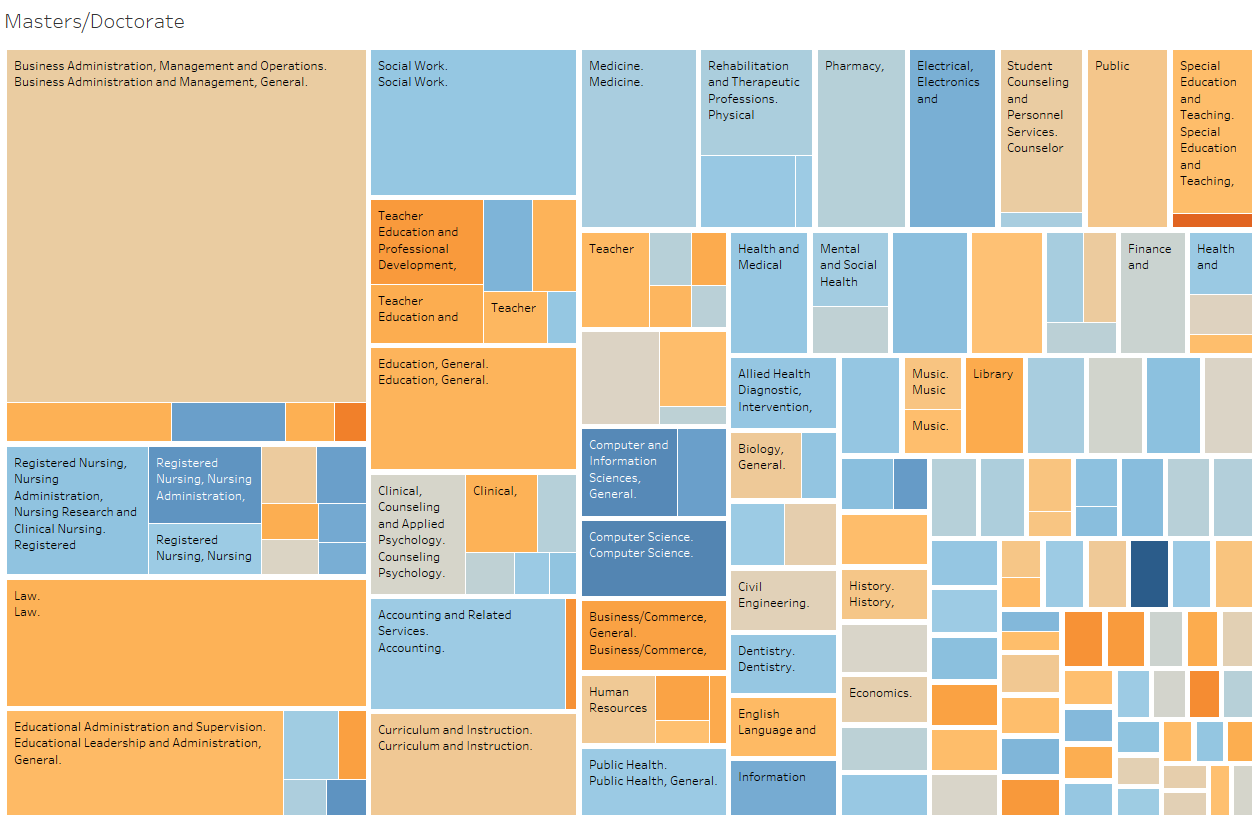
Nursing programs at a bachelor and master’s level continue to grow at a fast pace according to the most recent awards data from the Integrated Postsecondary Education Data System (IPEDS). Bachelor’s and Master’s level (see tree map left side blue growth area below) degrees for Registered Nurses (and related fields) both went up nearly 10% from 2014 to 2015. Employment projections for Registered Nurses is projected to increase 16% from 2014 to 2024 according to the most recent projections data from the Bureau of Labor Statistics. Skilled nursing is a train that has left the station and more and more medical diagnostic work will be pushed “downward” to nurses. I say that with some level of bias as my wife is a nurse. Interestingly, you just went to the CVS Minute Clinic this morning where a nurse practitioner diagnosed her with pneumonia and wrote a prescription for her care. Interestingly, Associate’s level degrees in nursing related programs actually declined 3.4% in 2015 perhaps reflective of the skill level needed.

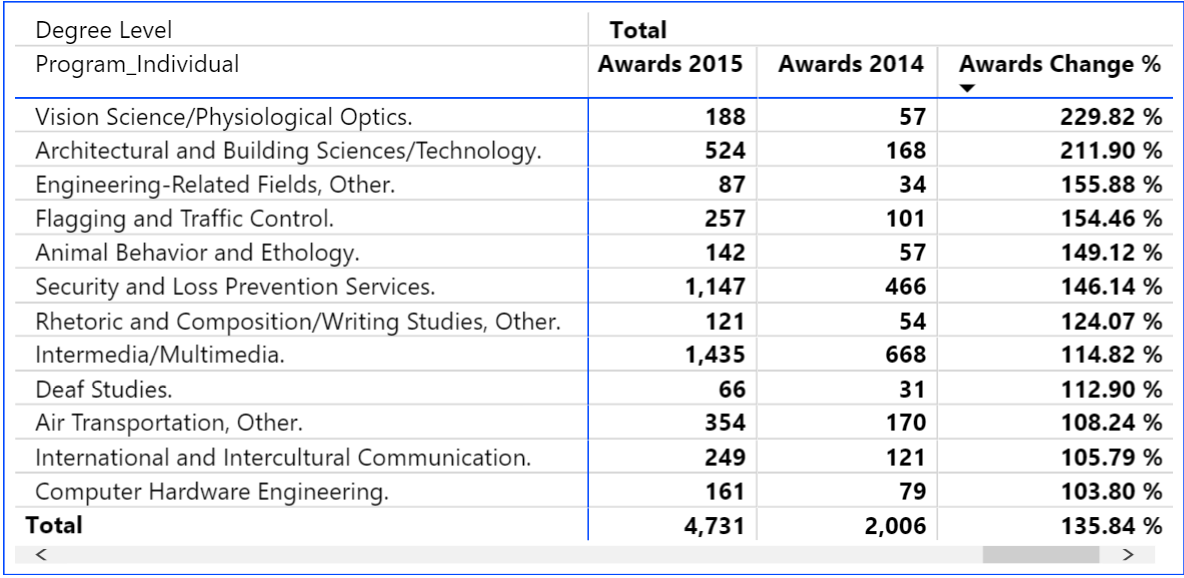
 We looked at over 1,000 individual programs and screened out for only those that had a minimum of 1,000 degrees awarded in 2015. You can look at the programs yourself using the free Interactive.  At an Associate’s level, specific skilled programs such as culinary arts as a group went up 10%. What fascinated me however was a 31% increase in speech rhetoric and communication which is offered by 219 institutions. Finally, at a bachelor’s level, computer science was a clear winner with growth as well as health related professions. Criminal justice areas continue to show strong growth.


The Degree-to-Jobs Interactive provides program analysis as well as a look at the connected labor data from the BLS Employment Projections and Occupational Employment Statistics.
Share This Story

Similar Posts

  • Black Disparities in Premature Death

    County Health Rankings has always used Premature Death as a measure in deriving its ranking formula. Years of Potential Life Lost Before Age 75 (or YPLL) counts as 50% of the Health Outcomes score. Every death occurring before the age of 75 contributes to the total number of years of potential…

  • As the Economy Grows, So Does Poverty

    There is a general perception that a rising economy raises all economic boats. But poverty rates would indicate that the poorest of the poor just seem to get poorer. Many counties have actually experienced a rise in poverty rates from 2012 to 2016. We took a quick look at the…

  • Student Debt Rises 13%

    The newest College Scorecard data released several weeks ago reveals an ongoing trend in student debt. The median student debt increased 13.1% from 2015 to 2016. The median student debt has now more than doubled since 2007 as shown by the following graph. We calculated this using a weighted average…

  • How Long Should You Wait in the Emergency Room?

    We recently had a health scare where a family member spent over 12 hours in the emergency room. While she was not thrilled to spend so much time there, she did ultimately get good medical care. So what is excessive time in the emergency room?   Centers for Medicare &…

  • Tuition Bears Increasing Brunt of Higher Ed. Revenue

    In 2011, Tuition and Fees represented 20.6% of public institutional revenue. In 2015, it has increased to 24.25%. Most of the reshuffling of revenue has come from federal operating grants and contracts as noted by the graphs below. Interestingly, state appropriations have remained relatively constant. Similarly, non-profit institutions have seen tuition…

  • Is Bureau of Labor Statistics Data Adequate?

    Several weeks ago, the Bureau of Labor Statistics (BLS) released updated Occupational Employment Statistics (OES) survey data. BLS OES is one of those foundational programs and datasets that are used for comprehensive occupational analysis. It produces employment and wage compensation estimates annually for nearly 800 occupations. These estimates are available…