Rural Hospitals are Five-Star According to CMS

Los Angeles County, CA and Cook County, IL (Chicago) have 117 CMS rated hospitals between them and over 15 million residents. Yet, there is not a single five-star hospital in either county. In this mini-series, we have examined the profile of the current 188 five-star hospitals as it marks its one-year anniversary. Last week, we looked at the characteristics of the five-star hospital and found that they are small and privately owned.  This week, we added county census data to the mix again using the Consumer Assessment (HCAHPS) Interactive


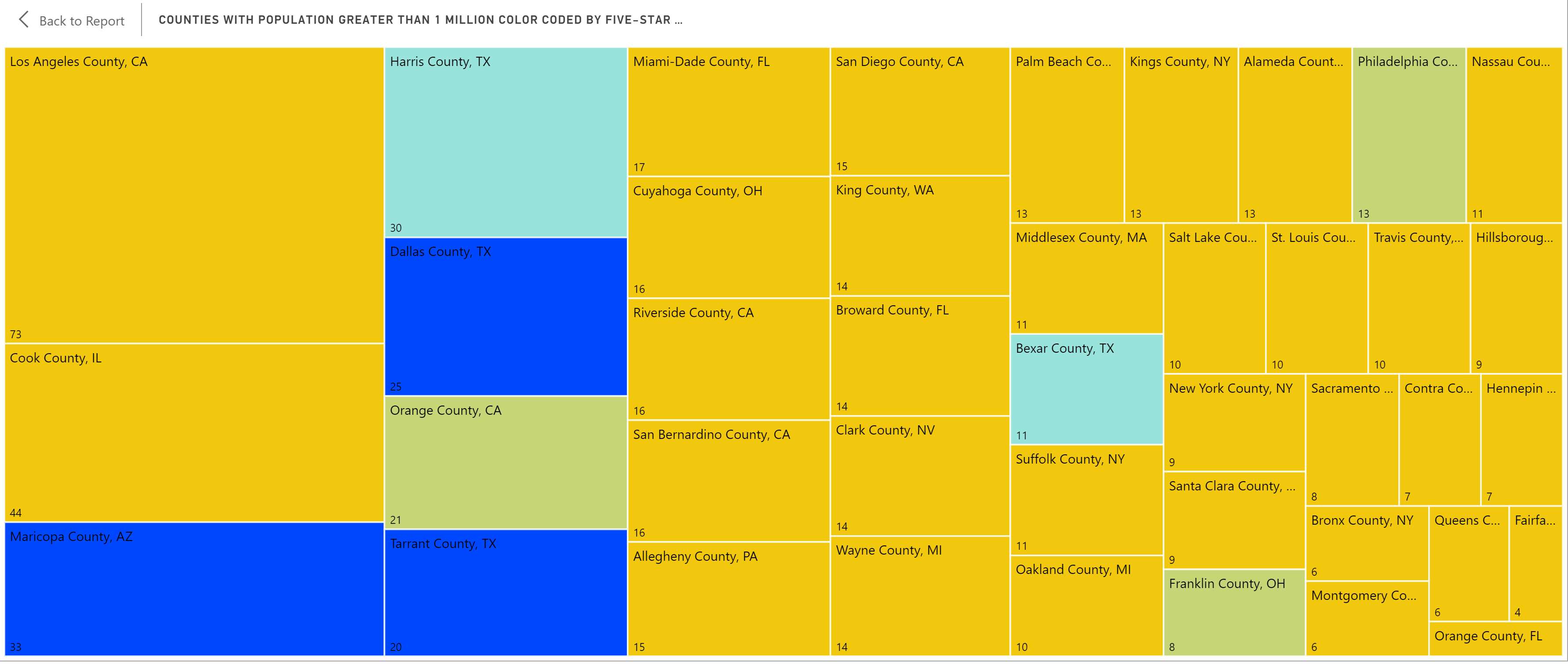
Of the 188 five-star hospitals, 74 are critical access hospitals, which by definition are rural hospitals. In fact, 16% of all critical access hospitals are five-star hospitals compared to just 3.7% of acute care hospitals.  The following tree map shows the breakdown of hospitals by county for every county with a population of greater than 1 million residents. The gold color indicates the absence of a single five-star hospital (blue indicates two or more). A quarter of the U.S. population is represented here and there are a total of 17 five-star hospitals.


I live near Cleveland, Ohio, home of Cleveland Clinic and University Hospitals, two world-class hospitals. Yet the areas around these two great health facilities are far from healthy. Cuyahoga County, where I live is ranked by County Health Rankings 85th out of 88 counties for physical environment and 75th for quality of life. The urban hospital may carry the complex challenges of its environment.  
 

Share This Story

Similar Posts

  • Student Default Rates for 2014 Flatten at 15.4%

    Last week we looked at student repayment rates and noted that longer-term repayment rates continue to decline for five and seven year repayment periods. Repayment rates are in essence a measure of optimism as it is the percentage of students who have made progress in paying down their student loans….

  • Room and Board Cost Increases Slowing

    After three straight years of 3-5% increases, room and board annual growth has finally slowed to a more pedestrian 2-3%. In recent years, universities have invested heavily in on-campus facilities and presumably passed these costs to the students at a rate greater than inflation. One administrator once told me that on-campus facilities…

  • Decoding Outcome Measures Data

    Breaking Down the Second Year Student Success Measure The IPEDS Outcome Measures data was designed as a supplement to graduation rate data which has always been questioned as an effective measure for measuring student outcomes. Outcome Measures is now in year two of its collection and provides a lot of…

  • Is the Federal Work Study Program Working?

    Over 4,000 institutions participate in the Federal Work Study Program. This program provides funds for part-time employment to help needy students finance the costs of postsecondary education. For the fiscal year ending June, 2016, $1.16 billion was paid to students under this program. This was roughly the same as the…

  • Is Bureau of Labor Statistics Data Adequate?

    Several weeks ago, the Bureau of Labor Statistics (BLS) released updated Occupational Employment Statistics (OES) survey data. BLS OES is one of those foundational programs and datasets that are used for comprehensive occupational analysis. It produces employment and wage compensation estimates annually for nearly 800 occupations. These estimates are available…

  • Tuition Bears Increasing Brunt of Higher Ed. Revenue

    In 2011, Tuition and Fees represented 20.6% of public institutional revenue. In 2015, it has increased to 24.25%. Most of the reshuffling of revenue has come from federal operating grants and contracts as noted by the graphs below. Interestingly, state appropriations have remained relatively constant. Similarly, non-profit institutions have seen tuition…