Infection Rates and the Long-Term View

My Cleveland Indians have now won 13 games in a row. That along with their overall record and stellar play over the entire season tells me they are a good team. However, at any given point the Indians or any particular player could play really poorly. The similar challenge with ratings is they can give us a false snapshot at any particular point in time. For example, if we measure infection rates at just a particular period of time, we are prone to come to the wrong conclusions. As an example, this article by Consumer Reports names 19 teaching hospitals with higher than the national average infection rates. It is based on a snapshot at one particular time.


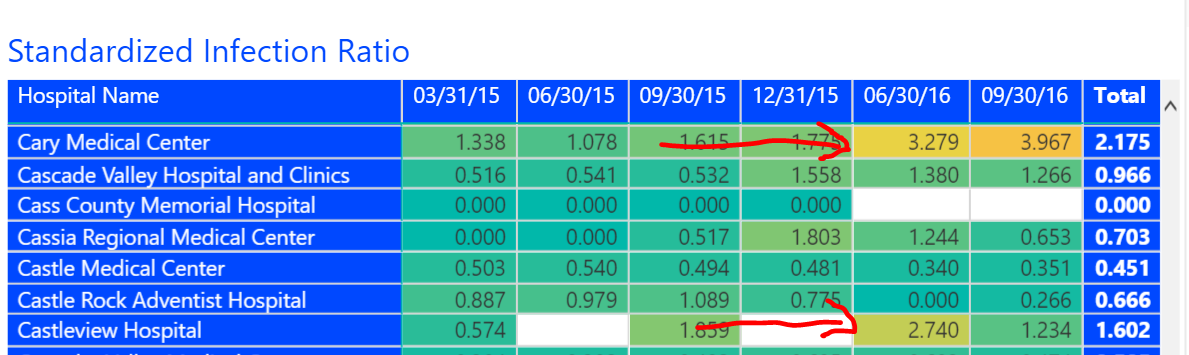
The Hospital Compare data tends to give us all a short-term view. In just the most recent data from September 2016, nearly 15% of hospitals had an increase or a decrease of 30% or more in the infection rate of clostridium difficile (aka C. diff). These variations really pop when looking at the data over many quarters with the Quality Ratings Interactive. For example, it is apparent that Cary Medical Center has a two quarter infection issue whereas Castleview had a high rate just in the June quarter.


While we love winners and losers, what really matters is a long-term sustained view of how facilities perform over time.
 

Share This Story

Similar Posts

  • Room and Board Cost Increases Slowing

    After three straight years of 3-5% increases, room and board annual growth has finally slowed to a more pedestrian 2-3%. In recent years, universities have invested heavily in on-campus facilities and presumably passed these costs to the students at a rate greater than inflation. One administrator once told me that on-campus facilities…

  • Student Financial Aid up 6.2%

    Postsecondary institutions gave over $17 billion in financial aid in 2015. This represented a 3% increase from 2014. However, the number of student receiving the financial aid declined 3% so the average financial aid per student when looked at over the entire postsecondary landscape actually increased 6%. We used data…

  • Is There an Oasis in the New Food Data?

    The recently released updated Food Environment Atlas data by the USDA give us a real glimpse into the progress that we as a nation are making on combating food deserts. The USDA defines food deserts as lack of access to a healthy food retail outlet (a supermarket or large grocery store)…

  • Villanova vs. Michigan in Athletic Costs

    Villanova clearly dominated Michigan on the basketball court and has now won the NCAA Men’s basketball tournament two of the last three years. But how has that success translated to other sports and to the athletic costs in general.    The Equity in Athletics data is released annually by the…

  • Are Outpatient Imaging Quality Measures Effective?

    CMS began developing measures evaluating imaging efficiency back in 2007. These performance measures have been distributed as part of Hospital Compare for the past four years. Lower percentages suggest more efficient use of medical imaging. The purpose of reporting these measures is to reduce unnecessary exposure to contrast materials and/or…