Infection Rates and the Long-Term View

My Cleveland Indians have now won 13 games in a row. That along with their overall record and stellar play over the entire season tells me they are a good team. However, at any given point the Indians or any particular player could play really poorly. The similar challenge with ratings is they can give us a false snapshot at any particular point in time. For example, if we measure infection rates at just a particular period of time, we are prone to come to the wrong conclusions. As an example, this article by Consumer Reports names 19 teaching hospitals with higher than the national average infection rates. It is based on a snapshot at one particular time.


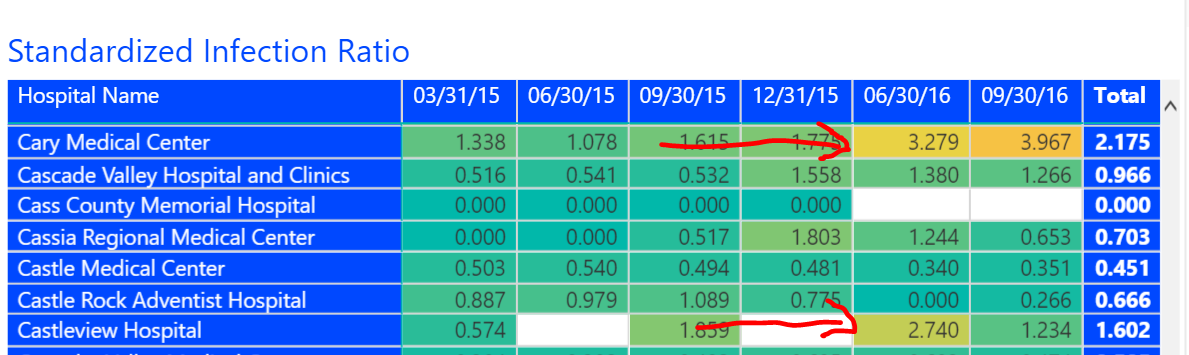
The Hospital Compare data tends to give us all a short-term view. In just the most recent data from September 2016, nearly 15% of hospitals had an increase or a decrease of 30% or more in the infection rate of clostridium difficile (aka C. diff). These variations really pop when looking at the data over many quarters with the Quality Ratings Interactive. For example, it is apparent that Cary Medical Center has a two quarter infection issue whereas Castleview had a high rate just in the June quarter.


While we love winners and losers, what really matters is a long-term sustained view of how facilities perform over time.
 

Share This Story

Similar Posts

  • Violence Against Women Offenses Up 9.5%

    This is the third year that the Campus Safety and Security (CSS) data has released separate violence against women (VAW) offenses. This data captures three types of offenses; domestic violence, dating violence, and stalking and analyzes it for both on campus and off campus locations. Overall, there were 16,183 VAW…

  • Where the Vets Live

    As we approach this Memorial Day Weekend, we pause to remember the sacrifice made on our behalf by our veterans. Nationwide veterans comprise 8% of the population. But there are clusters of populations where veterans comprise much higher percentages of the population. This article from Trulia published in Forbes back…

  • BLS Releases New 10-Year Employment Projections

    Last month, the Bureau of Labor Statistics released its 10-year employment projection data. This data is updated every other year. The new data shows a projected increase over the next decade of 7.4% which is a noticeable increase over the previous 6.5% 10-year projections in 2014. These projections are not…

  • Self-Funded Research Remains the Trend in Higher Education

    Research and development expenditures continued their flat growth since 2011 according to the most recent data from the National Science Foundation Higher Education Research and Development Survey (HERD). Research expenditures increased 1.66% for all reporting institutions from 2013 to 2014 and have increased cumulatively only 4.76% since 2011.  The primary…

  • What do Sierra Vista and Hinesville Have in Common?

    Sierra Vista, AZ and Hinesville, GA probably don’t seem to have much in common. One is in eastern Arizona and the other is in southeast Georgia. They are both very small cities with populations of around 40,000. What they have in common is a market concentration for computer occupations with…