Death Rates Rise Sharply for Millenials

The new CDC mortality data continues to paint a rather grim picture. Last week we focused on the external causes of the rise in death rates. This week we analyzed the mortality (death) rate among age groups using over 1.8 billion data points over 17 years from the CDC. You can now analyze this extensive data yourself with no data knowledge using the new Mortality Rate Interactive.  This Interactive is part of the Community Health subscription.


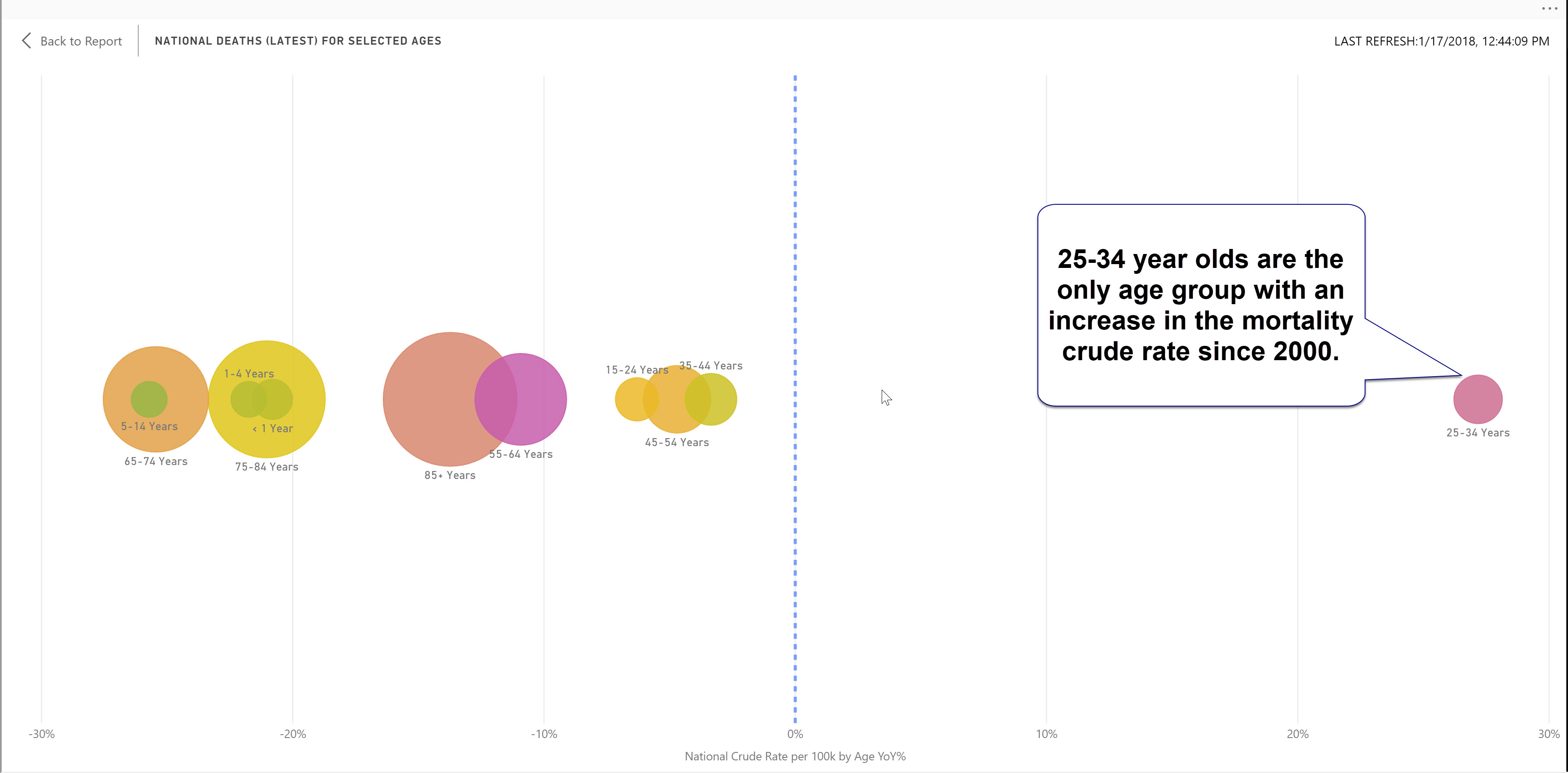
The mortality for every age group has declined from 2000 to 2016. The exception is the 25-34 year olds which is up 27% from 2000. The dot plot graphic below starkly shows this.


The mortality rate has skyrocketed in the past two years among age groups covering ages 15-44. This is a consistent trend that we saw with the external and behavioral causes last week. The counties that have experienced the highest jumps in this age bracket appears to be most concentrated in the MidAtlantic and Northeast. I go into these topics in more depth in the video blog.  


The new CDC mortality data is now available in Public Insight. We have launched an amazing new Interactive based on nearly 2 billion data points and 17 years of mortality data down to the county level. With Interactives, you can explore and analyze this critical data yourself with no data knowledge or experience. We have also created a free Interactive for the specific age related mortality data.
Share This Story

Similar Posts

  • March Madness and the Top Line

    Everyone has caught March Madness fever. The first two rounds of this landmark tournament sparked more double digit seed upsets than any other year. Yet as we sit here for the sweet 16, all of the number one seeds advanced. It is no surprise to anyone either that NCAA basketball…

  • More Students Paying Out-of-State Tuition Rates

    Over 230,000 students pay out-of-state tuition rates compared to approximately 1.5 million students who pay in-state or in-district rates according to the most recent cohort group from IPEDS. This represents 13.09% of the students and continues an upward progression of out-of-state paying students.    The number of students paying out-of-state…

  • Regional Disparities in Health Insurance

    We all know that health insurance is a moving target. According to the most recent ACS survey data, the national uninsurance rate declined from 13.0% to 11.7% in 2016. Public insurance coverages increased slightly more than private coverages (increases of .9% and .6%) respectively. This change was short-lived as Gallup…

  • Top 10 Projected Occupations in 2026

    Healthcare workers dominate the top 10 list for projected job growth. Nine of the top 10 jobs are projected to have greater than 30% growth over the coming 10 years. Using the new Degree-to-Jobs Interactive, we sorted the projections table by projected growth and isolated the top 10 jobs as shown…

  • The States That Send Students Elsewhere

    IPEDS reports residency numbers for first-time undergraduates by state. This data can be challenging to work with from several perspectives. It is not collected every year by every institution and it does not summarize the students coming from out of the state of the institution.     The Enrollment Suite…

  • Is Bureau of Labor Statistics Data Adequate?

    Several weeks ago, the Bureau of Labor Statistics (BLS) released updated Occupational Employment Statistics (OES) survey data. BLS OES is one of those foundational programs and datasets that are used for comprehensive occupational analysis. It produces employment and wage compensation estimates annually for nearly 800 occupations. These estimates are available…