What is the Newly Released Carnegie Data?

The Carnegie Classification™ has been the major institutional framework for describing higher education institutions since 1970. This classification system comes out approximately every five years with the latest rendition released on February 1, 2016. This release represents the initial data provided by the Indiana University Bloomington Center for Postsecondary Research that took over the responsibility from the Carnegie Foundation for the Advancement of Teaching. The Carnegie name and brand were retained.


The Carnegie Classification has six parallel classifications as follows: Basic (the traditional Carnegie Classification framework), Undergraduate and Graduate Instructional Program, Enrollment Profile and Undergraduate Profile, and Size & Setting. These classifications provide different lenses through which to view U.S. colleges and universities, offering researchers greater analytic flexibility. A total of 4,663 institutions are categorized under this system in the 2015 release.


There were a number of changes to the classifications in 2015. Most notable is the introduction of new Associates Colleges categories, which are broken down based on program and student mix. Additional two-year institutions referred to as “special-focus” are placed in separate categories, parallel to how four-year special-focus institutions are designated. These institutions typically have concentrations in specific specialty areas such as health fields.


In addition to the classifications, a number of additional metrics are provided. For example, ACT and SAT statistics are provided which were used in the construction of the classifications. By clicking HERE, you can download a spreadsheet that provides a detailed list of 4,663 U.S. institutions across the six seperate Carnegie Classifications. You can also browse through the various 2015 classifications and additional data in Public Insight.
Share This Story

Similar Posts

  • CDC Publishes 2016 Natality (Births) Data

    The CDC recently released updated Natality (Births) data for 2016. State laws require birth certificates to be completed for all births, and Federal law mandates national collection and publication of births and other vital statistics data. The National Vital Statistics System provides access to statistical information from birth certificates and CDC makes…

  • Distance Education Rebounds

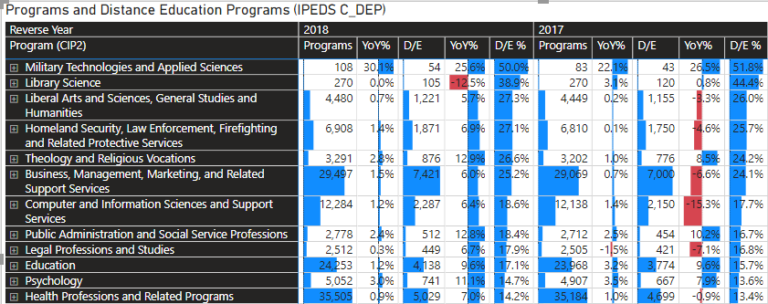
    Distance Education is now 12.3% of all programs and up 7.6% in 2018 Social distancing, at least for now, is the new normal and along with it comes distance education. Each year we look at what the data is telling us for distance education programs. Last year, I suggested that…

  • 12 College Programs with 100+% Growth

    Johnny Nash wrote an award winning song in 1972 called “I Can See Clearly Now”. It was one of those one-hit wonders that still is around today. Johnny would be proud to learn that the field of Vision Science and Physiological Optics topped our findings for emerging program growth with…

  • Inpatient vs. Outpatient – What the Numbers Show

    Analysts in health care don’t agree in unanimity very often, but most seem to agree that there will continue to be a quantum shift in healthcare from inpatient to outpatient. In this two part series, we will attempt to quantify and support this important trend. We utilized the Beds and…

  • The 13 College Scorecard Title IV Outcomes

    Where Students Go Based on the Latest College Scorecard Data In our last post, we provided some insight into the IPEDS Outcome Measures data. The IPEDS Outcome Measures data was designed as a supplement to graduation rate data which has always been questioned as an effective measure for measuring student…

  • Where the Vets Live

    As we approach this Memorial Day Weekend, we pause to remember the sacrifice made on our behalf by our veterans. Nationwide veterans comprise 8% of the population. But there are clusters of populations where veterans comprise much higher percentages of the population. This article from Trulia published in Forbes back…