The Profile of the Five-Star CMS Hospital (First in a Series)

It is hard to believe but it has been about one year since the Centers for Medicare & Medicaid Services released its initial hospital rating system. At that time 102 hospitals earned the coveted five-star rating. The most recent ratings show 188 hospitals with the five-star rating out of roughly 3,500 hospitals. The rating system is still evolving and has received criticism across a number of fronts as penalizing urban hospitals.


We ran the numbers to see what the profile of the 188 five-star hospitals are. Using the Hospital Consumer Assessment (HCAHPS) Interactive blended with general survey data from the AHA Annual Survey Databaseâ„¢, we were able to get a picture of what the five-star hospitals look like and where they are located. We constructed a ratio of five-star hospitals over all hospitals for various classifications.


Five-Star Hospitals are Small

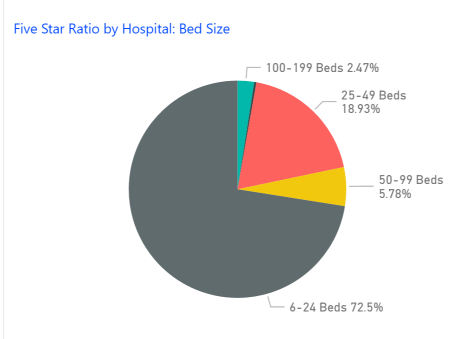
Of the 188 five-star hospitals, 144 of them are in hospitals with less than 50 beds. On the contrary, not a single hospital with more than 300 beds had a five-star rating. The following pie graph shows this discrepancy very starkly.


Five-Star Hospitals are Capitalistic

The 188 hospitals includes 26 that are owned by physicians which is 58% of all physician owned hospitals as noted in the table below. The list includes 38 hospitals that are private partnerships or 24% of all hospital partnerships. The worse five-star ratios? Non-profits which have less than 4% that are five-star hospitals.



Share This Story

Similar Posts

  • The Gender Debt Disparity

    The Huffington Post recently posted a very interesting article on gender debt disparity. The article notes that women hold nearly two-thirds of all student debt – a whopping $833 billion dollars. The article postulates that women also take longer to pay off the debt because they earn less than men….

  • The 13 College Scorecard Title IV Outcomes

    Where Students Go Based on the Latest College Scorecard Data In our last post, we provided some insight into the IPEDS Outcome Measures data. The IPEDS Outcome Measures data was designed as a supplement to graduation rate data which has always been questioned as an effective measure for measuring student…

  • Degrees, Jobs, and Crosswalks

    My daughter has a Bachelor’s Degree in Fine Arts with a concentration in Cartooning and Illustration. Today, she is a quality assurance manager for a software company. I am very glad that her career has morphed into a burgeoning field because it was very clear to me that it would…

  • College Building Boom Approaches $1 Trillion

    Postsecondary institutions continue to invest heavily in capital assets and the cumulative investment across public and private institutions has crossed $900 billion, an increase of 27% over a five-year period. The capital investment growth rates are almost identical for both public institutions and private non-profit institutions as noted in the…

  • Top Ten States with Growing Tuition Costs

    Nell Gluckman of The Chronicle of Higher Education wrote an interesting piece about the challenges of public cutbacks in the state of Louisiana. The premise of the article is that there are trickle-down implications of state cutbacks in tuition, faculty morale, and curriculum. Louisiana has passed along substantial tuition increases to its…