Have Student Debt Repayment Rates Bottomed?

Student repayment rates continues to decline, although the trend seems to be slowing, according to the most recent College Scorecard data. This data measures repayment rates at 1,3,5, and 7 years. Repayment rates and default rates are very different. Repayment rates are the percentage of students who have made progress in paying them down (i.e. have paid down at least $1 in the initial balance of their loans) after entering repayment. Default rates measure the worst-case scenario for repayment outcomes and can be manipulated through deferments and forbearances. 


To create this composite picture, we took the average repayment rate by institution and multiplied it by the number of students being measured to come up with an institutional average and then aggregated the data by year. 


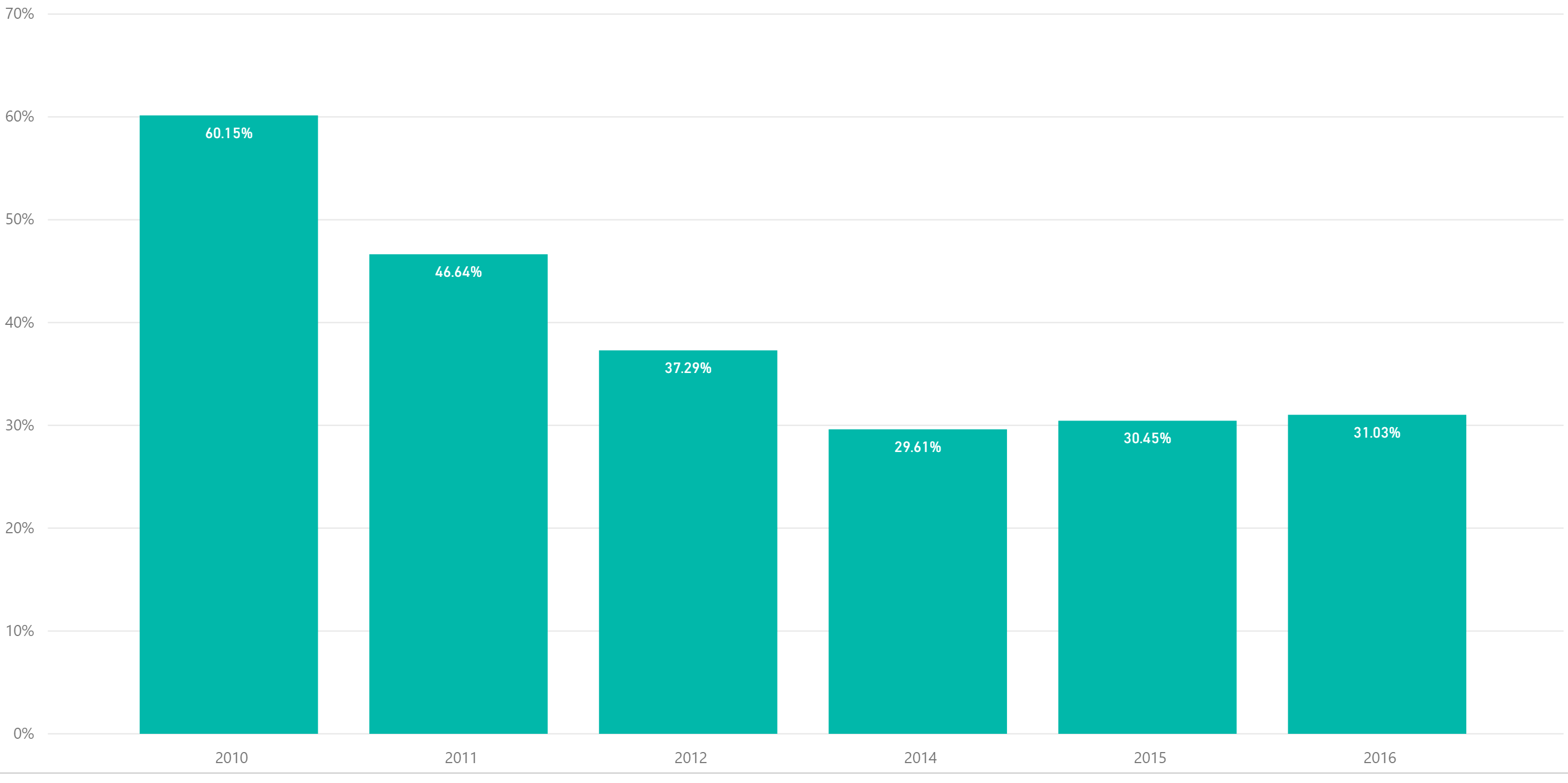
Three-Year Repayment Rates


 Five-Year Repayment Rates

Seven-Year Repayment Rates

The One-Year Repayment Rates were not updated and the last year we have is 2014. The Three-Year Repayment Rate has rebounded from 30.45% to 31.03% in 2016. The Five-Year Repayment Rate has declined from 38.55% to 36.42% and the Seven-Year Repayment Rate has declined from 53.23% to 46.28%. The trending graphs are shown below. Obviously the time horizon is the key. Those entering into repayment during the Great Recession continue to struggle to repay their debts whereas those entering into debt outside of the Great Recession seem to be doing better. On the other hand, we may be so accustomed to poor performance that we still accept that two out of three students do not pay their student debts down when they are due, even five years into the repayment cycle.
 

Share This Story

Similar Posts

  • Death Rate Continues to Inch Up

    The mortality (or death) rate increased nominally from 2016 to 2017 going from 844 to 849 deaths per 100,000. This probably is not earthshaking news but based on the overall crude rate, it has actually been increasing since 2009 as noted by the following graph.   Advances in medical care…

  • Tuition Bears Increasing Brunt of Higher Ed. Revenue

    In 2011, Tuition and Fees represented 20.6% of public institutional revenue. In 2015, it has increased to 24.25%. Most of the reshuffling of revenue has come from federal operating grants and contracts as noted by the graphs below. Interestingly, state appropriations have remained relatively constant. Similarly, non-profit institutions have seen tuition…

  • A Look at the New Education Outcome Measures Data

    The new IPEDS Outcome Measures (OM) survey is the first stab at going outside of the traditional first-time, full-time reporting. We took a birds-eye view of this data across the landscape of reporting institutions using a new Graduation Rates Interactive.  A total of 3,838 institutions reported data under the OM…

  • The Top Graduation Rate Institutions

    The character Bluto in the movie Animal House was famous for saying “Seven years of college down the drain”. This was on the heels of Dean Wormer’s pronouncement of his stellar grade point of 0.0. Given this performance, Bluto would not have graduated anyway. Thus, he would not have fallen…

  • More Students Paying Out-of-State Tuition Rates

    Over 230,000 students pay out-of-state tuition rates compared to approximately 1.5 million students who pay in-state or in-district rates according to the most recent cohort group from IPEDS. This represents 13.09% of the students and continues an upward progression of out-of-state paying students.    The number of students paying out-of-state…

  • Endowments per Student Down in 2016

    How financially fit is your institution? One of the measures that Forbes has used in assessing the financial fitness of postsecondary institutions is endowment assets per FTE. This metric takes the value of endowment assets at the end of the year and divides it by the number of FTE’s. In…