What is the Newly Released Carnegie Data?

The Carnegie Classification™ has been the major institutional framework for describing higher education institutions since 1970. This classification system comes out approximately every five years with the latest rendition released on February 1, 2016. This release represents the initial data provided by the Indiana University Bloomington Center for Postsecondary Research that took over the responsibility from the Carnegie Foundation for the Advancement of Teaching. The Carnegie name and brand were retained.


The Carnegie Classification has six parallel classifications as follows: Basic (the traditional Carnegie Classification framework), Undergraduate and Graduate Instructional Program, Enrollment Profile and Undergraduate Profile, and Size & Setting. These classifications provide different lenses through which to view U.S. colleges and universities, offering researchers greater analytic flexibility. A total of 4,663 institutions are categorized under this system in the 2015 release.


There were a number of changes to the classifications in 2015. Most notable is the introduction of new Associates Colleges categories, which are broken down based on program and student mix. Additional two-year institutions referred to as “special-focus” are placed in separate categories, parallel to how four-year special-focus institutions are designated. These institutions typically have concentrations in specific specialty areas such as health fields.


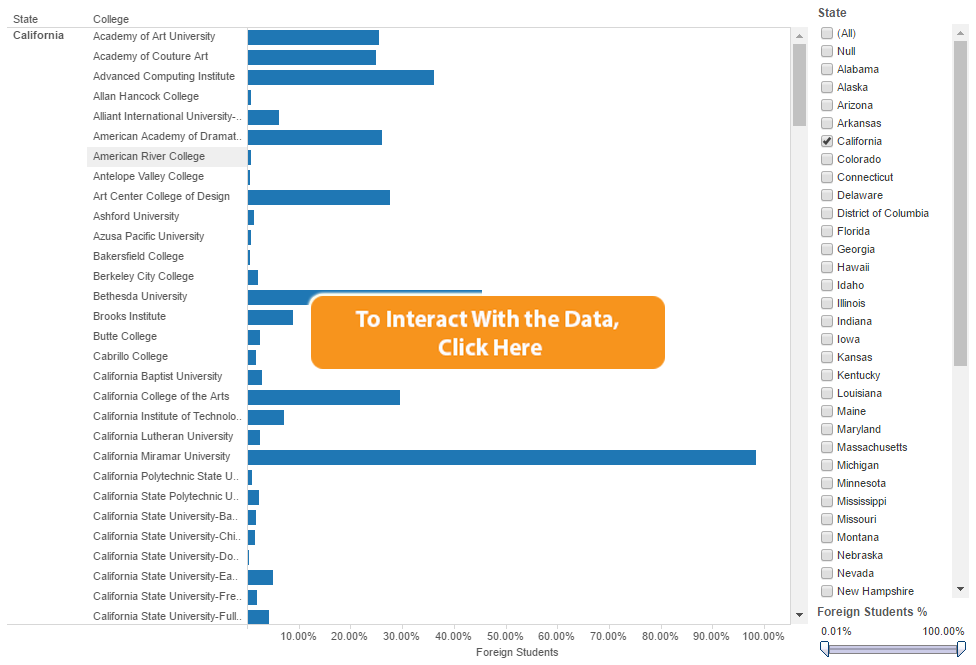
In addition to the classifications, a number of additional metrics are provided. For example, ACT and SAT statistics are provided which were used in the construction of the classifications. By clicking HERE, you can download a spreadsheet that provides a detailed list of 4,663 U.S. institutions across the six seperate Carnegie Classifications. You can also browse through the various 2015 classifications and additional data in Public Insight.
Share This Story

Similar Posts

  • Top 10 Projected Occupations in 2026

    Healthcare workers dominate the top 10 list for projected job growth. Nine of the top 10 jobs are projected to have greater than 30% growth over the coming 10 years. Using the new Degree-to-Jobs Interactive, we sorted the projections table by projected growth and isolated the top 10 jobs as shown…

  • Has Distance Education Hit Its Peak?

    Programs offered through distance education or what we might conventionally refer to as online programs actually declined as a percentage of all programs from 10.8% to 10.5% in 2017 and 2016 respectively. This was the first time that distance education has actually declined since this data started being collected by…

  • Student Financial Aid up 6.2%

    Postsecondary institutions gave over $17 billion in financial aid in 2015. This represented a 3% increase from 2014. However, the number of student receiving the financial aid declined 3% so the average financial aid per student when looked at over the entire postsecondary landscape actually increased 6%. We used data…

  • Where the Vets Live

    As we approach this Memorial Day Weekend, we pause to remember the sacrifice made on our behalf by our veterans. Nationwide veterans comprise 8% of the population. But there are clusters of populations where veterans comprise much higher percentages of the population. This article from Trulia published in Forbes back…

  • EVICTED – The Impact of Housing Affordability

    I was in the Bay Area this week for a health technology conference at Stanford University. I took Lyft back and forth from where I was staying. While conversing with one driver in my rudimentary Spanish, I found out that his family was spending $3,000 a month for a two…

  • Regional Disparities in Health Insurance

    We all know that health insurance is a moving target. According to the most recent ACS survey data, the national uninsurance rate declined from 13.0% to 11.7% in 2016. Public insurance coverages increased slightly more than private coverages (increases of .9% and .6%) respectively. This change was short-lived as Gallup…