Nursing Home Coverage of the Elderly

While long-term care services more than the elderly, approximately 63% of residents are 65 or older. According to the Administration on Aging, population 65 years or older will increase from 14.1% of the population to 21.7% of the population by 2040. As the population ages over the course of the next 24 years, additional long-term facilities will need to meet the demand. Yet residents in nursing homes have been flat for the past year. Further, coverage of the 65 and over age demographic ranges widely across the country.


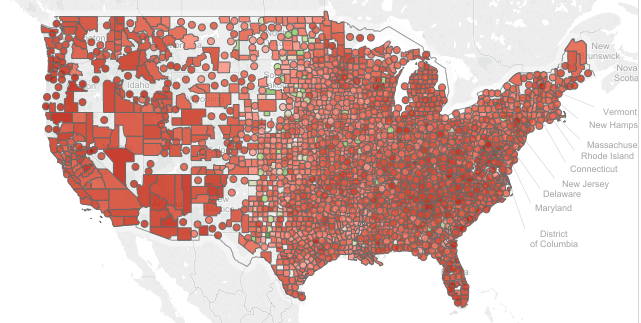
We constructed a ratio of residents in nursing homes to county populations 65 and over from the American Community Survey. Results range from .2% to 18.7% of the population. Geographic concentrations of high coverage are in the Midwest with low coverage in the west coast and Florida. The Tableau visualization shows visually the concentration. Counties highlighted in green have high coverage while those in red show lower coverage. You can use the slider to reveal counties within a range of coverage values. To interact with the Tableau visualization and the data, click HERE.


Share This Story

Similar Posts

  • Infection Procedures Top Inpatient Volume Growth

    While Medicare inpatient procedure volume has remained flat since 2013, infections are a significant area of high volume change. The treemap below from the Inpatient Procedure Analysis Interactive shows the inpatient volume growth by procedure with color coding by volume change from 2013-2015 using the Medicare Provider and Analysis Review…

  • Private Room Average Hospital Stays up 10%

    While average length of stay has experienced a long-term decline, one component of average stay seems to be increasing – private rooms. The average stay in a private room increased nearly 10% based on an analysis of the 2016 Medicare Provider Analysis and Review (MedPAR) data set.    Even more…

  • Distance Education Programs up 8.2%

    Distance Education continues its upward climb according to the most recent distance education data from IPEDS. The number of programs increased 8.2% in 2016, but this increase was less than the whopping 12.6% in 2015. There are now over 29,000 programs offered through distance education. Certificate programs continued their strong…

  • Has Distance Education Hit Its Peak?

    Programs offered through distance education or what we might conventionally refer to as online programs actually declined as a percentage of all programs from 10.8% to 10.5% in 2017 and 2016 respectively. This was the first time that distance education has actually declined since this data started being collected by…

  • Healthcare Rankings and the Healthiest Cities

    We in the U.S. love our rankings. I think it is embedded in our DNA. As a student of data, I love to see the various rankings and how people get worked up over them. Healthgrades recently released its latest analysis of top quality hospitals and its National Health Index, which…