Nursing, Computer Science Among Top Growth Program Areas in 2015

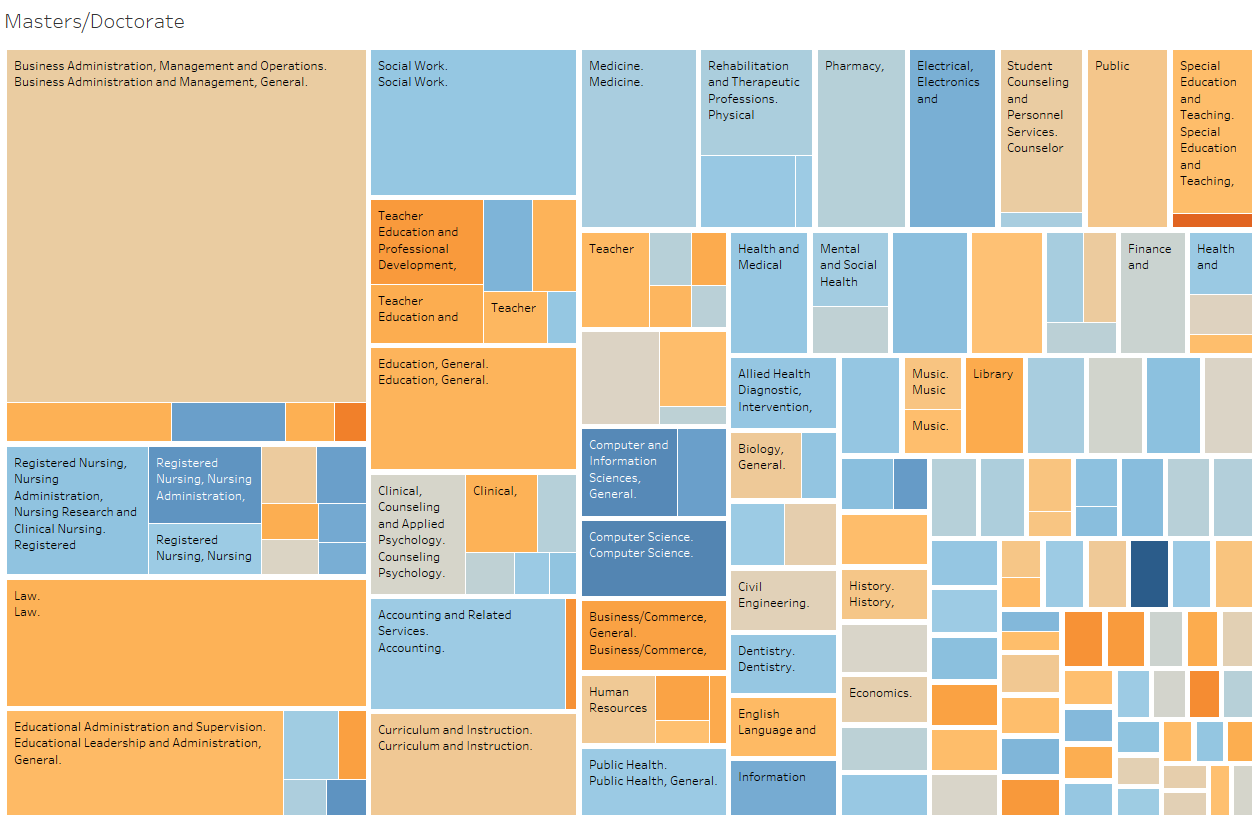
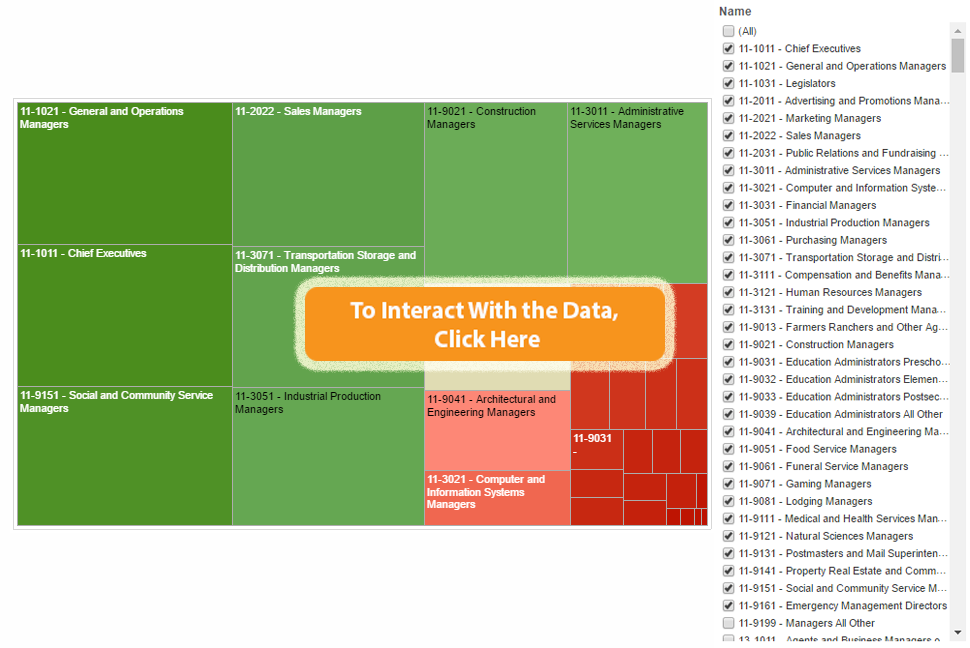
Nursing programs at a bachelor and master’s level continue to grow at a fast pace according to the most recent awards data from the Integrated Postsecondary Education Data System (IPEDS). Bachelor’s and Master’s level (see tree map left side blue growth area below) degrees for Registered Nurses (and related fields) both went up nearly 10% from 2014 to 2015. Employment projections for Registered Nurses is projected to increase 16% from 2014 to 2024 according to the most recent projections data from the Bureau of Labor Statistics. Skilled nursing is a train that has left the station and more and more medical diagnostic work will be pushed “downward” to nurses. I say that with some level of bias as my wife is a nurse. Interestingly, you just went to the CVS Minute Clinic this morning where a nurse practitioner diagnosed her with pneumonia and wrote a prescription for her care. Interestingly, Associate’s level degrees in nursing related programs actually declined 3.4% in 2015 perhaps reflective of the skill level needed.

 We looked at over 1,000 individual programs and screened out for only those that had a minimum of 1,000 degrees awarded in 2015. You can look at the programs yourself using the free Interactive.  At an Associate’s level, specific skilled programs such as culinary arts as a group went up 10%. What fascinated me however was a 31% increase in speech rhetoric and communication which is offered by 219 institutions. Finally, at a bachelor’s level, computer science was a clear winner with growth as well as health related professions. Criminal justice areas continue to show strong growth.


The Degree-to-Jobs Interactive provides program analysis as well as a look at the connected labor data from the BLS Employment Projections and Occupational Employment Statistics.
Share This Story

Similar Posts

  • Degrees, Jobs, and Crosswalks

    My daughter has a Bachelor’s Degree in Fine Arts with a concentration in Cartooning and Illustration. Today, she is a quality assurance manager for a software company. I am very glad that her career has morphed into a burgeoning field because it was very clear to me that it would…

  • Hot Educational Programs in 2018

    Econometrics Programs Show Nearly Triple Digit Growth I am delighted to return to the blogosphere community. It has been a few months since we have published a blog, but not for a lack of work going on behind the scenes here at Public Insight. You will notice that our blog…

  • Nursing Home Deficiencies by State

    When nursing home incidents occur, they receive big news. Just this week, a Pinellas Park, Florida nursing care center resident died after appearing to have been left outside in the sun. The nursing home had been cited for various deficiencies and had received a one-star rating. In fact, the nursing…

  • A Look at the New Education Outcome Measures Data

    The new IPEDS Outcome Measures (OM) survey is the first stab at going outside of the traditional first-time, full-time reporting. We took a birds-eye view of this data across the landscape of reporting institutions using a new Graduation Rates Interactive.  A total of 3,838 institutions reported data under the OM…

  • Tuition Bears Increasing Brunt of Higher Ed. Revenue

    In 2011, Tuition and Fees represented 20.6% of public institutional revenue. In 2015, it has increased to 24.25%. Most of the reshuffling of revenue has come from federal operating grants and contracts as noted by the graphs below. Interestingly, state appropriations have remained relatively constant. Similarly, non-profit institutions have seen tuition…

  • The States That Send Students Elsewhere

    IPEDS reports residency numbers for first-time undergraduates by state. This data can be challenging to work with from several perspectives. It is not collected every year by every institution and it does not summarize the students coming from out of the state of the institution.     The Enrollment Suite…