New Violence Against Women Data on Campuses

A slug of new data has recently been released covering campus statistics on violence against women. This data was mandated by the Violence Against Women Reauthorization Act of 2013 (VAWA) and is added to numerous other statistics required under the Campus Crime Statistics Act, or Clery Act. College institutions must now compile statistics for incidents of domestic violence, dating violence, sexual assault, and stalking and to include certain policies, procedures, and programs pertaining to these incidents in their annual security reports.


Domestic violence is the willful intimidation, physical assault, battery, sexual assault, and/or other abusive behavior as part of a systematic pattern of power and control perpetrated by one intimate partner against another. It includes physical violence, sexual violence, psychological violence, and emotional abuse. Dating violence is violence committed by a person who is or has been in a social relationship of a romantic or intimate nature with the victim is dating violence. Stalking is a course of conduct directed at a specific person that would cause a reasonable person to feel fear.


A total of 2,029 colleges reported 12,171 total offenses under these specific definitions including 3,992 acts of domestic violence, 3,570 acts of dating violence, and 4,609 acts of stalking. The data must be further reported by the location of the offense. When marrying the total offenses under the VAWA to the female enrollment, we find that an average of 140.6 offenses occurred per 100,000 female students.  You can view any of the campus safety data by institution for free in Public Insight. 


You can download a spreadsheet of all U.S. institutions and the reported number of offenses by category by clicking on this link. I have also shown the female enrollment and the calculated offenses per 100,000 female students. Finally, I have reported some summary data based on Institutional Affiliation and Size and Setting Classification.

Share This Story

Similar Posts

  • The Race for Nurses

    There is a race that is brewing between millenials who are becoming registered nurses and the hiring that has started at U.S. hospitals. A Health Affairs study concluded that Millennials are becoming registered nurses at nearly twice the rate of baby boomers, but that still won’t necessarily prevent a nursing shortage…

  • Top 10 Projected Occupations in 2026

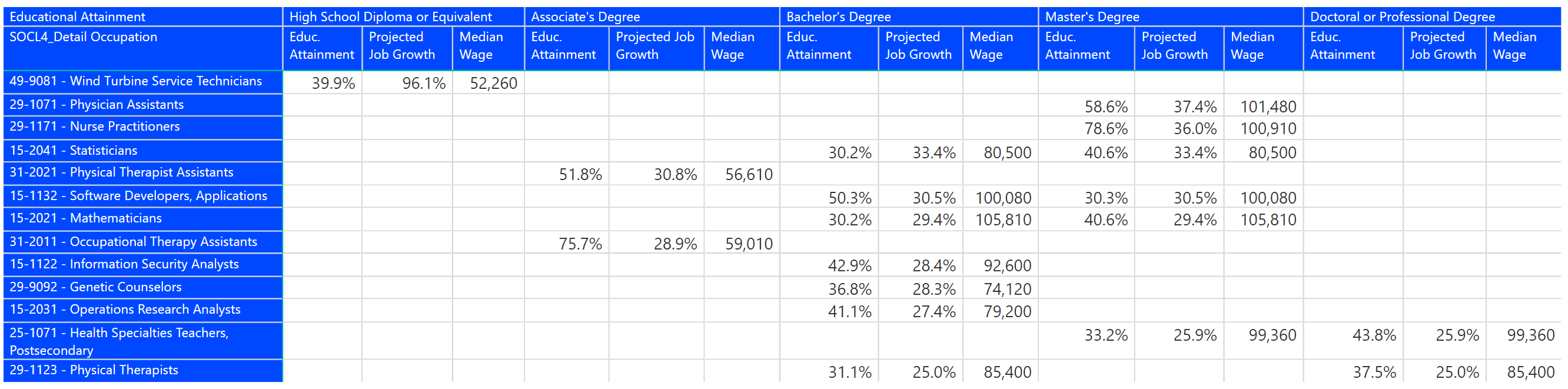
    Healthcare workers dominate the top 10 list for projected job growth. Nine of the top 10 jobs are projected to have greater than 30% growth over the coming 10 years. Using the new Degree-to-Jobs Interactive, we sorted the projections table by projected growth and isolated the top 10 jobs as shown…

  • What do Sierra Vista and Hinesville Have in Common?

    Sierra Vista, AZ and Hinesville, GA probably don’t seem to have much in common. One is in eastern Arizona and the other is in southeast Georgia. They are both very small cities with populations of around 40,000. What they have in common is a market concentration for computer occupations with…

  • Nursing Home Deficiencies by State

    When nursing home incidents occur, they receive big news. Just this week, a Pinellas Park, Florida nursing care center resident died after appearing to have been left outside in the sun. The nursing home had been cited for various deficiencies and had received a one-star rating. In fact, the nursing…

  • Black Disparities in Premature Death

    County Health Rankings has always used Premature Death as a measure in deriving its ranking formula. Years of Potential Life Lost Before Age 75 (or YPLL) counts as 50% of the Health Outcomes score. Every death occurring before the age of 75 contributes to the total number of years of potential…

  • On Faculty Compensation and Gender Disparity

    It will take many years for the faculty gender pay gap to close at the current rate of change. From 2014 to 2015, women received around half a percent higher pay increase from men over the various institutional sectors. There is still a 16% and 14% gender pay gap for full professors…