Hospital Staff Vacancies Support Healthcare Hiring Bonanza

Despite an overall tepid rebound of jobs, the outlook for jobs in the healthcare field is expected to continue to be strong. According to the US Bureau of Labor Statistics, healthcare will generate 3.2 million new wage and salary jobs between 2008 and 2018, more than any other industry. Over the 2008-18 period, total employment of home health aides is projected to increase by 50 percent, medical assistants by 34 percent, physical therapist assistants by 33 percent, and physician assistants by 39 percent. Within the inpatient world, Registered Nursing (RN) is listed among the top occupations in terms of job growth through 2022. The RN workforce is expected to grow from 2.71 million in 2012 to 3.24 million in 2022, an increase of 526,800 or 19%. The Bureau also projects the need for 525,000 replacements nurses in the workforce bringing the total number of job openings for nurses due to growth and replacements to 1.05 million by 2022.


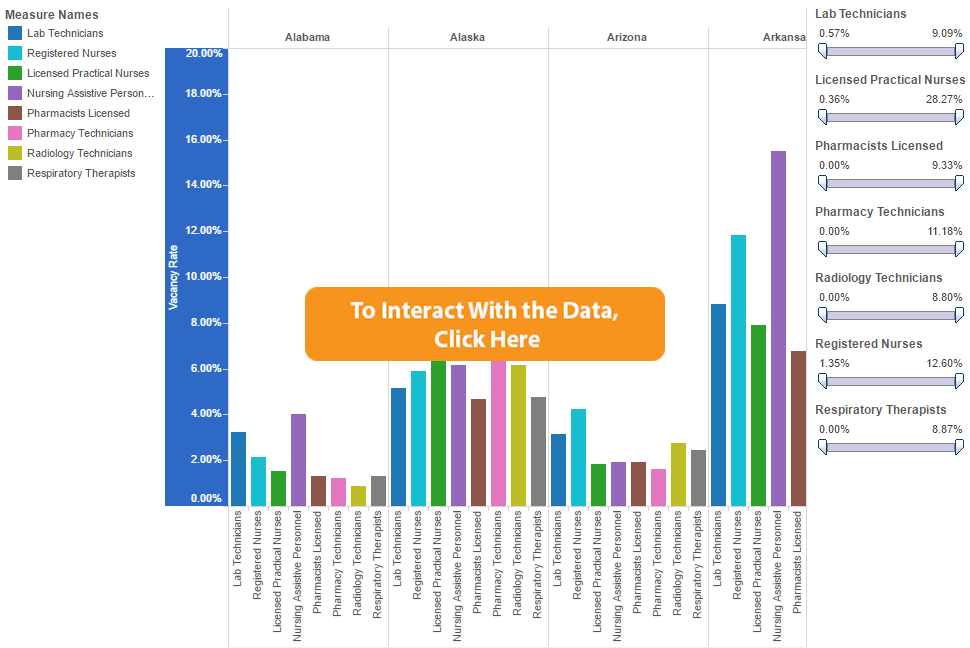
Staffing vacancy data from America’s hospitals seem to support the projections. The American Hospital Association® Annual Survey captures staffing vacancies by type of position as well as current FTE staff. We related the vacancies to the current staffing levels to arrive at a vacancy rate. We extracted the data by state using Public Insight Omniview and calculated the vacancy rate by position for each state. Vacancy rates range widely by state by position. For example, hospitals in the state of Connecticut show a summary vacancy rate for Licensed Practical Nurses of over 28%. The same state shows a vacancy rate of just over 6% for registered nurses. You can analyze the vacancy rate by state using the Tableau Public visualization we’ve created. You can zoom in on a particular state vacancy rate by using the sliders. To interact with the Tableau visualization and the data, click HERE.


Share This Story

Similar Posts

  • CMS Introduces New Hospital Returns Measure

    The most recent batch of Hospital Compare data has expanded the whole area of readmissions, returns, and deaths. There are now separate measures for mortality rates, readmissions, and hospital returns. The hospital returns measure is brand new, with the most recent data through June 2016, and applies to heart attack…

  • Students Moving Back on Campus

    The number of students living on-campus for the approximately 4,500 non-state institutions has increased from just over 43% in 2011 to nearly 53% just four years later in 2015. The pie graph below shows the movement from 2011 to 2015 with the yellow slice indicating the percentage of students living…

  • Is the Federal Work Study Program Working?

    Over 4,000 institutions participate in the Federal Work Study Program. This program provides funds for part-time employment to help needy students finance the costs of postsecondary education. For the fiscal year ending June, 2016, $1.16 billion was paid to students under this program. This was roughly the same as the…

  • The States That Send Students Elsewhere

    IPEDS reports residency numbers for first-time undergraduates by state. This data can be challenging to work with from several perspectives. It is not collected every year by every institution and it does not summarize the students coming from out of the state of the institution.     The Enrollment Suite…

  • Regional Disparities in Health Insurance

    We all know that health insurance is a moving target. According to the most recent ACS survey data, the national uninsurance rate declined from 13.0% to 11.7% in 2016. Public insurance coverages increased slightly more than private coverages (increases of .9% and .6%) respectively. This change was short-lived as Gallup…

  • Private Room Average Hospital Stays up 10%

    While average length of stay has experienced a long-term decline, one component of average stay seems to be increasing – private rooms. The average stay in a private room increased nearly 10% based on an analysis of the 2016 Medicare Provider Analysis and Review (MedPAR) data set.    Even more…