Has Distance Education Hit Its Peak?

Programs offered through distance education or what we might conventionally refer to as online programs actually declined as a percentage of all programs from 10.8% to 10.5% in 2017 and 2016 respectively. This was the first time that distance education has actually declined since this data started being collected by IPEDS in 2013. Further, the number of programs being offered by institution and 6 digit CIP combination declined from 21,748 to 21,339. Not much of a decline, but a decline nevertheless.


It appears that the original lure of distance education seems to have worn off somewhat and whatever works, works well. Whatever is not working is being phased out. Business Management continues to have the highest absolute number of distance education programs, but it is not the highest percentage of programs. The highest percentage of programs offered through distance education is in Organizational Leadership and Educational/Instructional Technology at over 34%. Nursing Administration and Health Care Administration are also high concentrations of distance education at around 31%.


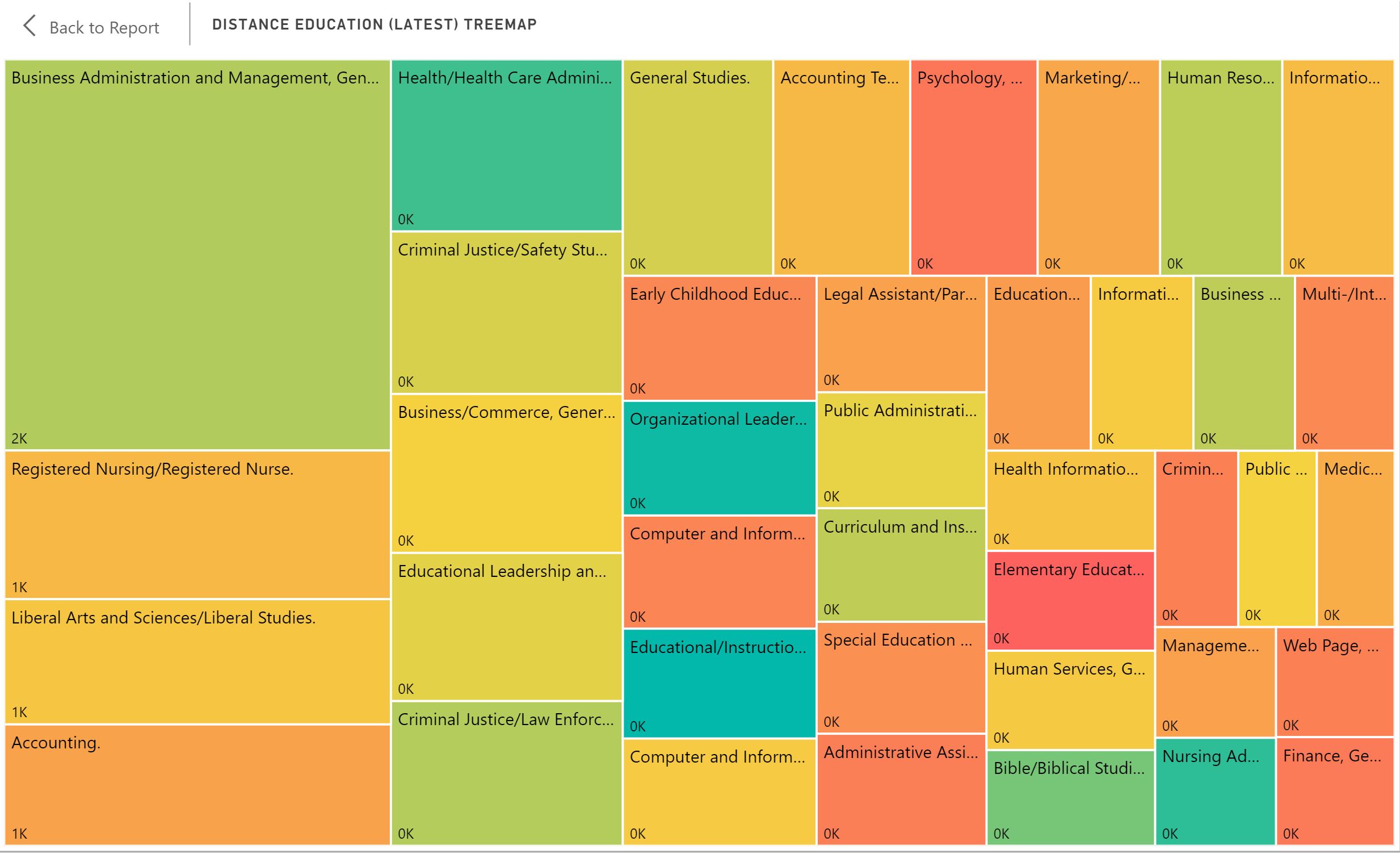
The treemap below shows the distribution of the largest distance education programs (screened for minimum of 150 programs). The size is the raw number of programs while the color is the percentage offered through distance education (blue being highest and red being lowest on diverging scale). 


Share This Story

Similar Posts

  • Death Rates Rise Sharply for Millenials

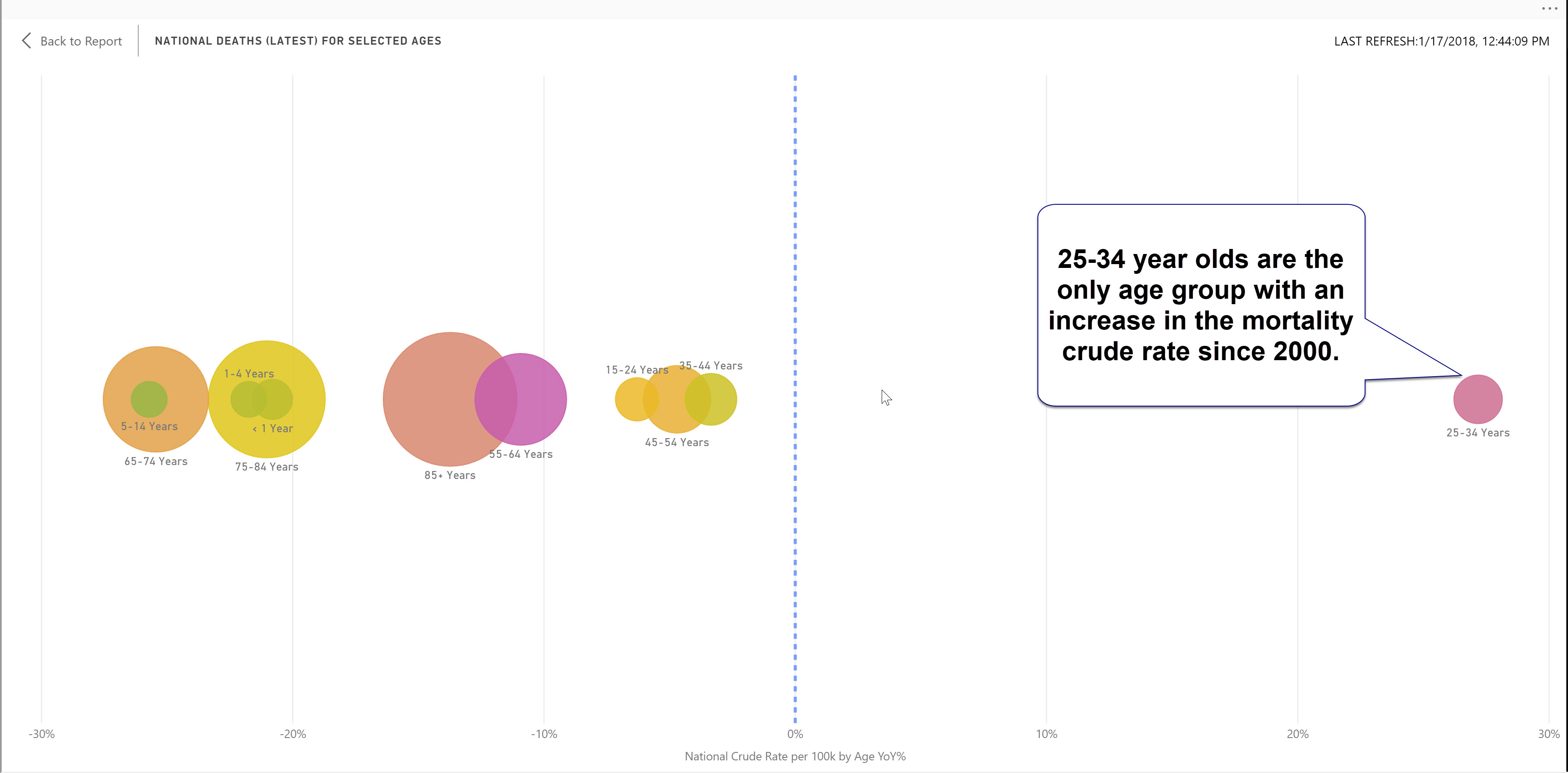
    The new CDC mortality data continues to paint a rather grim picture. Last week we focused on the external causes of the rise in death rates. This week we analyzed the mortality (death) rate among age groups using over 1.8 billion data points over 17 years from the CDC. You…

  • Self-Funded Research Remains the Trend in Higher Education

    Research and development expenditures continued their flat growth since 2011 according to the most recent data from the National Science Foundation Higher Education Research and Development Survey (HERD). Research expenditures increased 1.66% for all reporting institutions from 2013 to 2014 and have increased cumulatively only 4.76% since 2011.  The primary…

  • Nursing Home Coverage of the Elderly

    While long-term care services more than the elderly, approximately 63% of residents are 65 or older. According to the Administration on Aging, population 65 years or older will increase from 14.1% of the population to 21.7% of the population by 2040. As the population ages over the course of the…

  • What do Sierra Vista and Hinesville Have in Common?

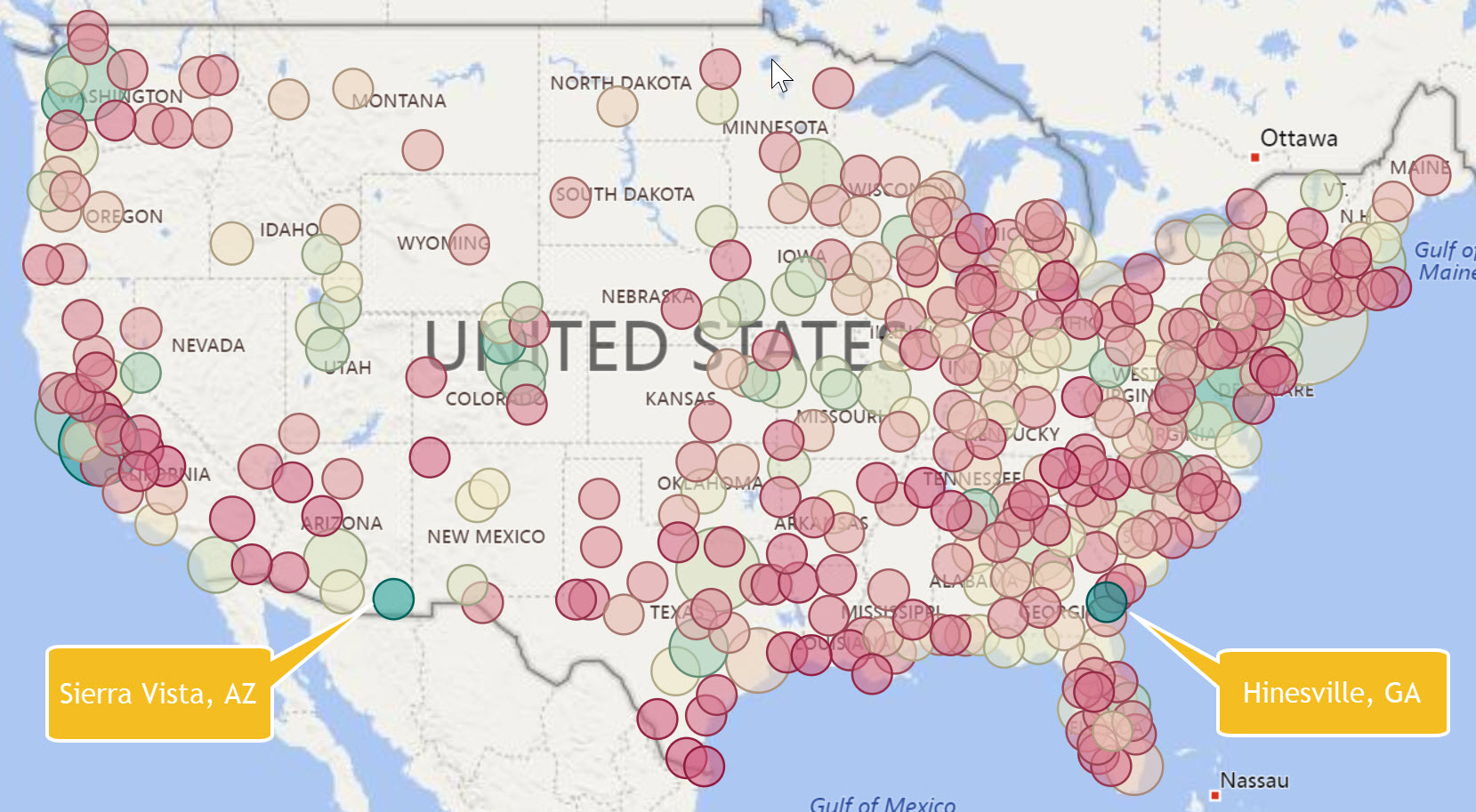
    Sierra Vista, AZ and Hinesville, GA probably don’t seem to have much in common. One is in eastern Arizona and the other is in southeast Georgia. They are both very small cities with populations of around 40,000. What they have in common is a market concentration for computer occupations with…

  • Hot Educational Programs in 2018

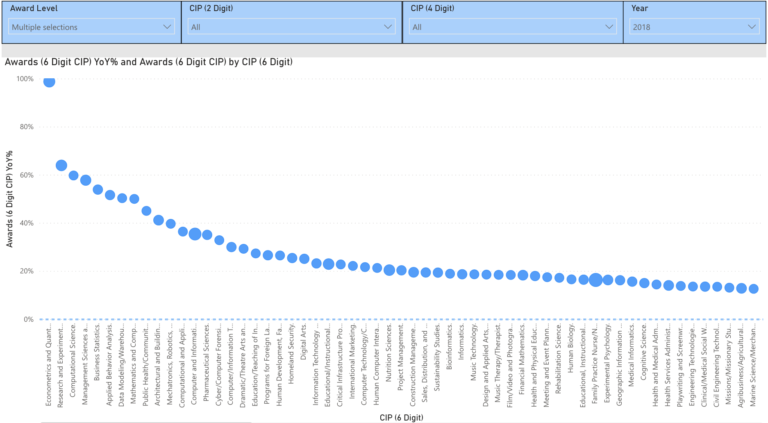
    Econometrics Programs Show Nearly Triple Digit Growth I am delighted to return to the blogosphere community. It has been a few months since we have published a blog, but not for a lack of work going on behind the scenes here at Public Insight. You will notice that our blog…