Distance Learning Growth Continues

In one of my favorite videos of my kid’s era, Grover from Sesame Street taught us the difference between near and far. I don’t think Grover had in mind today’s high tech tools and social media interaction when he taught us this principle. Distance Education continues to be a hot trend among college offerings (can’t say campus anymore).


The technology of today continues to enable more online experiences. Distance learning provides the ultimate in flexibility and enables programs to be not only conducted virtually, but introduced nationally and globally. Of course the cons of Distance Education have to do with the personal face-to-face communication and interaction that comes from a campus environment.


The Integrated Postsecondary Education and Data System (IPEDS) has been collecting statistics on Distance Education since 2012. IPEDS breaks down Distance Education into two primary buckets; those that are enrolled exclusively in Distance Education courses and those that are enrolled in some, but not exclusively Distance Education courses. IPEDS further breaks down the exclusive category into the location of the student.


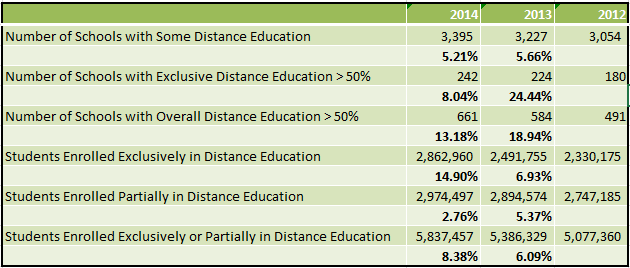
We analyzed the data for the most recent year and compared it to the two previous years. Overall, the number of students enrolled in some form of Distance Education has increased 8.38% but the number of students enrolled exclusively in Distance Education has increased a whopping 14.90%. The number of schools offering Distance Education has increased 5.21% in 2014, which was a similar increase to 2013. However, the number of schools with extensive forms of Distance Education (measured in our statistics as greater than 50%) has increased 13.18% in 2014.  Summary results are displayed below.


By clicking here, you can download a spreadsheet of all institutions that reported Distance Education results and their trends over the past three years along with calculated percentages of overall enrollment.

Share This Story

Similar Posts

  • Hot Jobs, Growing Wages, and Weird Titles

    I love looking at the Bureau of Labor Statistics Occupational Employment Statistics data. This data produces employment and wage estimates annually for over 800 occupations and estimates for states and metropolitan areas. I especially enjoy looking at this data from both a job growth and a wage growth perspective. That…

  • Self-Funded Research Remains the Trend in Higher Education

    Research and development expenditures continued their flat growth since 2011 according to the most recent data from the National Science Foundation Higher Education Research and Development Survey (HERD). Research expenditures increased 1.66% for all reporting institutions from 2013 to 2014 and have increased cumulatively only 4.76% since 2011.  The primary…

  • Out of State Enrollment – Show Me the Money

    When I graduated from high school, I couldn’t wait to go to a university that was far away from home. I landed in NE Indiana at Valparaiso University, which was far from my home state of New Jersey. For students, parents, and institutions, out of state enrollment is a double-edged…

  • Top Ten States with Growing Tuition Costs

    Nell Gluckman of The Chronicle of Higher Education wrote an interesting piece about the challenges of public cutbacks in the state of Louisiana. The premise of the article is that there are trickle-down implications of state cutbacks in tuition, faculty morale, and curriculum. Louisiana has passed along substantial tuition increases to its…

  • Regional Variations in Opioid Prescribing Rates

    Given the state of the opioid crisis, any meaningful data is valuable. So when CMS released three years of Opioid Part D prescription data in November, we all rejoiced. CMS also released a mapping tool to analyze the data. While mapping tools can be effective, they can also get in…

  • Student Debt Continues to Rise – Repayments Flat

    Last week, the Government Accountability Offices announced that the federal government will forgive a whopping $108 billion in student loans in the coming years. Prognosticators project a coming economic doom as the student debt crisis approaches mortgage meltdown proportions.   Last week we focused on the earnings of students six…