Nursing Home Coverage of the Elderly

While long-term care services more than the elderly, approximately 63% of residents are 65 or older. According to the Administration on Aging, population 65 years or older will increase from 14.1% of the population to 21.7% of the population by 2040. As the population ages over the course of the next 24 years, additional long-term facilities will need to meet the demand. Yet residents in nursing homes have been flat for the past year. Further, coverage of the 65 and over age demographic ranges widely across the country.


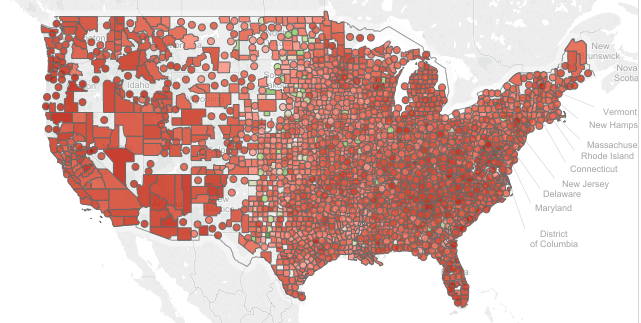
We constructed a ratio of residents in nursing homes to county populations 65 and over from the American Community Survey. Results range from .2% to 18.7% of the population. Geographic concentrations of high coverage are in the Midwest with low coverage in the west coast and Florida. The Tableau visualization shows visually the concentration. Counties highlighted in green have high coverage while those in red show lower coverage. You can use the slider to reveal counties within a range of coverage values. To interact with the Tableau visualization and the data, click HERE.


Share This Story

Similar Posts

  • Student Debt Continues to Rise – Repayments Flat

    Last week, the Government Accountability Offices announced that the federal government will forgive a whopping $108 billion in student loans in the coming years. Prognosticators project a coming economic doom as the student debt crisis approaches mortgage meltdown proportions.   Last week we focused on the earnings of students six…

  • Students Moving Back on Campus

    The number of students living on-campus for the approximately 4,500 non-state institutions has increased from just over 43% in 2011 to nearly 53% just four years later in 2015. The pie graph below shows the movement from 2011 to 2015 with the yellow slice indicating the percentage of students living…

  • March Madness and the Top Line

    Everyone has caught March Madness fever. The first two rounds of this landmark tournament sparked more double digit seed upsets than any other year. Yet as we sit here for the sweet 16, all of the number one seeds advanced. It is no surprise to anyone either that NCAA basketball…

  • Is There an Oasis in the New Food Data?

    The recently released updated Food Environment Atlas data by the USDA give us a real glimpse into the progress that we as a nation are making on combating food deserts. The USDA defines food deserts as lack of access to a healthy food retail outlet (a supermarket or large grocery store)…

  • Self-Funded Research Remains the Trend in Higher Education

    Research and development expenditures continued their flat growth since 2011 according to the most recent data from the National Science Foundation Higher Education Research and Development Survey (HERD). Research expenditures increased 1.66% for all reporting institutions from 2013 to 2014 and have increased cumulatively only 4.76% since 2011.  The primary…

  • Top Ten States with Growing Tuition Costs

    Nell Gluckman of The Chronicle of Higher Education wrote an interesting piece about the challenges of public cutbacks in the state of Louisiana. The premise of the article is that there are trickle-down implications of state cutbacks in tuition, faculty morale, and curriculum. Louisiana has passed along substantial tuition increases to its…