Degrees, Jobs, and Crosswalks

My daughter has a Bachelor’s Degree in Fine Arts with a concentration in Cartooning and Illustration. Today, she is a quality assurance manager for a software company. I am very glad that her career has morphed into a burgeoning field because it was very clear to me that it would be very hard to get a job in her chosen field.


Program development requires a knowledge of the jobs that employ them. A “crosswalk” attempts to match up one type of database element to another. That is not always easy because jobs can deploy multiple degrees. A degree can result in multiple jobs and a single job can come from multiple degrees. In database terminology, it is what we call a many to many relationship.


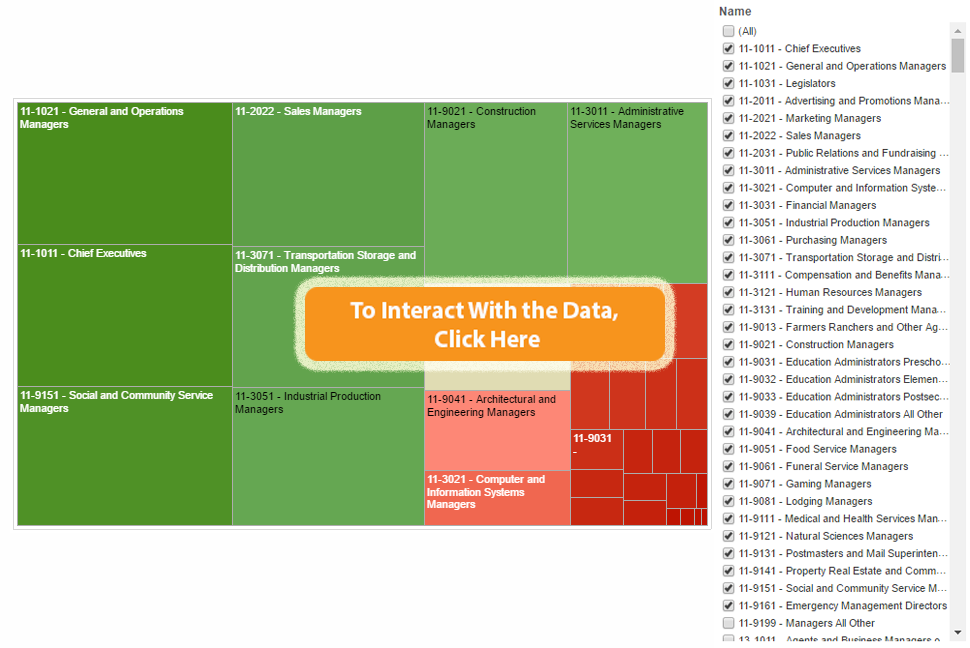
We have deployed a crosswalk in Public Insight that matches up jobs by Standard Occupational Classification (SOC) to degrees awarded by Classification of Instructional Programs (CIP). To find which jobs are moving which degrees, we created a treemap visualization in Tableau Public , which you can access by clicking HERE. The degrees awarded need to be looked at proportionately and a treemap is perfect for this. You can select the individual job codes by six digit SOC code and see proportionate degrees to other SOC codes. For example, we plotted all managerial jobs which begin with SOC code 11 and find Industrial Management jobs are almost three times more relevant in degrees awarded than Computer and Information System Managers. To interact with the Tableau visualization, click HERE.


Share This Story

Similar Posts

  • Cleveland, TN a Hot Market for Job Growth?

    I live in Cleveland, Ohio (home of Lebron James and the Rock ‘N’ Roll Hall of Fame). I would love to believe that our city is having explosive job growth but the real winner according to the latest Occupational Employment Statistics (OES) survey is not Cleveland, Ohio, but Cleveland, Tennessee….

  • Lower Student Default Rates – Calm Before the Storm?

    Loan repayment rate data may trigger resurgence in default rates The most recent Federal Student Aid student default rate data indicates that the composite student default rates declined from 10.8% in 2015 to 10.1% in 2016, a decline of 6.5% and continuing a seven-year post-recession trend. In 2010, the default…

  • Distance Education Programs up 8.2%

    Distance Education continues its upward climb according to the most recent distance education data from IPEDS. The number of programs increased 8.2% in 2016, but this increase was less than the whopping 12.6% in 2015. There are now over 29,000 programs offered through distance education. Certificate programs continued their strong…

  • Decoding Outcome Measures Data

    Breaking Down the Second Year Student Success Measure The IPEDS Outcome Measures data was designed as a supplement to graduation rate data which has always been questioned as an effective measure for measuring student outcomes. Outcome Measures is now in year two of its collection and provides a lot of…

  • Have Student Debt Repayment Rates Bottomed?

    Student repayment rates continues to decline, although the trend seems to be slowing, according to the most recent College Scorecard data. This data measures repayment rates at 1,3,5, and 7 years. Repayment rates and default rates are very different. Repayment rates are the percentage of students who have made progress…

  • Friendly Skies Just Got Friendlier

    Airlines have taken it on the chin in recent months for bad customer service. This despite the fact that overall customer service rankings of the airline industry are up. Flight attendants received nearly a 14% bump in pay based on a comparison of mean wage data from the 2016 Occupational…