Maternal Care and Rural Counties

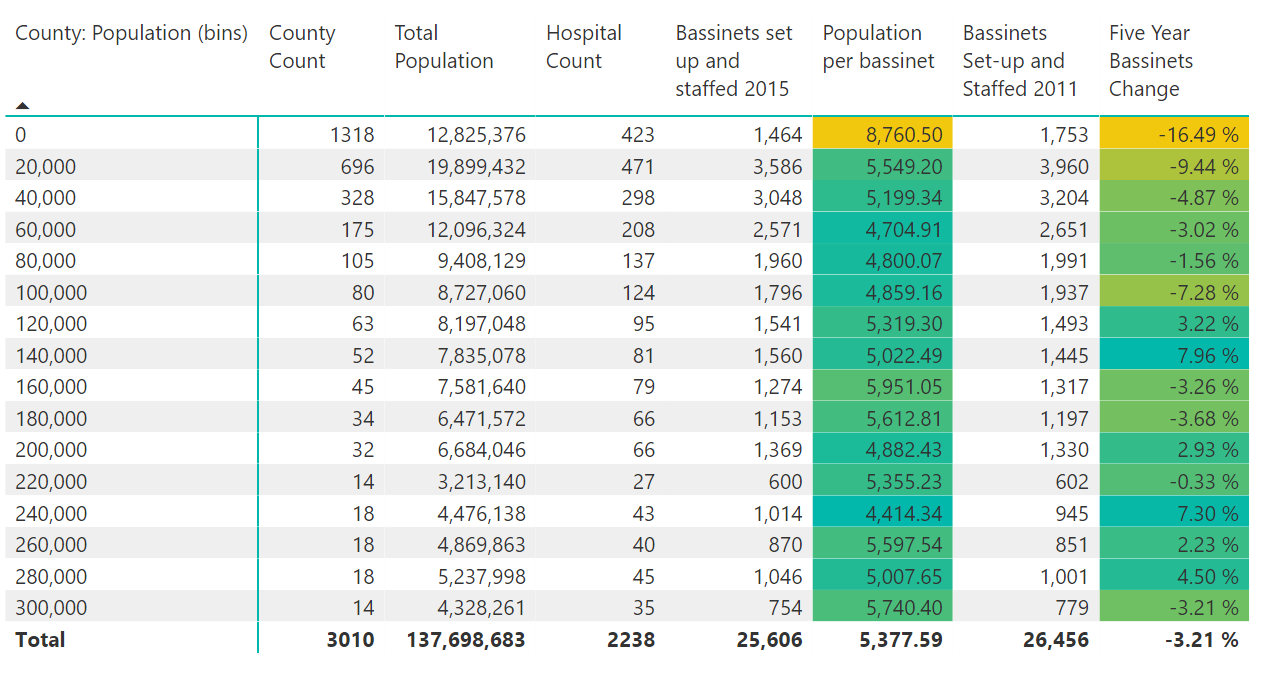
An interesting study published in the September issue of Health Affairs found that 9 percent of rural counties experienced the loss of all hospital obstetric services in the period 2004–14. In addition, another 45 percent of rural US counties had no hospital obstetric services at all during the study period. We took a slightly different angle and looked at the bassinets set up and staffed over a five year period from 2011 to 2015 and compared it to clusters (bins) of populations in increments of 20,000. The results are striking:


  • While 40% of the counties in the U.S. have under 20,000 residents, the number of bassinets set up and staffed relative to the population (population per bassinet) is about 63% lower. 

  • The number of bassinets staffed for these rural counties has declined 16.5% over the five year period compared to the national change of 3.2%. 

The table below shows this information which we assimilated using the Beds and Utilization Interactive. Note, we cut off the county population clusters at 300,000. 


The study goes on to state that rural counties with lower median household incomes, higher populations of black women, and those located in states with lower Medicaid income eligibility limits for pregnant women were the most likely to lose or have no obstetric services.

 

Share This Story

Similar Posts

  • Violence Against Women Offenses Up 9.5%

    This is the third year that the Campus Safety and Security (CSS) data has released separate violence against women (VAW) offenses. This data captures three types of offenses; domestic violence, dating violence, and stalking and analyzes it for both on campus and off campus locations. Overall, there were 16,183 VAW…

  • BLS Releases New 10-Year Employment Projections

    Last month, the Bureau of Labor Statistics released its 10-year employment projection data. This data is updated every other year. The new data shows a projected increase over the next decade of 7.4% which is a noticeable increase over the previous 6.5% 10-year projections in 2014. These projections are not…

  • FAFSA Application Volume Down 11%

    The FAFSA Application Volume declined nearly 11% for the application cycles from June 30, 2014 through June 30, 2017 based on data from Federal Student Aid and analyzed using the Financial Aid Interactive. FAFSA application cycles are based on an 18-month period for any one particular school year.  Note the…

  • COVID-19 Dashboard with NYT Data

    Analyze COVID-19 Cases by National, State and County Level It is important for today’s business leaders to consider the impact of COVID-19 when making decisions and allocating resources. The accuracy of COVID-19 data reported by news sources and online publications goes beyond the numbers themselves, the interpretation of the statistics…

  • EVICTED – The Impact of Housing Affordability

    I was in the Bay Area this week for a health technology conference at Stanford University. I took Lyft back and forth from where I was staying. While conversing with one driver in my rudimentary Spanish, I found out that his family was spending $3,000 a month for a two…