Distance Learning Growth Continues

In one of my favorite videos of my kid’s era, Grover from Sesame Street taught us the difference between near and far. I don’t think Grover had in mind today’s high tech tools and social media interaction when he taught us this principle. Distance Education continues to be a hot trend among college offerings (can’t say campus anymore).


The technology of today continues to enable more online experiences. Distance learning provides the ultimate in flexibility and enables programs to be not only conducted virtually, but introduced nationally and globally. Of course the cons of Distance Education have to do with the personal face-to-face communication and interaction that comes from a campus environment.


The Integrated Postsecondary Education and Data System (IPEDS) has been collecting statistics on Distance Education since 2012. IPEDS breaks down Distance Education into two primary buckets; those that are enrolled exclusively in Distance Education courses and those that are enrolled in some, but not exclusively Distance Education courses. IPEDS further breaks down the exclusive category into the location of the student.


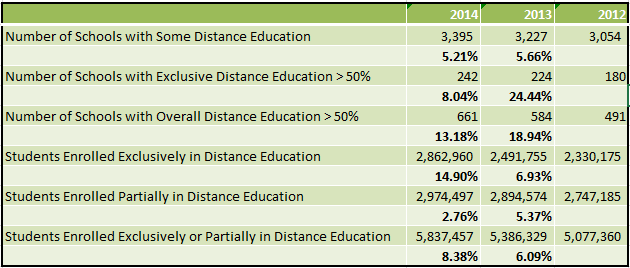
We analyzed the data for the most recent year and compared it to the two previous years. Overall, the number of students enrolled in some form of Distance Education has increased 8.38% but the number of students enrolled exclusively in Distance Education has increased a whopping 14.90%. The number of schools offering Distance Education has increased 5.21% in 2014, which was a similar increase to 2013. However, the number of schools with extensive forms of Distance Education (measured in our statistics as greater than 50%) has increased 13.18% in 2014.  Summary results are displayed below.


By clicking here, you can download a spreadsheet of all institutions that reported Distance Education results and their trends over the past three years along with calculated percentages of overall enrollment.

Share This Story

Similar Posts

  • Student Debt Continues to Rise – Repayments Flat

    Last week, the Government Accountability Offices announced that the federal government will forgive a whopping $108 billion in student loans in the coming years. Prognosticators project a coming economic doom as the student debt crisis approaches mortgage meltdown proportions.   Last week we focused on the earnings of students six…

  • Regional Disparities in Health Insurance

    We all know that health insurance is a moving target. According to the most recent ACS survey data, the national uninsurance rate declined from 13.0% to 11.7% in 2016. Public insurance coverages increased slightly more than private coverages (increases of .9% and .6%) respectively. This change was short-lived as Gallup…

  • Violence Against Women Offenses Up 9.5%

    This is the third year that the Campus Safety and Security (CSS) data has released separate violence against women (VAW) offenses. This data captures three types of offenses; domestic violence, dating violence, and stalking and analyzes it for both on campus and off campus locations. Overall, there were 16,183 VAW…

  • The 13 College Scorecard Title IV Outcomes

    Where Students Go Based on the Latest College Scorecard Data In our last post, we provided some insight into the IPEDS Outcome Measures data. The IPEDS Outcome Measures data was designed as a supplement to graduation rate data which has always been questioned as an effective measure for measuring student…

  • What are Five Star Hospitals?

    Consumer ratings are always controversial. You can always ask the wrong question or ask the right question the wrong way. In an attempt to shed transparency on our nation’s healthcare system, the Centers for Medicare and Medicaid Services (CMS) instituted the star ratings system. CMS’ star-rating system is meant to…