What do Sierra Vista and Hinesville Have in Common?

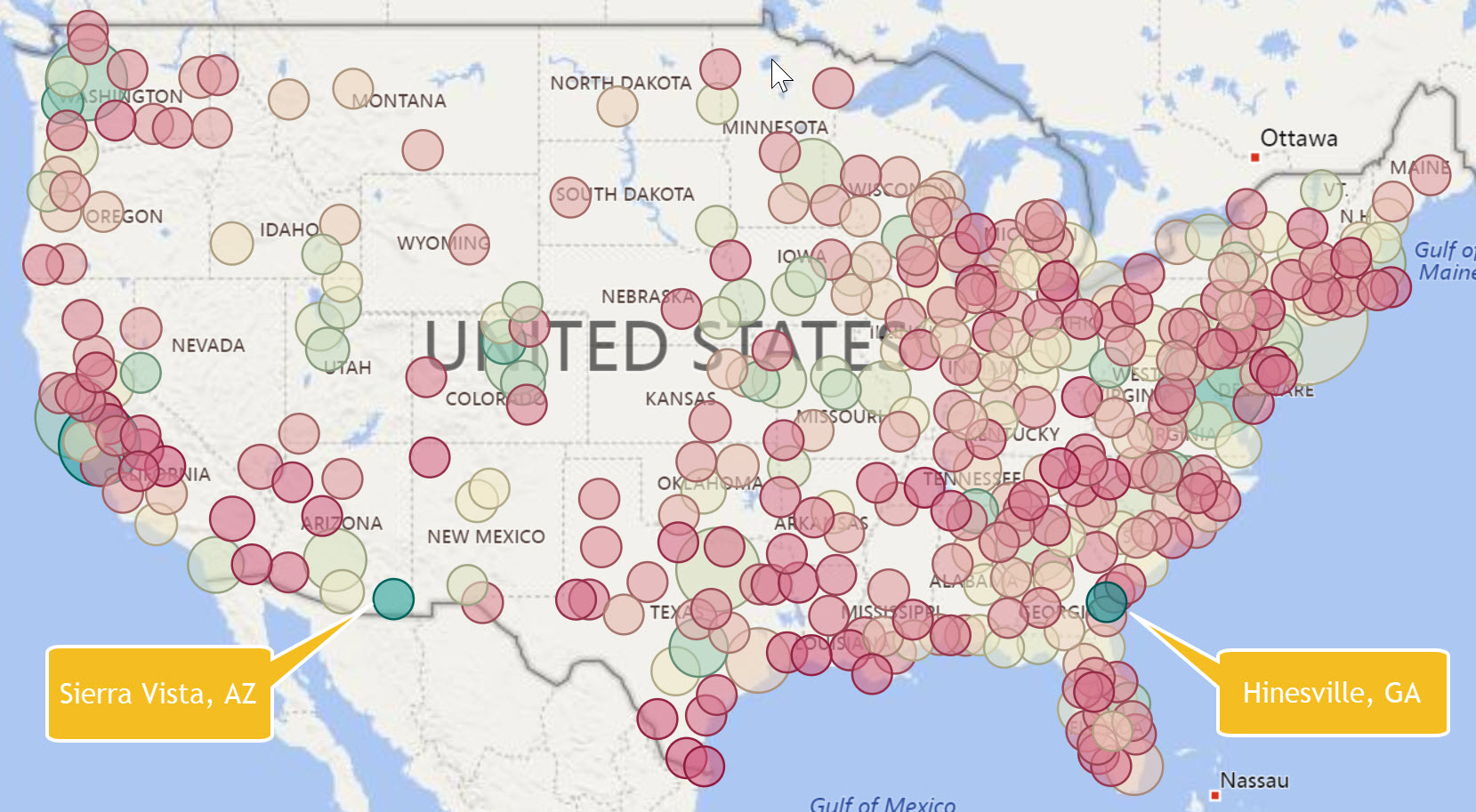
Sierra Vista, AZ and Hinesville, GA probably don’t seem to have much in common. One is in eastern Arizona and the other is in southeast Georgia. They are both very small cities with populations of around 40,000. What they have in common is a market concentration for computer occupations with a location quotient of around four times the national average. These two markets pop out when you show a map of metropolitan areas color coded for location quotient as shown below. Markets with a high saturation for computer occupations are a cyan color while those with lower saturation are in red.


Location quotient reveals market concentration because it compares the local region (metro area in this case) to the nation. The size of the points in the map above is the absolute number of jobs (computer occupations in this case). A market like Chicago has a high number of computer jobs but it is not concentrated compared to the nation. In other words, it has the expected number of computer jobs compared to all other occupations for that size market. 


We have updated the popular Degree-to-Jobs Interactive to include the latest data from the Occupational Employment Statistics survey for 2017. This Interactive includes job and wage analysis by market for over 800 job occupations with crosswalks to CIP codes for program planning and analysis. This update is automatically available to our subscribers. You can purchase this as an individual Interactive for $295 or as part of the Higher Education Institution library


Share This Story

Similar Posts

  • Student Debt Rises 13%

    The newest College Scorecard data released several weeks ago reveals an ongoing trend in student debt. The median student debt increased 13.1% from 2015 to 2016. The median student debt has now more than doubled since 2007 as shown by the following graph. We calculated this using a weighted average…

  • The States That Send Students Elsewhere

    IPEDS reports residency numbers for first-time undergraduates by state. This data can be challenging to work with from several perspectives. It is not collected every year by every institution and it does not summarize the students coming from out of the state of the institution.     The Enrollment Suite…

  • Healthcare Rankings and the Healthiest Cities

    We in the U.S. love our rankings. I think it is embedded in our DNA. As a student of data, I love to see the various rankings and how people get worked up over them. Healthgrades recently released its latest analysis of top quality hospitals and its National Health Index, which…

  • Top 10 Projected Occupations in 2026

    Healthcare workers dominate the top 10 list for projected job growth. Nine of the top 10 jobs are projected to have greater than 30% growth over the coming 10 years. Using the new Degree-to-Jobs Interactive, we sorted the projections table by projected growth and isolated the top 10 jobs as shown…

  • Nursing Home Coverage of the Elderly

    While long-term care services more than the elderly, approximately 63% of residents are 65 or older. According to the Administration on Aging, population 65 years or older will increase from 14.1% of the population to 21.7% of the population by 2040. As the population ages over the course of the…

  • STEM Enrollment Fields Show Strong Growth

    The IPEDS Enrollment by Major Fields of Study is collected every other year and 2016 is a new reported year. IPEDS collects nine major fields of study and the enrollment is disaggregated by attendance status (full-time, part-time), level (undergraduate, graduate), race, and gender.   There are numerous ways to breakdown…