Are Outpatient Imaging Quality Measures Effective?

CMS began developing measures evaluating imaging efficiency back in 2007. These performance measures have been distributed as part of Hospital Compare for the past four years. Lower percentages suggest more efficient use of medical imaging. The purpose of reporting these measures is to reduce unnecessary exposure to contrast materials and/or radiation, to ensure adherence to evidence-based medicine and practice guidelines, and to prevent wasteful use of Medicare resources. We looked at this data using the Quality Ratings Interactive which analyzes all of the quality ratings measures from CMS.

  • Overall, imaging performance across the six measures has declined over the past four years or remained flat (MRI for lower back pain has not changed much).

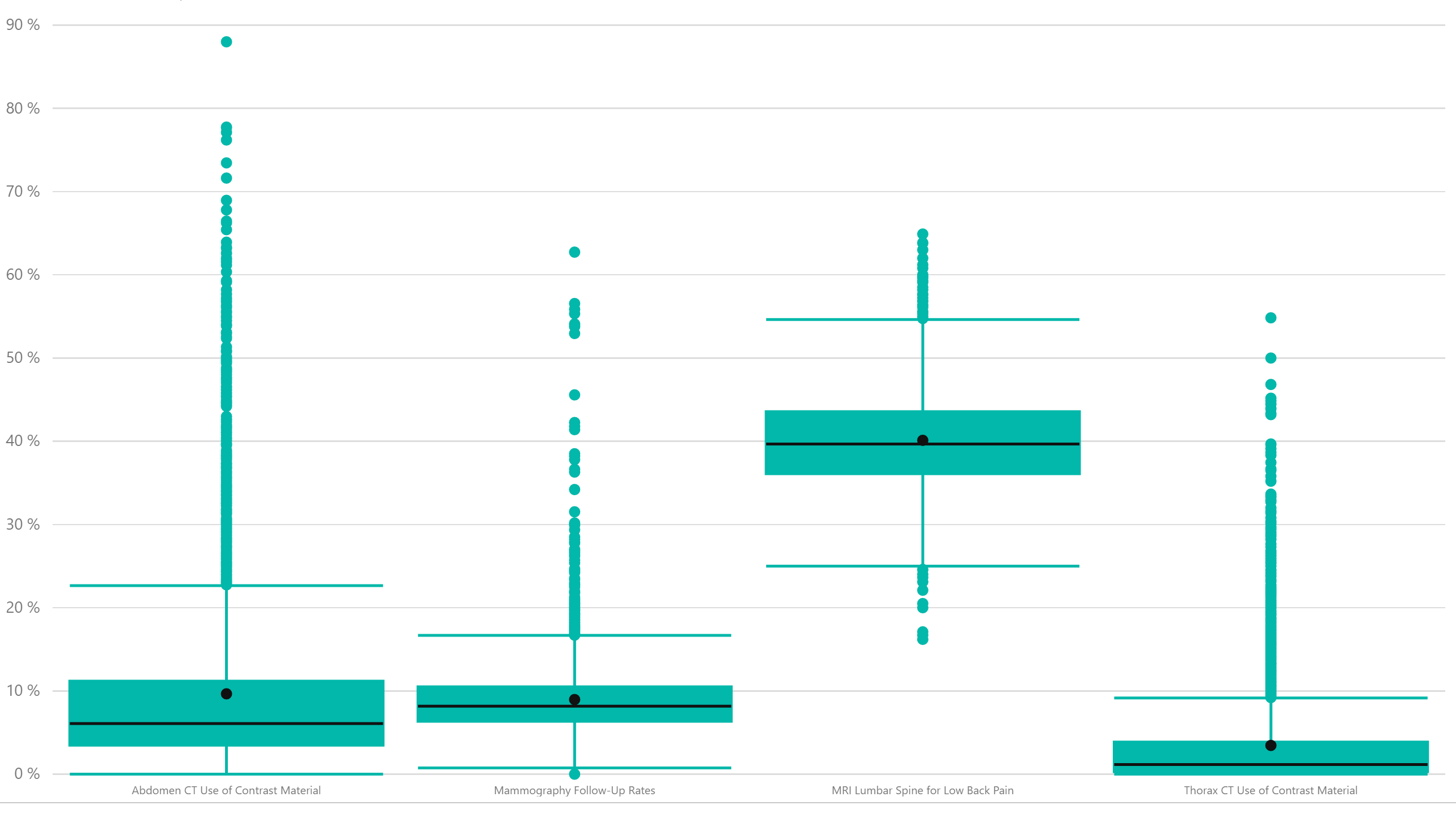
  • However, there is incredible variability among hospitals across all of the imaging measures as shown in the box and whiskers plot below. 

We picked four of the measures to illustrate. The line indicates the median of the performance rate with the inner and outer lines representing the inner two quartiles. Anything outside of that is an outlier. We can see that the number of outliers covers a very wide range of results and even within the inner quartiles, there is a pretty wide range of results (see MRI of the back in particular). Further, the variability has not changed a whole lot over the trailing four years. 


The Lewin Group was contracted by CMS to perform an assessment on these performance rates and they make some interesting observations in their research. You can find these studies on the QualityNet site.
 

Share This Story

Similar Posts

  • Self-Funded Research Remains the Trend in Higher Education

    Research and development expenditures continued their flat growth since 2011 according to the most recent data from the National Science Foundation Higher Education Research and Development Survey (HERD). Research expenditures increased 1.66% for all reporting institutions from 2013 to 2014 and have increased cumulatively only 4.76% since 2011.  The primary…

  • Distance Learning Growth Continues

    In one of my favorite videos of my kid’s era, Grover from Sesame Street taught us the difference between near and far. I don’t think Grover had in mind today’s high tech tools and social media interaction when he taught us this principle. Distance Education continues to be a hot…

  • Visualizing Student Debt and Earnings

    Leveraging Scatterplots to Analyze the New College Scorecard Data There has always been a symbiotic relationship between student debt and student earnings. As student debt has creeped up in recent years, there has also been a data gap with post-graduation earnings. The most recent College Scorecard data is a first…

  • What is the Newly Released Carnegie Data?

    The Carnegie Classification™ has been the major institutional framework for describing higher education institutions since 1970. This classification system comes out approximately every five years with the latest rendition released on February 1, 2016. This release represents the initial data provided by the Indiana University Bloomington Center for Postsecondary Research…

  • Degrees, Jobs, and Crosswalks

    My daughter has a Bachelor’s Degree in Fine Arts with a concentration in Cartooning and Illustration. Today, she is a quality assurance manager for a software company. I am very glad that her career has morphed into a burgeoning field because it was very clear to me that it would…

  • College Building Boom Approaches $1 Trillion

    Postsecondary institutions continue to invest heavily in capital assets and the cumulative investment across public and private institutions has crossed $900 billion, an increase of 27% over a five-year period. The capital investment growth rates are almost identical for both public institutions and private non-profit institutions as noted in the…