Student Earnings Experience a Sluggish Recovery

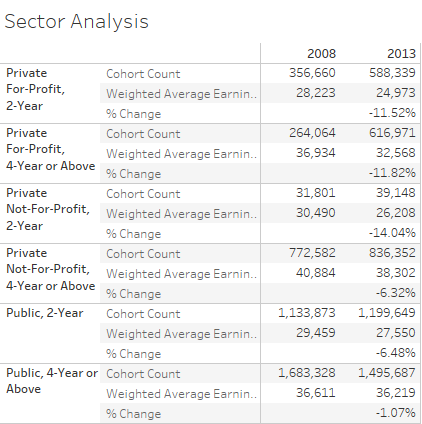
College students are earning 8% less in 2013 than in 2008 per the most recent data published by the US Department of Education College Scorecard database. Students earned $31,382 in 2013 compared to $34,119 in 2008. The earnings were ostensibly flat from 2012 earnings of $31,528.


The College Scorecard database was established last year to encourage competitive evaluation of institutions. The earning data were the first attempt at integrating earnings data from the Treasury data against the specific institution attended. It links the student social security number per tax filings to the FAFSA form. Thus, only students applying for some form of financial aid are included in the earnings calculation. This data used in our analysis is based on student’s earnings six years after entry. The Treasury has no visibility into whether those students graduated from those institutions or even how long they were there.


Despite the limitations of this data, it is the first national comparison of earnings data across institutions giving higher education professionals a wide lens look at how students are performing. The College Scorecard database also segments earnings by gender, dependency status, and family income based on these categories on the FAFSA.  You can access a free viz here that gives you institution earnings over the last four reporting years.


Access Free Viz and Student Earnings Interactive


In analyzing this data, we uncovered some interesting variations by type of institution.  The Public Insight Student Earnings Interactive gives you the ability to define any peer group comparison to see how students compare in and among institutions. For example, comparing institutions by sector, private institutions have experienced less of a recovery than public institutions.  


Share This Story

Similar Posts

  • How Healthy Are U.S. Hospitals?

    If we said that 20% of any industry was at financial risk, we would all be up in arms. However, a recent Morgan Stanley report citing that statistic was met with some degree of yawning. The report cites that 450 hospitals are at risk of closure and another 600 are…

  • The 13 College Scorecard Title IV Outcomes

    Where Students Go Based on the Latest College Scorecard Data In our last post, we provided some insight into the IPEDS Outcome Measures data. The IPEDS Outcome Measures data was designed as a supplement to graduation rate data which has always been questioned as an effective measure for measuring student…

  • Maternal Care and Rural Counties

    An interesting study published in the September issue of Health Affairs found that 9 percent of rural counties experienced the loss of all hospital obstetric services in the period 2004–14. In addition, another 45 percent of rural US counties had no hospital obstetric services at all during the study period. We…

  • College Building Boom Approaches $1 Trillion

    Postsecondary institutions continue to invest heavily in capital assets and the cumulative investment across public and private institutions has crossed $900 billion, an increase of 27% over a five-year period. The capital investment growth rates are almost identical for both public institutions and private non-profit institutions as noted in the…

  • Is the Federal Work Study Program Working?

    Over 4,000 institutions participate in the Federal Work Study Program. This program provides funds for part-time employment to help needy students finance the costs of postsecondary education. For the fiscal year ending June, 2016, $1.16 billion was paid to students under this program. This was roughly the same as the…

  • The Top Graduation Rate Institutions

    The character Bluto in the movie Animal House was famous for saying “Seven years of college down the drain”. This was on the heels of Dean Wormer’s pronouncement of his stellar grade point of 0.0. Given this performance, Bluto would not have graduated anyway. Thus, he would not have fallen…