
Our Process for Turning Data into Decision-Ready Insights
Public Insight cleans, enriches and normalizes current data from job postings, resumes, employer reviews and workforce social profiles to generate market insights for detailed analysis and benchmarking. Our process is what turns good data into decision-ready insights you can trust.
Our Process for Data Transformation
Every record we deliver passes through six stages. Each one provides a reason to trust the numbers. Our process does the heavy lifting, so your team gets the market intelligence and the KPIs that matter — decision-ready insights you can trust.
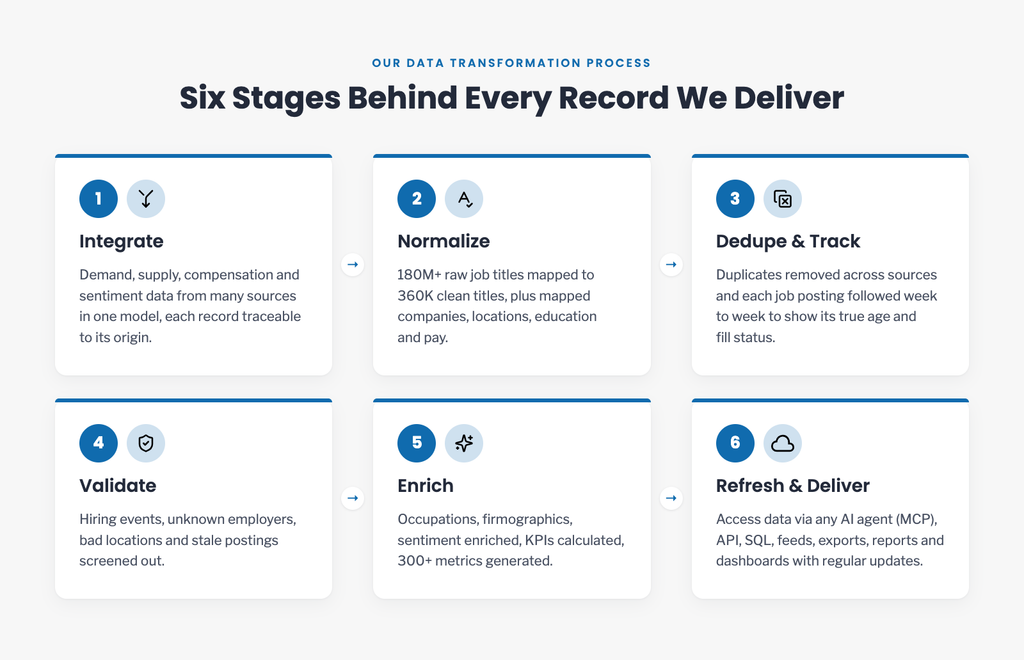
1. Integrate Multiple Sources of Good, Current Data
We collect and integrate demand, supply, and employer reviews data from multiple sources into one data model:
Our job discovery system searches every city in the U.S., Great Britain and Canada, plus targeted job titles and companies and then we refresh weekly today and are moving to a daily refresh.
The original source of data is retained, so every record can be traced back to where it came from and we provide the individual postings, reviews and profiles.
Learn more about the types of job market data we provide.
2. Normalize to a Common Language
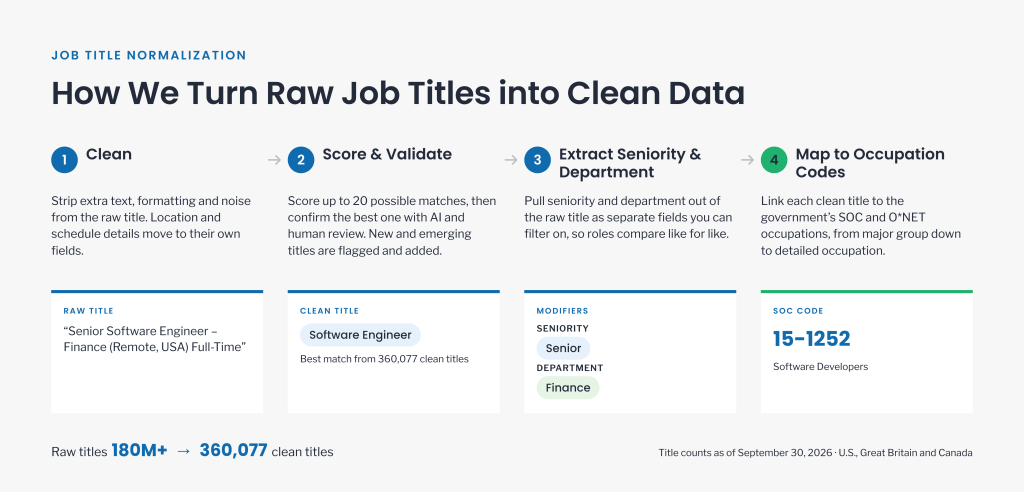
Job titles follow no standard. Across postings, profiles and reviews, we’ve collected more than 180 million raw job titles. We translate each one into one of 360,077 consistent “clean titles” and this process is continually being updated and enhanced:
Job titles – proprietary cleaning built on methods from the University of Chicago’s Workforce Data Initiative, and refined by AI. Each title is scored against up to 20 candidate matches, then validated, with human review through our internal QC portal. We also spot emerging job titles so clean titles keep up with the market.
Companies – every employer, across every source, is mapped to one universal company record by name and web domain. Job boards, review sites and professional networks each use their own company IDs, and even a single job board can list the same employer several times.
Locations – free-text locations like “St.louis, Mo” and “south county, st loius mo” are geocoded to one clean location and metro area.
Education – raw degree text such as “BA” or “Bachelor” maps to seven standard attainment levels. U.S. colleges and universities get the same treatment as companies. The same school shows up many ways in work and social profiles, both where alumni list their education and where people list a university as their employer, such as “UMich,” “U of M” and “University of Michigan – Ann Arbor.” We map every variation to one institution record from the federal IPEDS list of about 6,000 U.S. colleges and universities. As we expand workforce profiles to other countries, we will do this same process for their higher education institutions.
Pay – hourly, daily, weekly and monthly pay is converted to comparable annual figures, with the original text kept.
Clean titles are also more specific than government categories. For example, the Bureau of Labor Statistics files all registered nurses under one occupation code, and O*NET adds only a few specialties, such as critical care. Yet pediatric, oncology, emergency and travel nurses differ widely in pay, skills and how hard they are to hire. Clean titles include those distinctions for filtering and deep analysis, while still mapping to the official government codes.
3. Dedupe and Track the Full Job Lifecycle
The same job is often posted many times, on many sites. We remove duplicates using company, title, location and posting date, and separate employer-site postings from aggregator copies.
Then we go further. We follow each job opening week after week, linking reposts back to the original posting. That tells you how old a job really is, whether it was filled, and roughly when. Our filled days status carries a confidence score, which is capped at 90%.
4. Validate
Next, we screen out records that would distort analysis, including:
5. Enrich
The enrichment process adds context, and builds the metrics clients use. Clean records become far more useful once they carry context:
Company intelligence that connects everything. Every posting, resume, rating and review points to the same universal company record. That lets you see any employer’s hiring demand, talent supply, pay and reputation in one view. Industries follow the LinkedIn® industry schema and map to the most detailed NAICS code available, padded to six digits. For example, Medical Practices becomes 621100. You can roll companies up into sectors, compare them by size or type, and line them up with government data.
Industry metrics – we pre-calculate the metrics and KPIs that answer real workforce questions. We generate 300+ metrics and growing. Each one is ready to slice by job title, occupation, company, industry, region, college/field and date:
5. Refresh and Deliver
The market moves, so the data does too. Job postings, including posted pay and fill status update weekly for now, and we are moving to daily soon. Employer ratings and reviews and resumes update monthly. Salary surveys and workforce profiles update quarterly.
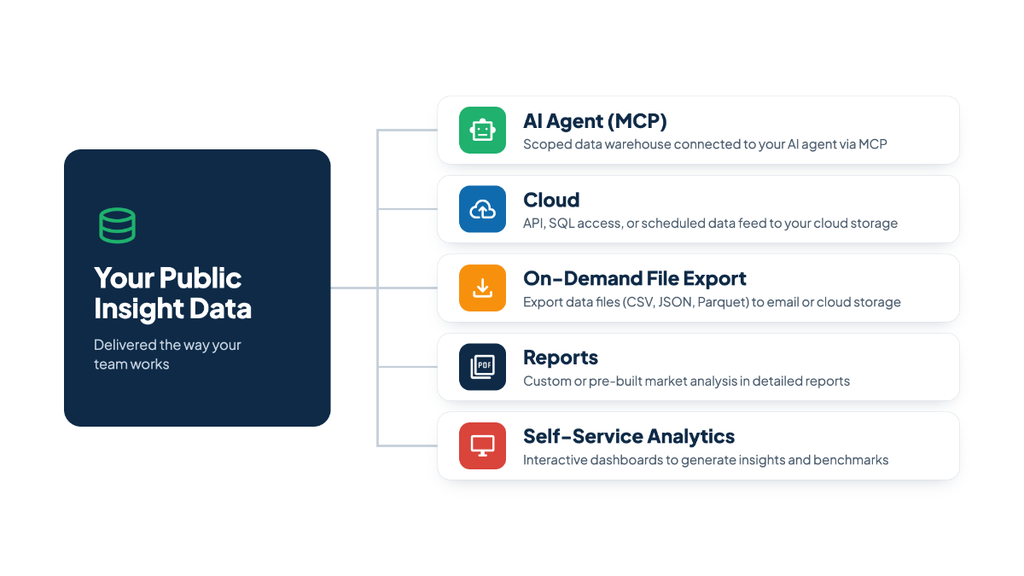
We have multiple methods for delivering our data based on the way your team works. Learn more about our data delivery methods.
From Market Data to Decision-Ready Insights
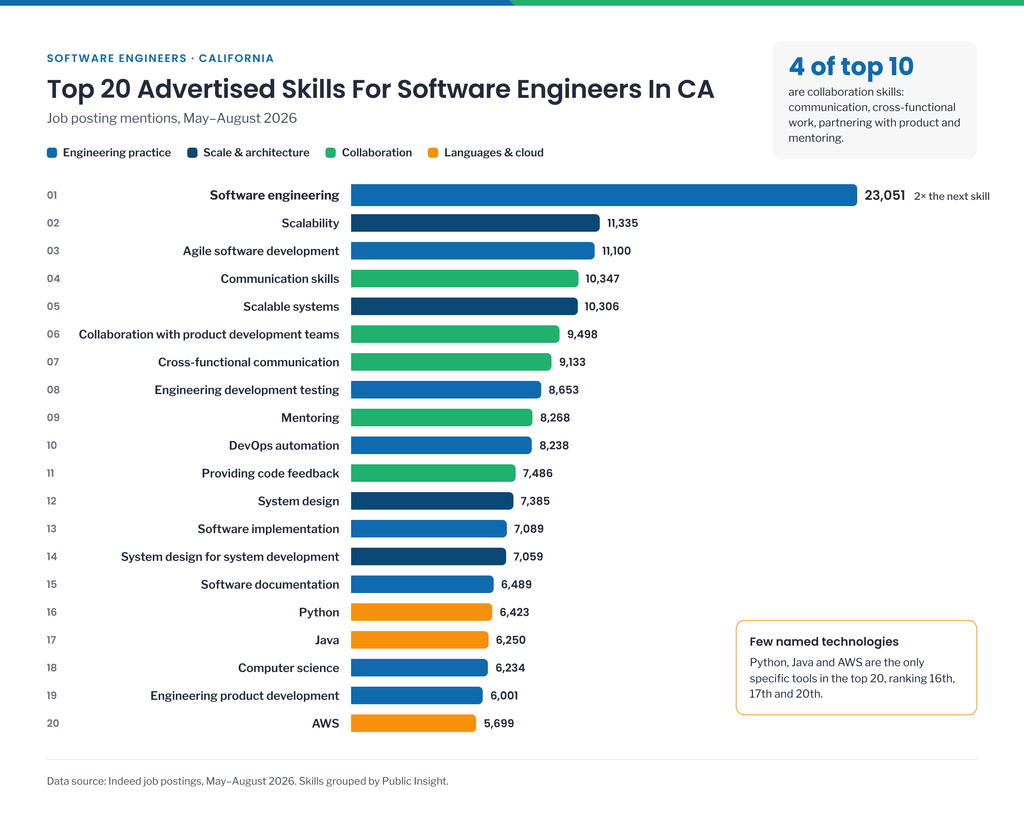
This foundation powers detailed market and industry landscape analysis, competitive benchmarking, higher ed alumni outcomes/ROI analysis, career path analysis, skills and benefits trends and so much more. See example analysis below:

Learn More and Take the Next Step
Frequently Asked Questions
What is a job market data process?
A job market data process turns raw labor market signals, such as job postings, compensation, workforce profiles, and employer reviews, into analysis-ready data. At Public Insight, that means collecting from multiple sources, then cleaning, normalizing, deduplicating and enriching the data, and calculating metrics and KPIs on top of it.
Where does Public Insight’s job market data come from?
We combine job postings from Indeed® and direct employer sites, salary surveys, and employer ratings and reviews from Indeed® and Glassdoor®. Workforce profiles are from LinkedIn® and other social media profiles, firmographic data comes from LinkedIn® and other sources. Job postings and resume profiles cover the U.S., Great Britain and Canada; workforce profiles and college and university data covers the U.S.
Where does your employer/company and firmographic data come from?
Company details come from LinkedIn® and other firmographic sources. We first map every employer, across every data source, to one universal company record. Then we add employee count, company type and industry, coded to six-digit NAICS.
How do you normalize job titles?
We clean each raw title, score it against up to 20 standardized matches, and validate the result with AI and human review. Each clean title is then mapped to SOC and O*NET occupations, with seniority and department captured separately.
How do you remove duplicate job postings?
We dedupe postings by company, title, location and posting date, and separate employer-site postings from copies on aggregator sites. We also link reposts to the original opening so one job isn’t counted as many.
How do you know when a job has been filled?
We check every tracked posting weekly. If a job disappears and isn’t reposted within four weeks, we mark it filled with a 75% confidence score that rises to a maximum of 90% over time. Reposts within 90 days are tracked as the same opening.
How often is the data updated?
Job postings, including posted pay, and fill status update weekly. Employer ratings and reviews update monthly. Salary surveys and workforce profiles update quarterly.
How can I access the data?
Through AI agent access to a scoped data warehouse via our MCP server, API, SQL, bulk delivery to cloud storage or SFTP, on-demand export files, reports and interactive dashboards.